

 +1.844.3539.746
 info@flexsin.com
The New Reality of Enterprise AI Resilience in the Age of Frontier Models
 Munesh Singh
Let's talk
Table of Contents:
- The Enterprise Risk Landscape Has Fundamentally Shifted
- Why Total Resilience Is a Different Discipline Than Cyber Resilience
- The Sovereign Security Dimension Most Organizations Are Underestimating
- Integrated Risk Operations: The Architecture of Enterprise AI Resilience
- The Growing Impact of Supply Chain Vulnerabilities on Enterprise Resilience
- What Enterprise AI Resilience Looks Like in Practice
- People Also Ask
- Ready to Build a Resilience Program That Matches Your AI Ambitions?
- Frequently Asked Questions
The threat is no longer just outside your perimeter – it is embedded inside your most strategic technology investments. As organizations race to embed frontier AI into core operations, they are simultaneously creating a new category of enterprise risk that conventional cybersecurity frameworks were never designed to handle.
According to the World Economic Forum’s Global Cybersecurity Outlook 2026, 94% of surveyed leaders now identify AI as the single most significant driver of cybersecurity change – and 87% flag AI-related vulnerabilities as the fastest-growing threat category they faced over the past year. Enterprise AI resilience is not a future priority. It is the defining operational challenge right now. For organizations embedding AI into core operations, this shift is increasingly part of broader Digital Transformation Services, where security, governance, data, and AI capabilities must evolve together.
The Enterprise Risk Landscape Has Fundamentally Shifted
Security leaders spent decades refining defenses against human attackers using increasingly sophisticated tools. That problem is hard enough. Frontier AI security introduces a structurally different dynamic – one where the threat actor can operate at machine speed, industrialize reconnaissance, generate convincing phishing content at scale, and identify exploitable vulnerabilities in hours rather than weeks.
At the same time, the organizations being attacked are now running AI systems that carry their own governance, operational, and security risks. A compromised AI model is not merely a data breach – it is a decision-making failure embedded in critical business processes. An agentic AI workflow with poorly governed permissions does not just expose data; it can autonomously execute actions across connected systems before a human analyst detects anything is wrong.
Why Total Resilience Is a Different Discipline Than Cyber Resilience
Most enterprise risk programs were built on a simple mental model: prevent the breach, detect the intruder, recover from the incident. That model made sense when cyber risk was the dominant threat category. The total resilience strategy required in the frontier AI era is fundamentally broader. Modern Enterprise Solutions therefore need to account for cybersecurity, AI governance, operational resilience, identity, and business continuity as interconnected capabilities rather than isolated systems.
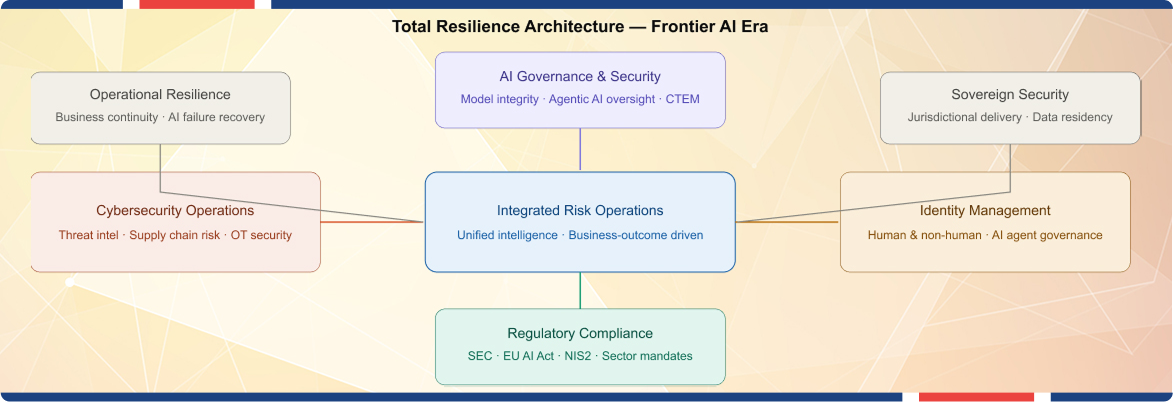
Consider what a modern enterprise now has to govern simultaneously: cybersecurity operations across hybrid and multi-cloud environments; AI governance covering model integrity, training data provenance, autonomous agent behavior and operational resilience, ensuring business continuity when AI systems fail or are manipulated.
The Sovereign Security Dimension Most Organizations Are Underestimating
There is a dimension of enterprise AI resilience that sits awkwardly between technology strategy and geopolitics: where your security operations run, and whose jurisdiction governs your most sensitive data and AI systems. This is not a compliance checkbox – it has become a strategic board-level consideration.
The Gartner Top Cybersecurity Trends for 2026 highlights regulatory volatility as a primary driver of cyber resilience investment, noting that boards and executives now face direct accountability for compliance failures. Sovereign delivery capabilities are not just about data residency. They are about establishing a trusted operating model for AI adoption that can satisfy local regulatory expectations without sacrificing global threat intelligence and innovation access.
Integrated Risk Operations: The Architecture of Enterprise AI Resilience
The operational truth is that most enterprises are managing cyber, AI, and operational risk through disconnected programs. Security teams run threat detection. Compliance teams manage regulatory reporting. AI governance – where it exists – is often siloed inside product or engineering functions. The integrated risk operations model challenges this architecture directly. Implementing this architecture requires AI Development Services that integrate AI governance, model monitoring, identity controls, and security requirements directly into enterprise AI workflows.
Rather than treating each risk domain as a separate P&L, integrated risk operations builds a unified intelligence and governance layer that connects cybersecurity operations, identity and access management across human and non-human identity governance, AI governance enterprise and security posture, continuous threat exposure management (CTEM), operational technology (OT) security, and third-party supply chain cyber risk.
The Growing Impact of Supply Chain Vulnerabilities on Enterprise Resilience
Third-party supply chain cyber risk is now the leading resilience challenge for large enterprises. The WEF Global Cybersecurity Outlook 2026 documents that 65% of large organizations cite supply chain vulnerabilities as their greatest obstacle to cyber resilience – up from 54% the previous year. Yet only 27% simulate cyber incidents with supply chain partners, and just 33% maintain comprehensive maps of their supply chain ecosystems.
This gap matters because supply chain risk in the AI era is qualitatively different from earlier generations of vendor risk. When a third-party AI tool is embedded in a critical workflow, the AI risk management enterprise is not just data access – it is decision contamination. Poisoned training data, compromised model outputs, and unauthorized data exposure through AI-powered integrations represent a threat surface that most third-party risk management programs have not yet been designed to assess.
What Enterprise AI Resilience Looks Like in Practice
The organizations getting this right share three operational characteristics. They treat AI governance as a security function, not a policy function – meaning AI models, agents, and integrations are subject to the same continuous monitoring, vulnerability management, and access controls applied to traditional infrastructure.
The cost differential is significant. Security AI tools shorten breach detection and containment cycles by approximately 98 days, and dedicated incident response capabilities save an average of $2.2 million per breach. Organizations with poor AI risk governance face compounding costs: regulatory fines, reputational damage, and the operational cost of AI system failures that cascade across interconnected business processes.
People Also Ask:
What is enterprise AI resilience? Enterprise AI resilience is the organizational capability to anticipate, withstand, and recover from disruptions affecting AI systems, enterprise AI risk governance frameworks, and AI-dependent business operations.
How does frontier AI increase enterprise cybersecurity risk? Frontier AI accelerates the speed and scale of attacks by enabling automated reconnaissance, AI-generated phishing, and rapid vulnerability exploitation.
What is total resilience in the context of AI governance?Total resilience means an organization can maintain operational continuity and regulatory compliance across interconnected cyber, operational resilience AI, and governance risk domains – not just survive cyberattacks.
How do SEC cybersecurity disclosure rules affect AI risk management?The SEC Cybersecurity Disclosure Rules require public companies to disclose material cybersecurity incidents and describe their risk governance processes, placing direct accountability on boards.
What is continuous threat exposure management (CTEM) and why does it matter for AI security? Continuous threat exposure management is an ongoing security discipline that identifies, prioritizes, and reduces an organization’s exploitable attack surface for AI agentic security risk in real time.
Ready to Build a Resilience Program That Matches Your AI Ambitions?
As an AI Development Company, Flexsin works with enterprise technology and security leaders to design and deploy integrated enterprise AI resilience frameworks spanning cybersecurity operations, AI governance, sovereign delivery, and operational risk management. Our AI practice connects security architecture decisions directly to business outcomes, so your enterprise AI resilience investments protect the operations that matter most.
Explore how Flexsin’s AI and enterprise technology services can help your organization build total resilience.
Connect with our team to assess your current AI risk posture and define the right integrated resilience strategy for your business.
Frequently Asked Questions:
1. How is enterprise AI resilience different from traditional cybersecurity resilience? Traditional cybersecurity resilience focuses primarily on preventing, detecting, and recovering from external cyberattacks.
2. What are the top regulatory requirements driving enterprise AI risk governance?Several overlapping mandates are now shaping enterprise AI risk governance: the SEC Cybersecurity Disclosure Rules requiring material incident reporting and documented risk governance at the board level.
3. How should enterprises address non-human identity governance in AI environments? As AI agents, service accounts, and machine credentials now outnumber human users in most enterprise environments, non-human identity governance requires extending traditional identity and access management frameworks to cover the full lifecycle of machine actors.
4. What does integrated risk operations mean for a CISO today?For a CISO, integrated risk operations means operating a unified risk intelligence and governance layer that connects cybersecurity operations, AI governance, third-party supply chain risk, operational technology security, and regulatory compliance into a single operational framework.
5. How can organizations measure the ROI of enterprise AI resilience investments?The most defensible ROI metrics for enterprise AI resilience tie investment directly to breach cost reduction, recovery time improvement, and regulatory fine avoidance.
