

 +1.844.3539.746
 info@flexsin.com
Scaling AI Healthcare Solutions: What Separates Success from Failure
 Sudhir K Srivastava
Let's talk
Table of Contents:
- The Hidden Barriers to Scaling AI Healthcare Solutions
- Why Some AI Healthcare Solutions Reach Production – and Others Don’t
- The ROI Math Behind AI Healthcare Solutions
- Agentic AI Is Changing the Operating Model, Not Just the Workflow
- A Practical Path to Scaling AI Healthcare Solutions
- People Also Ask
- Partner with Flexsin to Scale AI Healthcare Solutions
- Frequently Asked Questions
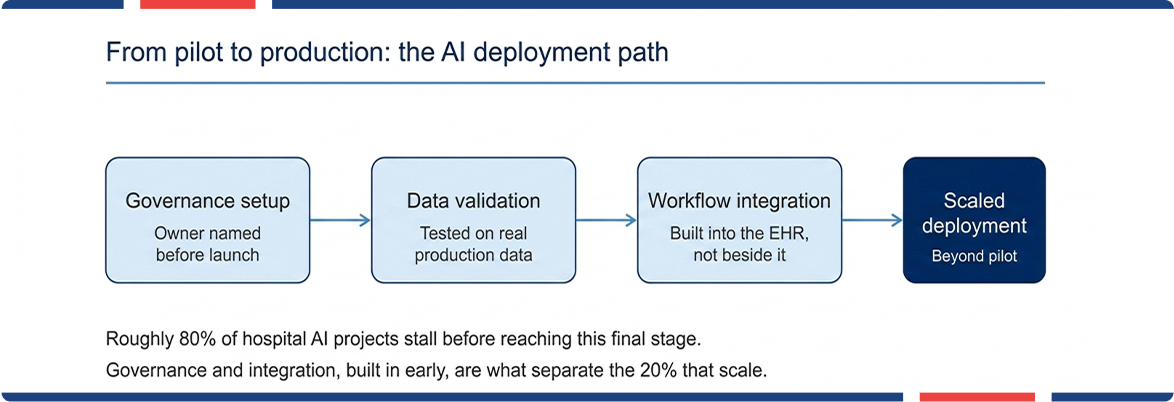
Four out of five hospital AI projects never reach a single patient. Independent analysis drawing on RAND Corporation and McKinsey research puts the failure rate at roughly 79 percent, a figure that has barely moved despite three straight years of record AI investment. The model usually works. The demo always works. What breaks is everything between the pilot cart and the nursing station. Source: GeekyAnts.
That gap matters because the market for AI healthcare solutions is no longer small or experimental. Global spending climbed from $39.34 billion last year to a projected $56.01 billion this year. Hospitals are not asking whether to adopt AI anymore. They are asking why so much of that spending stalls before it reaches a single chart. Source: Fortune Business Insights.
The Hidden Barriers to Scaling AI Healthcare Solutions
The pattern repeats across health systems of every size. A vendor installs the software. A handful of clinicians try it. Three months later, the project quietly disappears from the budget review. No governance owner was named. No integration plan existed beyond the pilot unit. No one defined what success would even look like before the contract was signed.
This is not a model-accuracy problem. A sepsis-prediction algorithm can clear 94 percent accuracy in a controlled trial and still collapse against a fragmented electronic health record, because production data rarely resembles the curated set used for validation. Legacy infrastructure compounds the issue, since many hospital systems still run core applications on hardware that predates modern AI workloads.
Regulatory friction adds another layer. An algorithm that predicts patient risk still has to get HIPAA compliance and institutional governance before it touches a chart. Hospitals that skip this step routinely discover it the hard way during deployment, when compliance teams pull the plug on a project engineering already considers finished.

Why Some AI Healthcare Solutions Reach Production – and Others Don’t
The platforms that do scale share a structural trait: they were built to sit inside an existing clinical workflow, not beside it. Microsoft Dragon Copilot listens to patient conversations and drafts structured notes directly inside Epic and Oracle Cerner, rather than asking clinicians to open a separate application.
Viz.ai takes the same approach with stroke and cardiac imaging, routing alerts straight into the communication tools specialists already use, which is why it can shorten the gap between scan and intervention to minutes instead of hours.
Aidoc and Tempus follow the same logic from different angles. Aidoc flags urgent findings across neuro, chest, and cardiovascular imaging and pushes them into the radiologist’s existing reading list. Tempus pairs genomic sequencing with trial-matching engines that scan a patient’s profile against eligibility criteria automatically, cutting out weeks of manual searching for oncologists.
None of these four required clinicians to change how they work. They changed what showed up inside the workflow clinicians already trusted.
That distinction explains a counterintuitive finding in this year’s adoption data: documentation and administrative tools, not diagnostic algorithms, are the fastest-growing category in healthcare AI right now. Clinical note-taking adoption reached 68 percent among U.S. health systems, growing 62 percent year over year. Documentation burden is not the most clinically dramatic problem in a hospital. It is simply the one administrators can fix fastest, which is exactly why it scales. Source: Fierce Healthcare survey.
The ROI Math Behind AI Healthcare Solutions
Boards do not fund pilots forever. The systems that move past the pilot stage can usually point to a number. Healthcare organizations report an average return of $3.20 for every dollar invested in AI, with payback typically landing inside 14 months. More than half of the health systems in the Fierce Healthcare survey that could quantify their AI return reported at least 2x AI healthcare ROI on deployed tools. Source: Demandsage.
Physician behavior backs up the spending. Sixty-six percent of physicians reported using health AI tools this year, up from 38 percent two years earlier, a 78 percent increase. That is clinicians voting with their workflow once a tool proves it saves time without adding risk. On the regulatory side, the FDA has authorized 1,451 AI-enabled medical devices through the end of last year, with 1,104 of them, or 76 percent, concentrated in radiology. Clearance alone never guaranteed healthcare AI adoption. The Imaging Wire.
Agentic AI Is Changing the Operating Model, Not Just the Workflow
The next shift will not look like a smarter chatbot bolted onto an electronic health record (EHR). Agentic AI in healthcare systems are designed to pursue a goal across multiple steps without waiting for a human to trigger each one. In a diagnostic setting, an agent can pull a patient’s prior imaging from the archive, request a follow-up scan when something looks inconsistent, and bundle the full package for a specialist before anyone asks for it.
Hospitals are starting to apply the same model to operations. An agent tracking bed availability can predict an admissions surge and adjust scheduling in real time, while a second agent watching lab results nudges that same scheduling system to open an earlier slot when a result looks abnormal. The agents pass context between systems instead of operating in isolation, which is precisely the closed-loop behavior that reduces delay and, over time, builds clinical trust in the technology. None of this removes the clinician from the decision.
A Practical Path to Scaling AI Healthcare Solutions
Hospitals that consistently move past the pilot stage do three things before they ever sign a vendor contract. They name a governance owner, clinical and technical, before deployment begins, so no project runs in a silo without an escalation path. They validate the model against their own messy production data rather than relying on a vendor’s curated benchmark, because a 94 percent accuracy score on someone else’s dataset says little about performance on a hospital’s actual patient mix.
None of this is exotic. It is closer to disciplined enterprise software delivery than to medical innovation, and that is precisely the point. The hospitals winning with AI healthcare solutions right now are not the ones with the most advanced models. They are the ones that treated AI deployment like the systems-integration project it actually is, with the same rigor applied to legacy ERP rollouts or core banking migrations. The technology has been ready for a while. The organizational discipline to deploy it at scale is the part still catching up.
People Also Ask:
What are AI healthcare solutions?CRM integration connects your CRM platform to other business applications so data syncs automatically. It eliminates manual data entry and gives every team access to the same accurate customer information.
What are the main benefits of CRM integration?AI healthcare solutions are software platforms that use machine learning in healthcare to support diagnosis, documentation, or hospital operations. They range from imaging triage tools to ambient clinical documentation, and clinical decision support.
How do hospitals implement AI healthcare solutions successfully?Successful AI in hospitals implementations name a governance owner before deployment and validate models against their own production data. They build compliance review into the original timeline.
What is the difference between AI healthcare solutions and agentic AI?Traditional AI healthcare solutions flag a result and wait for a clinician to act. Agentic AI in healthcare pursues a multi-step goal automatically, such as requesting a follow-up scan.
How much do AI healthcare solutions cost to implement? Costs range from a few hundred thousand dollars for a focused pilot to several million for an enterprise rollout. Integration and compliance work usually costs more than the license.
How long does it take to see ROI from AI healthcare solutions?Healthcare organizations report payback within roughly 14 months on average. Returns depend on whether the tool was built into existing workflows from day one.
Are AI healthcare solutions safe under HIPAA and FDA rules? Yes, when deployed with proper encryption, audit trails, and FDA clearance where applicable. Over 1,400 AI-enabled medical devices currently hold FDA-cleared AI marketing authorization.
Partner with Flexsin to Scale AI Healthcare Solutions
Scaling an AI healthcare solution past the pilot stage takes governance, EHR-native integration, and compliance built in from day one. Flexsin’s AI development services and agentic AI consulting team designs enterprise-grade deployments that connect directly into existing clinical and administrative systems. Explore Flexsin‘s AI development services to scope a deployment built for production from the start.
Frequently Asked Questions:
1. Why do most hospital AI pilots fail to scale? Most pilots fail because hospitals skip governance ownership and compliance planning until after the pilot looks successful. The technology rarely fails first; the organizational structure around it does.
2. What makes Microsoft Dragon Copilot different from a standard transcription tool? Microsoft Dragon Copilot drafts structured clinical notes directly inside Epic and Oracle Cerner, rather than running as a separate application. That EHR-native integration is why adoption scaled faster than comparable tools.
3. Can a mid-sized hospital realistically deploy agentic AI today? Yes, starting with a narrow operational use case, such as bed management or lab-result triage, works best. A phased rollout can expand from there into clinical decision support.
4. Is building a custom AI healthcare solution better than buying one?Buying offers faster deployment with built-in compliance, while building offers full control over proprietary clinical workflow integrations. Most health systems now blend both approaches.
