

 +1.844.3539.746
 info@flexsin.com
AI Can Automate Work. Trust Unlocks Value.
 Munesh Singh
Table of Contents:
- Trust: The Investment That Determines AI ROI
- Speed Is Not the Advantage Anymore, Integration Is
- What Defines a Truly AI-Native Enterprise
- Zero Trust: The Only Way Intelligence Scales Safely
- A CIO's Sequencing Playbook for Trust, Speed, and Intelligence
- Frequently Asked Questions
- Partner of Flexsin for AI Native Enteprise Transformation
- People Also Ask
Let's talk
Every CIO says their company is building an agentic AI-native enterprise. Few can explain what separates that claim from a slide deck with better graphics. Gartner expects 40% of enterprise applications to carry embedded, task-specific AI agents by the end of this year, up from under 5% just twelve months ago. That is not incremental change. That is a rewrite of how software gets built, secured, and trusted, and most IT leaders are improvising the trust part as they go.
Trust: The Investment That Determines AI ROI
Digital trust framework is the part of this transformation nobody puts on a roadmap. Executives fund the model. They fund the pilot. They rarely fund the governance layer that makes autonomous decisions defensible to a regulator, a customer, or a board. Gartner predicts that by 2028, half of all organizations will adopt zero-trust data governance specifically because AI-generated data is proliferating faster than anyone can verify it.
That is a direct response to a problem enterprises are creating for themselves right now, this year, with 84% of CIOs already planning to increase GenAI funding. This matters because the enterprises winning right now are not the ones with the flashiest agents.
They are the ones whose agents can be audited, traced, and shut off in seconds if something goes wrong. That distinction rarely shows up in a product demo. It shows up eighteen months later, when an agent makes a decision nobody can explain. Consider what happens inside a typical claims department once an agent starts approving routine payouts on its own.
Speed Is Not the Advantage Anymore, Integration Is
Speed used to mean shipping faster. Now it means connecting faster, because an agent is only as capable as the systems it can actually reach. MuleSoft’s 2026 Connectivity Benchmark Report, built from more than 1,000 IT leaders, found that 88% of organizations are already on track for partial or full agentic transformation. Here is the uncomfortable part: half of the AI agents in production today operate in isolated silos.
This is why so many agentic AI initiatives stall after a promising pilot. Gartner projects that more than 40% of agentic AI projects will be canceled by the end of 2027, largely due to escalating costs, unclear business value, or AI risk management enterprise controls bolted on too late to matter. The pattern is consistent. A team proves an agent can draft a report or triage a ticket, declares victory, and only later discovers the agent cannot see half the data it needs to do the job unsupervised.
What Defines a Truly AI-Native Enterprise
An agentic AI-native enterprise is not a company that bought a chatbot license. It is one where intelligence is embedded in the architecture itself, not bolted onto the front end of an app. Picture the difference between a call center that added an AI assistant and one rebuilt so agents pull live inventory, customer history, and shipping data automatically before a human ever sees the ticket.
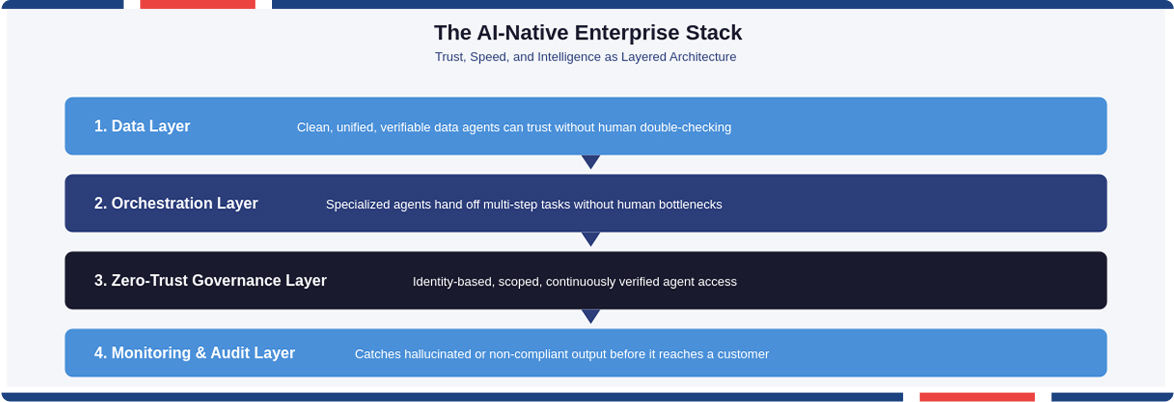
Three capabilities separate the two. First, a data layer clean enough for an agent to trust without a human double-checking every field. Second, an orchestration layer that lets specialized agents hand off work the way departments used to hand off a case file, minus the delay. Third, a monitoring layer that catches a hallucinated output before it reaches a customer, not after.
Multi-agent AI systems consulting raises the stakes further, because a mistake no longer stays contained to one workflow. When a pricing agent, a fulfillment agent, and a customer service agent all act on the same order, an error in one can cascade through the other two before a human notices. That is a coordination problem as much as a technical one, and it is why the most sophisticated AI-native applications now treat orchestration as a first-class discipline.
Zero Trust: The Only Way Intelligence Scales Safely
Zero trust AI security used to be a network security posture. Now it has to be an AI operating principle, because an agent with standing access to every system is a bigger liability than any single employee could ever be. Every agent needs identity-based access, scoped narrowly to the task in front of it, verified continuously rather than once at login. That is the only version of speed that survives contact with a compliance audit.
This is not paranoia. It is arithmetic. An IBM study of CEO priorities found only 25% of AI initiatives delivered the ROI leadership expected, and unmanaged access is one of the quiet reasons why. When an agent can touch more than it needs, a small error compounds fast, and the blast radius grows with every new integration you bolt on. Zero-trust architecture keeps that blast radius small enough to fix before it becomes a board-level conversation.
A CIO’s Sequencing Playbook for Trust, Speed, and Intelligence
Sequencing beats ambition here. Start with the data layer, because no orchestration enterprise AI strategy survives contact with siloed, unverified information. Build identity-based access controls before the first agent goes into production, not after the second incident. Pilot one high-value, well-bounded workflow, prove the audit trail works end to end for AI governance and compliance, and only then expand horizontally across the business.
The enterprises that get right cloud native enterprise AI infrastructure treat governance as a capability, not a checkpoint that slows everyone down. They are already ahead of the 40% of applications Gartner expects to carry embedded agents by year’s end, and they are the ones who will still be running those agents in 2028, when zero-trust governance stops being optional for everyone else.
Frequently Asked Questions:
What does it mean for an enterprise to be AI-native?It means intelligence is built into the core architecture, not added as a front-end feature on top of existing software.
How is agentic AI different from traditional automation? Agentic AI plans, decides, and executes multi-step tasks with minimal human input, while traditional automation only follows fixed, pre-written rules.
Why does zero trust matter for AI agents specifically?AI agents can touch far more systems and data than a single employee, so unscoped access turns one small error into an enterprise-wide risk.
What is the biggest reason agentic AI projects fail?Most failures trace back to weak data integration and governance, not weak AI models.
How long does it take to see ROI from enterprise AI agents?Well-scoped deployments typically show measurable value within about five months, according to BCG and Forrester research.
Partner of Flexsin for AI Native Enteprise Transformation
Building an agentic AI-native enterprise means nothing if the agents inside it can’t be trusted, audited, or governed at scale. Flexsin’s Responsible AI practice builds the governance framework, access controls, and explainability layer that let enterprises deploy AI agents with confidence instead of guesswork. Explore Flexsin’s Responsible AI development services and put AI governance framework in place before your next agent goes into production.
Explore Flexsin’s responsible AI services.
People Also Ask:
1. What is an AI-native enterprise? It is an organization whose applications, data, and workflows are built around embedded AI agents rather than AI being bolted onto legacy systems.
2. Is agentic AI the same as generative AI? No, generative AI creates content on request, while autonomous AI agents plan and completes multi-step tasks toward a goal.
3. How much does an AI governance framework cost to implement? Costs vary widely by scale for enterprise AI implementation, but enterprises typically fund it as an ongoing capability rather than a one-time project line item.
4. What industries are adopting AI agents fastest? Banking and insurance currently lead adoption, largely because they already have AI security compliance infrastructure that AI governance can build on.
5. Can AI agents be trusted with sensitive enterprise data? Only when identity-based access, continuous verification, and full audit logging are built in before the agent goes live.
