

 +1.844.3539.746
 info@flexsin.com
Agentic AI at Enterprise Scale Starts with Financial Discipline, Not Bigger Budgets
 Munesh Singh
Let's talk
Table of Contents:
- Agentic AI at Scale: Designing an Operating Model for Enterprise Success
- Building a Secure AI Control Plane for Enterprise Scale
- AI Workflow Redesign: Where Enterprise Value Begins
- Responsible AI and LLM Observability: Governance as a Growth Lever
- Inference Economics: A Strategic Advantage for Enterprise AI
- Why Human Judgment Remains the Core of Enterprise AI Strategy
- People Also Ask
- Partner With Flexsin to Execute Your Enterprise AI Imperatives
- Frequently Asked Questions
A Goldman Sachs analysis found enterprises consuming a full year’s worth of AI budget within three months of deployment – and most of them had nothing production-grade to show for it. That is not a technology failure. That is a strategy failure. The AI imperatives for CTOs have shifted decisively: CTO AI strategy 2026 is not about whether you have AI, it is about whether you can govern it, price it, and make it compound into actual revenue.
Gartner puts 40% of enterprise applications on track to embed task-specific AI agents by end of year, up from under 5% just 12 months prior. Yet the same research firm projects that over 40% of agentic AI projects will be canceled by the end of next year. The math is brutal. Adoption is accelerating; production is stalling; governance is lagging.
Agentic AI at Scale: Designing an Operating Model for Enterprise Success
Most enterprises are still running isolated AI assistants for their agentic AI strategy – chat-based tools that answer questions, summarize documents, and draft emails. That era is closing fast. McKinsey’s global survey found 62% of organizations experimenting with AI agents, but only a minority have industrialized them. The gap between experimenting with agentic AI strategy consulting and operating at scale is not a model problem. It is an architecture problem.
The shift that matters right now is from chat assistants to goal-driven, multi-step agentic AI operating models – systems that plan, execute, call tools, and collaborate across workflows. This is the CTO AI strategy for enterprises in the current cycle: build modular agent teams governed by business outcomes, not by individual tool capabilities. This approach turns isolated AI experiments into scalable Enterprise Solutions that can operate across business functions while maintaining consistent governance and accountability.
Building a Secure AI Control Plane for Enterprise Scale
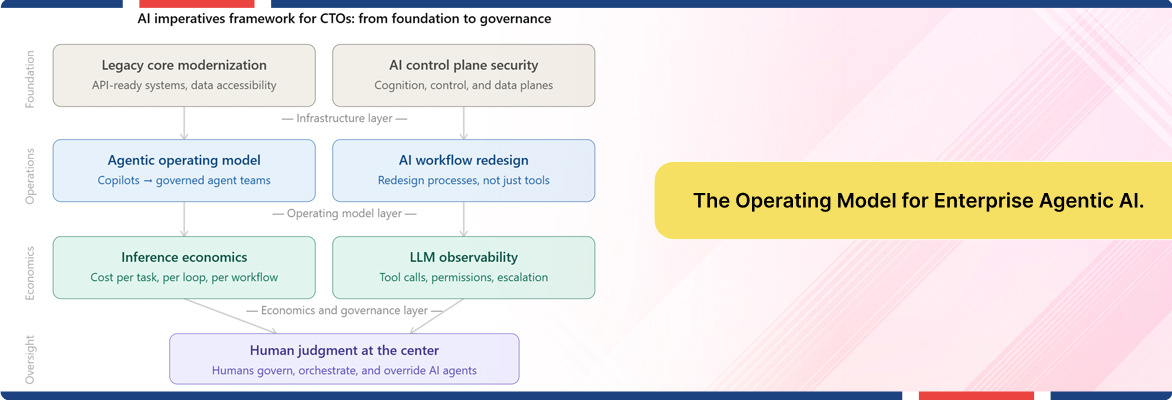
Enterprise agentic AI governance cannot live inside the model. It has to be engineered into the infrastructure layer. As agents connect to enterprise tools, APIs, and data stores, the new strategic asset is the control plane – the layer that links models, data sources, and permissioned actions under a unified governance policy. Building this control plane requires specialized AI Development Services that integrate models, enterprise data, APIs, permissions, monitoring, and human oversight into a governed architecture.
Three distinct planes define the architecture that scales safely in an agentic AI strategy: a cognition plane that provides context-aware intelligence, a control plane that enforces guardrails and permissions, and a data plane that handles runtime execution including reasoning, retrieval, and tool calls. Without this separation, AI agent orchestration for enterprises collapses into a security liability.
AI Workflow Redesign: Where Enterprise Value Begins
Only 50% of AI initiatives are creating measurable value as of the most recent Infosys AI Business Value Radar. The failure mode is consistent: organizations change the technology without redesigning the process. Digital Engineering Services can help organizations redesign the underlying workflows, integrations, data flows, and applications so AI agents operate within processes built for measurable outcomes. They add an AI layer to a workflow that was designed for human workers and then wonder why the outputs are wrong, expensive, and slow to iterate.
Effective agentic AI strategy workflow redesign for enterprises starts with a two-question test before approving any agentic investment. First – does this use case span fragmented systems or siloed knowledge pools? Second – can it be governed as part of a redesigned workflow with measurable cycle-time or quality outcomes? If both answers for AI governance maturity model are yes, agents will likely transform results.
Responsible AI and LLM Observability: Governance as a Growth Lever
The Infosys responsible enterprise AI study surveyed 1,500 business executives and found that 95% reported AI-related incidents, while 86% expect agentic systems to heighten risk further. The companies that treated responsible AI governance as an enterprise-wide growth driver – not a compliance checkbox, experienced significantly lower financial loss and lower incident severity.
LLM observability is the operational companion to governance of agentic AI strategy. Traditional monitoring – accuracy, latency, token consumption – is insufficient when an agent can plan across multiple steps, call external tools, and act autonomously inside enterprise systems. Enterprises need layered observability: infrastructure, prompt behavior, tool call patterns, policy adherence, escalation triggers, and human override rates.
Inference Economics: A Strategic Advantage for Enterprise AI
The enterprise agentic AI market spent three years obsessing over training costs and GPU clusters. That chapter is not closed, but it is no longer the primary cost vector for most organizations. The next phase is inference economics – cost per task, cost per autonomous workflow loop, cost per agentic cycle.
AI inference cost reduction is now a board-level priority. Agents running on long-context models like Gemini 2.5 or processing million-token windows process massive amounts of information per task. Each tool call, retrieval step, and reasoning iteration adds to that cost.
Why Human Judgment Remains the Core of Enterprise AI Strategy
The final and most important AI imperative for CTOs is not technical. It is organizational. Deloitte’s 2026 state of AI report surveyed 3,235 senior leaders and found that worker access to AI rose by 50% in the past year – yet only 34% of organizations are truly reimagining business operations, not just automating existing tasks.
The agentic-first operating model for agentic AI strategy raises the value of human judgment rather than replacing it. Repetitive execution moves to agents. Architecture, oversight, governance, and strategic context move to humans. The enterprises that will compound through this cycle are building human-in-the-loop AI enterprise architectures from day one – not retrofitting oversight after incidents force the issue in enterprise AI modernization strategy.
People Also Ask:
What are AI imperatives for CTOs in an agentic AI era? AI imperatives for CTOs are the strategic and architectural priorities that determine whether AI scales into business value or spirals into runaway cost.
How can enterprises reduce agentic AI inference costs?Enterprises reduce agentic AI inference costs by tiering workloads across frontier and distilled models based on task complexity.
What is the difference between an agentic AI operating model and a copilot?A copilot responds to prompts within a single session and does not retain context or execute multi-step tasks autonomously.
How long does it take to move from an agentic AI pilot to production deployment? Organizations with strong data foundations, clear workflow redesign, and a defined AI control plane security typically move from pilot to production in three to six months.
Why do most agentic AI projects fail before reaching production? Gartner projects that over 40% of agentic AI projects will be canceled by end of next year, primarily because organizations layer agents onto unchanged workflows rather than redesigning for outcomes.
Partner With Flexsin to Execute Your Enterprise AI Imperatives
As an AI Development Company, Flexsin helps enterprise technology leaders move from agentic AI pilots to governed, production-scale AI agent deployments without the runaway inference costs or governance gaps that derail many programs. Our AI and agentic AI strategy solutions practice combines architecture design, responsible AI frameworks, and workflow redesign into a single, outcome-linked engagement model.
Explore Flexsin’s AI and Agentic Solutions.
If your AI roadmap needs to deliver measurable ROI this year, Flexsin builds the architecture that makes it possible.
Frequently Asked Questions:
1. What should CTOs prioritize first when building an enterprise AI strategy?The first move is architecture, not model selection. CTOs should define the AI control plane – the governance layer linking models, data sources, APIs, and human oversight – before deploying agents at scale.
2. How does responsible AI governance improve business growth rather than just reducing risk?Research from Infosys covering 1,500 executives shows that the most mature responsible AI organizations experienced the least financial loss and the lowest incident severity.
3. What role does LLM observability play in enterprise AI cost management for CTOs? LLM observability prevents inference cost overruns by surfacing which agent actions are consuming disproportionate token budget relative to business output. It also identifies when agents are calling tools unnecessarily.
4. How should enterprises approach AI reskilling for software engineering teams?Effective AI reskilling for software engineers is a role redesign exercise, not a training curriculum. Delivery teams should be restructured so that agentic tools handle implementation volume while engineers focus on architecture framing.
5. What is inference economics, and why does it matter for enterprise AI ROI?Inference economics enterprise AI is the discipline of managing cost per task, cost per workflow, and cost per agentic loop – the real cost drivers once AI systems move from pilots to agentic AI production deployment at scale.
