

 +1.844.3539.746
 info@flexsin.com
Why Traditional Integration Approaches Are Failing – And Where MuleSoft Vibe Fits In
 Mahendra Singh Panwar
Let's talk
Table of Contents:
- Expanding Development Capabilities with MuleSoft Vibe Coding
- Where Specialized MuleSoft Expertise Continues to Be Essential
- The Business Impact of MuleSoft Vibe: A Look at Real Outcomes
- Five Things to Do Before You Scale MuleSoft Vibe Adoption
- People Also Ask
- Work With a Partner Who Has Done This Before
- Frequently Asked Questions
Three integration projects are stuck in your backlog right now – not because the platform can’t handle them, but because the one person who knows DataWeave cold is already at capacity. That is the integration specialist lock, and it has been quietly throttling enterprise IT velocity for years. MuleSoft Vibe – Salesforce’s agentic AI experience purpose-built for the Anypoint Platform – targets exactly this constraint.
The question worth asking before you change a single hiring plan or training budget: does it actually work, and for whom?
According to MuleSoft’s 2025 Connectivity Benchmark Report, enterprises now manage an average of 897 applications – yet only 29% are integrated. Meanwhile, IT teams spend 39% of their time building custom integrations rather than strategic work. MuleSoft Vibe entered general availability in October of last year specifically to attack that problem – and the early evidence is more nuanced than the marketing materials suggest.
Expanding Development Capabilities with MuleSoft Vibe Coding
The honest answer is: for a specific, bounded set of tasks, yes – non-specialist developers using MuleSoft Vibe coding can produce reviewable, production-ready integration artifacts they could not have created in a reasonable timeframe before. That is not a small thing.
API Specification Drafting and MuleSoft Vibe
A mid-level developer who has never written a RAML file or an OAS 3.0 specification can describe an API’s resources, operations, expected payloads, and error scenarios in plain English and receive a standards-compliant specification in return. It rarely comes out perfect – but it consistently captures structural intent well enough that targeted expert review is a fraction of the time required to write from scratch.
Standard DataWeave AI Generation
AI DataWeave transformation for common patterns – field-to-field mapping, JSON-to-XML conversion, basic filtering and grouping – now sits within reach of developers who understand the data model but have never learned DataWeave syntax. This category of mapping work previously required a specialist for every iteration.
Connector Configuration for Common Systems
Salesforce, SAP, Workday, ServiceNow, standard HTTP connectors – Vibe configures these correctly for common patterns far more often than not, surfacing the property combinations that matter and steering users away from defaults that cause silent runtime failures.
Where Specialized MuleSoft Expertise Continues to Be Essential
This is where most vendor coverage stops, and where the real planning conversation starts. MuleSoft Vibe automates the syntactic and mechanical layer. The conceptual and architectural layer remains a human responsibility.
Architectural Decisions Are Not Automatable
Should this integration be synchronous or asynchronous? Is a scatter-gather the right pattern for this load profile, or will it introduce latency problems at scale? Should you build a process API here or call the system API directly? Vibe will implement whatever pattern you describe, quickly and correctly.
Complex DataWeave AI Generation Has a Ceiling
The AI DataWeave transformation capability in Vibe handles standard mappings reliably. Complex DataWeave AI generation- recursive structures, multi-source merge logic with conflict resolution, advanced type coercions across unpredictable schema variations – produces plausible-looking output that can be subtly wrong.
Production Incidents Still Need a Specialist
Vibe’s observability integration makes routine triage faster and more accessible. That is useful. But timing issues, race conditions in async flows, connector-level protocol bugs, and JVM memory behavior under sustained load are not diagnosable from log analysis alone. These are the 2:00 AM Saturday failures.
The Business Impact of MuleSoft Vibe: A Look at Real Outcomes
Benchmarked outcomes from early MuleSoft Vibe adoption tell a consistent story: Vibe accelerates specialists; it does not replace expertise that was never there. A regional hospital network completed an HL7 v2-to-FHIR R4 transformation in 6 days against a historical 4-week baseline – but two corrections were needed in specialist review, and the reviewers had HL7 domain expertise.
The pattern is consistent: Vibe lowers the floor without raising the ceiling. Teams with strong specialists get dramatically more leverage. Teams without specialists get a faster way to reach the limits of what they can safely build without them. With available-at-no-additional-cost access for all Anypoint Platform AI customers, the adoption case is straightforward.
Five Things to Do Before You Scale MuleSoft Vibe Adoption
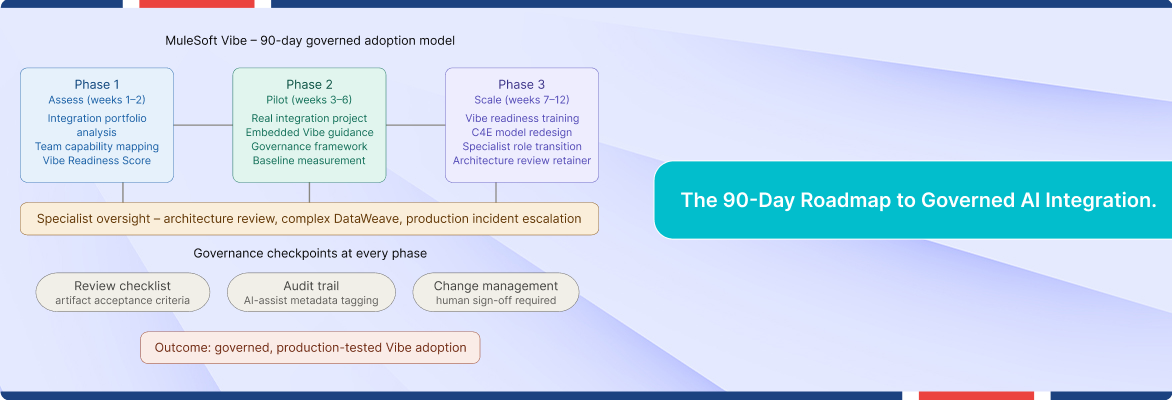
- Define your review standard first. Before you scale, define exactly what a good Vibe artifact review looks like and what the acceptance criteria are for a Vibe-assisted flow before it reaches staging. Without this, ‘reviewed’ becomes a checkbox that means different things to different people.
- Pilot on real work, not a demo project. Run your first Vibe engagement on something that was going to be built anyway, where you can measure actual delivery time against your historical baseline.
- Invest in prompt engineering early. The quality of Vibe output is substantially shaped by the quality of the input. Train your developers to describe MuleSoft Vibe integration requirements with precision.
- Update your audit trail and change management. Vibe-generated artifacts are automatically tagged with AI-assistance metadata in Anypoint. Your governance processes need to require explicit human sign-off on AI-assisted artifacts before deployment.
- Measure relentlessly. Track time-to-first-draft, review cycle time, total delivery time, and post-deployment defect rate against your pre-Vibe baseline. The ROI is real but not uniform, and you will not know your specific profile until you measure it.
People Also Ask:
What is MuleSoft Vibe, and how does it differ from a standard AI coding assistant?MuleSoft Vibe is a MuleSoft AI agent embedded natively inside Anypoint Code Builder, purpose-built for the enterprise integration lifecycle rather than general-purpose code generation. Unlike generic AI tools, it runs output through a proprietary AI Quality Pipeline.
Can MuleSoft Vibe replace a certified MuleSoft integration specialist? MuleSoft Vibe expands what non-specialist developers can contribute – particularly for standard DataWeave AI generation, API specification drafting, and common connector configuration.
Which MuleSoft Vibe use cases deliver the highest ROI?Legacy SOAP-to-REST migration, standard REST CRUD API development, and common connector configuration are among the highest-ROI use cases for MuleSoft Vibe adoption, where structural and syntactic work is highly pattern-repetitive.
How does MuleSoft Vibe handle integration governance and compliance?MuleSoft Vibe integration automatically tags all AI-assisted artifacts with AI-assistance metadata in the Anypoint Platform, enabling enterprise integration AI governance teams to enforce explicit human sign-off in change management workflows.
What is enterprise vibe coding in the context of MuleSoft?Enterprise MuleSoft Vibe coding refers to the shift from syntax-driven integration development to conversational, agentic integration platform development using natural language prompts.
Work With a Partner Who Has Done This Before
Flexsin’s MuleSoft integration practice helps enterprises move from Vibe curiosity to governed production adoption – with the architecture review framework, team transition playbook, and specialist oversight that turn a compelling demo into a reliable delivery capability. Whether you are scoping a pilot, restructuring your integration team model, or building the MuleSoft integration governance framework that makes MuleSoft Vibe adoption safe to scale, Flexsin brings the delivery experience your organization needs. Explore Flexsin’s MuleSoft integration services and start your Vibe readiness conversation today.
Frequently Asked Questions:
1. Is MuleSoft Vibes available at no additional cost?Yes. MuleSoft Vibes became generally available in October of last year and is accessible at no additional cost for all Anypoint Platform customers with an Einstein-enabled Salesforce org, without requiring Einstein or Flex credits.
2. What types of DataWeave transformations can MuleSoft Vibe reliably generate?MuleSoft Vibe’s AI DataWeave transformation capability reliably handles standard use cases: field-to-field mappings, format conversions such as JSON to XML or XML to CSV, and basic filtering and grouping operations.
3. How should engineering leaders restructure their integration teams for MuleSoft Vibe? Engineering leaders should rebalance hiring criteria toward integration architecture thinking rather than MuleSoft-specific syntax knowledge, shift specialist responsibilities toward architecture review, C4E governance, and complex incident resolution.
4. FWhat governance steps should organizations complete before scaling MuleSoft Vibe adoption?Before scaling MuleSoft Vibe adoption, organizations should establish a written review checklist for Vibe-generated artifacts covering syntactic correctness, error handling completeness, security posture, and alignment with API governance standards.
5. How does Flexsin support MuleSoft Vibe adoption?Flexsin’s MuleSoft practice supports enterprise Vibe adoption across the full adoption lifecycle – from Integration Readiness Assessment and pilot design to governance framework setup, team model restructuring, and ongoing architecture review.
