

 +1.844.3539.746
 info@flexsin.com
Odoo vs Salesforce CRM: Finding the Right Balance Between Cost and Capability
 Munesh Singh
Let's talk
Table of Contents:
- Why Odoo vs Salesforce CRM Is Not a Fair Fight
- The Real Cost of Odoo vs Salesforce
- Odoo vs Salesforce CRM Features: Where Each Platform Earns Its Price
- Odoo vs Salesforce CRM: Scenarios Where Salesforce Comes Out Ahead
- Making the Odoo vs Salesforce CRM Decision
- Why Flexsin Sees This Decision Differently Than Most Vendors
- Partner with Flexsin
- People Also Ask
Most B2B software decisions get made on license price. That instinct will cost you.
When companies evaluate Odoo vs Salesforce CRM, they typically pull up a pricing page, compare the headline numbers, and start building a business case. It is a reasonable place to start – and almost always the wrong place to stop. The actual financial gap between these two platforms shows up not in the per-seat fee, but in the architectural differences that determine what you will be paying for three years from now.
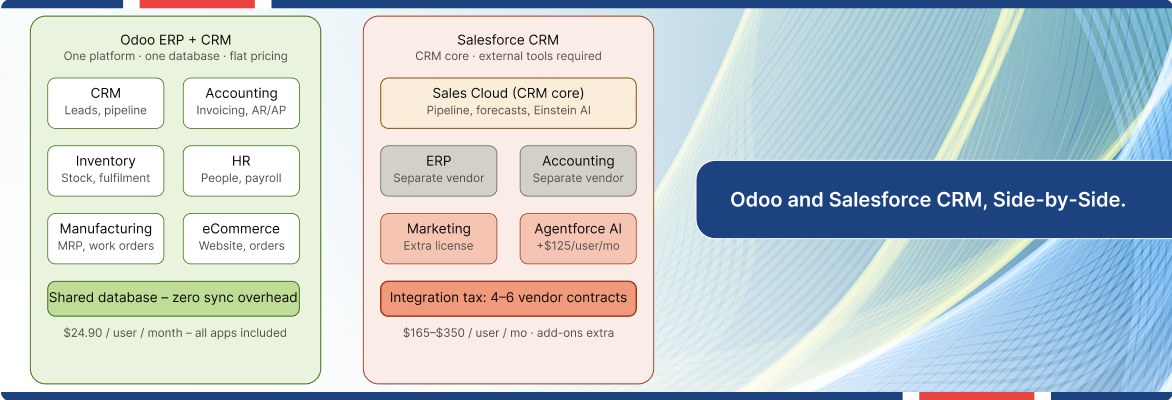
Salesforce raised list prices roughly 6% on Enterprise and Unlimited editions in August 2025, per public announcements, with Agentforce AI add-ons now starting at $125 per user per month. Meanwhile, Odoo Standard sits at $24.90 per user per month and includes every native module – CRM, accounting, inventory, HR, and 70-plus apps – without a single add-on purchase.
Why Odoo vs Salesforce CRM Is Not a Fair Fight
Salesforce is the world’s market-leading CRM. It controls roughly 21% of the global CRM market, per Statista, and for good reason – its pipeline management, Einstein AI forecasting, and AppExchange ecosystem are genuinely mature. But Salesforce was built to do one thing exceptionally well: manage the sales layer of a business. That is its entire identity.
Odoo is an ERP. That distinction changes the conversation entirely. When a sales rep closes a deal in Odoo CRM integration, the accounting module generates the invoice, inventory adjusts stock availability, and fulfillment flags the dispatch team – all on one database, without a single API call to an external system.
The Real Cost of Odoo vs Salesforce
Here is what actually happens when a 25-person company goes with Salesforce Professional at $80 per user per month: they quickly discover that predictive lead scoring requires Enterprise at $165 per user per month, that Agentforce AI is an add-on starting at $125 per user per month on top of the base license, that API access is locked behind the Custom tier.
By the time you stack licensing, add-ons, implementation (which mid-market deployments typically run $20,000 to $50,000), and ongoing maintenance at 15% to 20% of implementation cost annually, Salesforce’s true total cost of ownership routinely runs 40% to 100% over the base subscription figure, according to analysis by Sweep.io.
Odoo’s pricing model is structured differently. The Standard edition includes all AI features, all integrations with external providers like Stripe, FedEx, and WhatsApp, and all automation tools at the flat per-user rate. A 10-person team comparing actual delivered feature sets – not headline prices – often finds Odoo’s total cost of ownership three to five times lower over a comparable scope, per analysis by Sybill.ai.
Odoo vs Salesforce CRM Features: Where Each Platform Earns Its Price
On core CRM functionality – lead management, pipeline visualization, activity scheduling, email integration, and sales forecasting – both platforms are competitive. Odoo’s Kanban pipeline is praised for its speed and low learning curve; most sales reps get productive within a day. Salesforce’s depth in territory management, granular reporting, and complex quota handling is unmatched for large, dedicated sales organizations.
The divergence appears at the edges of the sales workflow. Odoo includes quote building, electronic signatures, online payments, event-based lead generation from website visits and appointment bookings, and inventory-linked order management – all in the Standard edition. Salesforce gates CPQ (Configure, Price, Quote), online payment tools, and marketing automation behind separate purchases or higher tiers.
Odoo vs Salesforce CRM: Scenarios Where Salesforce Comes Out Ahead
There are organizations for which Salesforce is clearly the right call. If your business runs on CRM as its core operating system – meaning your entire revenue motion lives in the pipeline, you have 100+ sales reps, complex forecasting needs, and an existing Salesforce infrastructure – disrupting that ecosystem carries more risk than the cost savings justify.
Salesforce’s Agentforce platform, which introduces autonomous AI agents across sales, service, and marketing, represents a genuine capability lead in enterprise AI for CRM-centric businesses. For companies where the sales layer is the business, that matters.
If you need a best CRM for SMBs and enterprises that plugs into an existing tech stack – separate ERP, separate accounting, separate marketing automation – and you have the budget and the admin resources to run it, Salesforce is a proven choice. If you want the entire business on one platform at a predictable per-user price, Odoo changes the equation.
Making the Odoo vs Salesforce CRM Decision
Three questions cut through the noise.
First: Is CRM your primary operational system, or one function among several? If your team also needs inventory, manufacturing, HR, or accounting in the same platform, Odoo’s unified architecture removes weeks of integration work and eliminates ongoing sync risk between disconnected systems.
Second: What is your actual five-year TCO, not your year-one license cost? Model the full picture – licenses, add-ons, implementation, admin salaries, and annual price escalation. Salesforce historically adjusts list prices upward; the 2023 increase averaged 9%, followed by the 2025 increase of 6%. That compounding matters in a multi-year contract.
Third: What is your team’s technical capacity? Odoo’s customization is deeper – it is open-source Python, which means full code-level changes are possible – but that depth requires a capable implementation partner. Salesforce’s low-code tools lower the barrier for in-house customization, at the cost of operating inside a vendor-controlled platform.
Why Flexsin Sees This Decision Differently Than Most Vendors
In our experience advising technology decisions for open source CRM software integration across industries, the Odoo vs Salesforce CRM question is almost never really about features. Both platforms have enough capability to run a well-organized sales operation. The decision turns on operational philosophy: how much of your business you want integrated versus modular, and how much budget certainty matters to your CFO.
Flexsin has implemented both platforms across manufacturing, distribution, and professional services environments. The pattern we see consistently for ERP CRM integration: companies that choose Odoo ERP integration to reduce inter-system data lag, eliminate duplicate data entry across platforms, and cut software licensing costs – often by more than they initially projected.
Partner with Flexsin
Flexsin has worked with companies across the full spectrum of this decision – from first-time CRM deployments to complex migrations between Salesforce and Odoo. Our Odoo CRM implementation practice covers CRM setup, ERP integration, data migration, and ongoing optimization, helping businesses get the CRM and ERP in one platform working the way their operations actually run – not the way a default configuration assumes they should.
Explore Flexsin’s CRM services:If you are evaluating Odoo vs Salesforce CRM for your business, Flexsin can run a structured assessment that maps your operational requirements to platform capabilities and gives you a realistic CRM total cost of ownership model before you commit. Reach out to Flexsin to schedule a no-obligation scoping session with our team.
People Also Ask:
1. What is the main difference between Odoo and Salesforce CRM?Salesforce is a dedicated CRM platform built for sales pipeline management and customer-facing operations at scale. Odoo is an open-source ERP suite that includes CRM as one of 70-plus integrated modules.
2. Is Odoo cheaper than Salesforce?Odoo Standard at $24.90 per user per month includes all apps, AI tools, and integrations. Salesforce’s meaningful features – including advanced AI and API access – require Enterprise tier at $165 per user per month or higher, plus add-ons.
3. Can Odoo replace Salesforce for enterprise teams? For large enterprises with complex, multi-department revenue processes and mature Salesforce infrastructure, a full replacement carries integration risk. For mid-market companies seeking to consolidate.
4. What are the hidden costs of Salesforce that buyers miss? Common hidden costs include Agentforce AI add-ons starting at $125 per user per month, dedicated administrator salaries ($75K-$120K annually), AppExchange app subscriptions, implementation fees ($20K-$50K for mid-market), and annual price increases.
5. Which CRM is better for small businesses?Odoo is the stronger choice for most small and mid-sized businesses that need CRM alongside accounting, inventory, or operations. Its flat per-user pricing and modular architecture scale with the business without triggering new licensing tiers.
