

 +1.844.3539.746
 info@flexsin.com
Your CRM and ERP Don’t Talk. Here’s What That Costs You
 Munesh Singh
Let's talk
Table of Contents:
- Why CRM ERP Integration Benefits Go Beyond IT
- Where AI-Powered ERP Integration Changes the Equation
- AI Agents Enterprise Integration: The Next Layer
- The Real-Time Data Sync CRM ERP Problem
- Unified Customer Data Platform: The Foundation AI Needs
- Choosing Between Salesforce ERP Integration, Dynamics, and Odoo Paths
- Building the Business Case for ROI
- Getting Started Without Breaking What Already Works
- The Bottom Line on CRM-ERP Integration with AI
- People Also Ask
Picture this: a sales rep closes a deal at 4 PM. The warehouse doesn’t see it until the next morning, because someone has to manually re-key the order into the ERP. That gap – those 18 hours – is where revenue leaks, customers get frustrated, and finance starts asking uncomfortable questions. CRM-ERP integration exists to close that gap, and AI is now the fastest way to do it.
Here is what that looks like in practice: most enterprises run hundreds of applications, but only a fraction talk to each other. That is not a technology gap. That is a coordination failure with a price tag.
Why CRM ERP Integration Benefits Go Beyond IT
The obvious win is data accuracy. The bigger win is speed. When CRM and ERP share a live data layer, a sales quote reflects real inventory, a support ticket reflects real order status, and finance closes the books without chasing spreadsheets.
This matters because disconnected systems force people to become the integration layer – copying numbers from one screen to another, hoping nothing gets missed. That is expensive, slow, and quietly demoralizing for the team doing it.
As a result, the case for CRM ERP integration software has shifted from ‘nice to have’ to ‘how did we operate without this.’ The conversation in boardrooms has moved from whether to integrate to how fast it can happen and how intelligently.
Where AI-Powered ERP Integration Changes the Equation
Traditional integration projects were brutal: custom code, brittle point-to-point connections, and a six-month timeline before anyone saw value. AI-powered ERP integration flips that model by using prebuilt connectors, low-code workflow builders, and AI-assisted mapping to compress that timeline dramatically.
In contrast, modern iPaaS platforms now embed AI directly into the integration layer. Gartner notes that the iPaaS market grew 23.4% to $8.5 billion in 2024, driven largely by rising adoption of AI and no-code tooling. That growth rate is not hype – it is enterprises voting with their budgets.
AI Agents Enterprise Integration: The Next Layer
This is where it gets interesting. Gartner predicts that 40% of enterprise applications will be integrated with task-specific AI agents by the end of 2026, up from less than 5% in 2025.
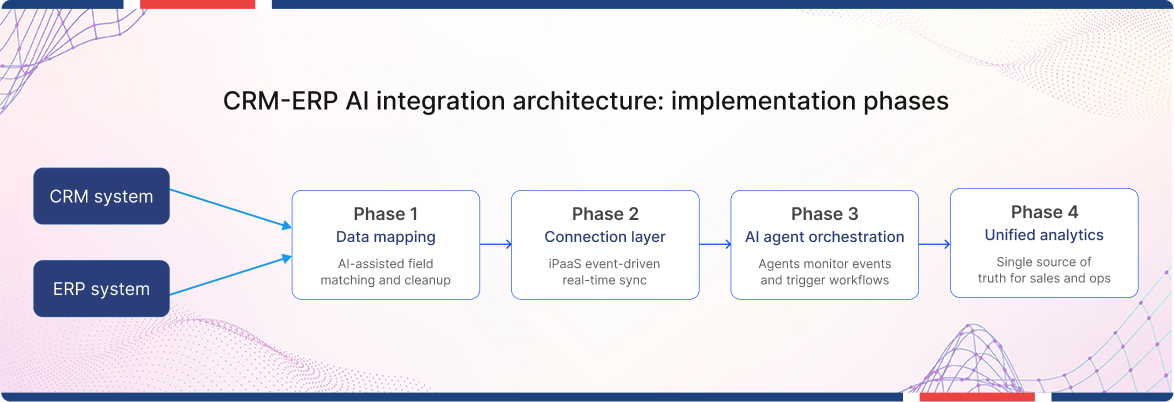
Which means the integration layer itself is becoming intelligent, as it enables real time data sync for CRM-ERP. An agent can watch for a CRM deal closing, trigger inventory checks in the ERP, flag a fulfillment risk, and notify the account team – without a human writing a single line of orchestration code for that specific scenario.
The Real-Time Data Sync CRM ERP Problem
Real-time sync sounds simple until you try to build it. Sales data changes by the second. Inventory data changes by the minute. Finance data closes on a schedule. AI-driven integration platforms reconcile these different rhythms using event-driven architecture, so a change in one system propagates to the other the moment it happens – not at the next nightly batch job.
TRooTech’s analysis of 2026 enterprise AI integration notes that event-driven architectures are gaining traction precisely because they let systems react to live changes like customer actions or supply chain disruptions.
Here is what that looks like in practice for a manufacturer: a customer increases an order quantity in the CRM. The ERP immediately recalculates material requirements. Procurement gets an alert if a component is short. No spreadsheets. No Monday-morning surprises.
Unified Customer Data Platform: The Foundation AI Needs
AI models are only as good as the data feeding them. Google Cloud research, cited by ACTGSYS, identifies data quality as the primary condition for AI success – and integration is the mechanism that delivers it.
A unified customer data platform means a sales rep, a support agent, and a finance analyst are all looking at the same record. No duplicate contacts. No conflicting order histories. No AI model trained on half the picture.
That is why CRM ERP integration is increasingly framed as an AI readiness project first, and an efficiency project second. The efficiency of business process automation AI gains follow naturally once the data foundation is solid.
Choosing Between Salesforce ERP Integration, Dynamics, and Odoo Paths
The right integration path depends heavily on what is already in place. Salesforce-centric organizations typically lean on native connectors or platforms like MuleSoft. Microsoft-centric organizations often find that Microsoft Dynamics CRM ERP integration benefits from the fact that both systems already share a data model and identity layer.
Odoo takes a different approach entirely to unified customer data platform. Because Odoo CRM and Odoo ERP modules run on one unified architecture, the ‘integration’ problem shrinks – there is no separate system to sync because CRM and ERP share the same database natively.
Building the Business Case for ROI
CFOs do not approve integration projects because they sound modern. They approve them because the math works for CRM ERP integration costs. Forrester-cited figures put three-year ROI from integration suites at 345%, according to APPSeCONNECT’s 2026 enterprise integration analysis.
The reason this number holds up is that integration ROI compounds across departments simultaneously – sales gets faster quote-to-cash, finance gets cleaner books, and operations gets fewer fulfillment errors, all from the same underlying investment.
In contrast to a single-department tool purchase, CRM-ERP integration with AI touches every team that touches a customer record. That breadth is exactly why the ROI multiplies rather than adds.
Getting Started Without Breaking What Already Works
The teams that succeed do not rip out their CRM or ERP and start over. They layer an AI-enabled integration platform on top for CRM ERP data sync, connect the highest-friction workflows first, and expand from there.
Start with the workflow that causes the most manual rework today – often order-to-cash or lead-to-quote. Prove the AI-driven sync works there. Then extend it to inventory, service, and finance, one workflow at a time.
This matters because a phased rollout builds trust with the teams who will live with the new system every day. A big-bang rewrite, by contrast, tends to generate resistance before it generates value.
The Bottom Line on CRM-ERP Integration with AI
CRM-ERP integration used to be a multi-month IT project with a vague payoff. AI has turned it into a faster, smarter, and more strategic move – one that builds the data foundation your next ten AI initiatives will depend on.
The enterprises moving first on AI-powered ERP integration are not doing it because it is trendy. They are doing it because every day of disconnected systems is a day of lost margin, slower decisions, and frustrated customers. CRM-ERP integration is the unglamorous fix that makes everything else – forecasting, automation, AI agents – actually work.
People Also Ask:
1. What is CRM ERP integration? CRM ERP integration connects customer-facing systems with operational and financial systems. It lets sales, service, and finance teams work from one shared data set.
2. How to integrate CRM and ERP systems? Most teams use an iPaaS platform with prebuilt connectors for their specific CRM and ERP. AI-assisted mapping tools now handle much of the field-matching work automatically.
3. What is the cost of CRM ERP integration? Costs vary widely based on system complexity and the number of workflows connected. Cloud-based iPaaS platforms generally cost less than custom point-to-point integration code.
4. How long does AI-powered ERP integration take? A focused first workflow can go live in weeks rather than months using modern iPaaS for ERP and CRM tools. Full enterprise system integration AI rollout typically happens in phases over several quarters.
5. Salesforce ERP integration vs Odoo CRM ERP integration: which is faster? Odoo CRM ERP integration is often faster because both modules share one database natively. Salesforce ERP integration usually requires a separate iPaaS layer to connect distinct systems.
6. Why do AI integration projects fail? Most failures trace back to poor data quality rather than weak AI models. Clean, governed data is the prerequisite AI needs to deliver accurate results.
7. What role do AI agents play in enterprise integration? AI agents deployment allows for the monitoring of events across CRM and ERP and trigger actions automatically. This moves integration from passive data sync to active, intelligent workflow automation.
Flexsin’s Odoo ERP implementation team builds CRM-ERP integration architectures that are AI-ready from day one – not retrofitted later. Whether your stack runs on Odoo, Microsoft Dynamics, or a hybrid of cloud applications, Flexsin connects the systems your sales, operations, and finance teams depend on. Explore Flexsin’s Odoo ERP Development Services. Your integrated, AI-ready enterprise system starts with a single conversation with Flexsin’s team .Flexsin’s team.
