

 +1.844.3539.746
 info@flexsin.com
How Odoo ERP Integration Becomes the Next Step After SAP
 Tarun Malhotra
Let's talk
Table of Contents:
- The Operational ERP Integration Debt That Kills Mid-Market Momentum
- The Operational ERP Integration Debt That Kills Mid-Market Momentum
- Why Standard ERP Configurations Fall Short for Scaling Organizations
- Odoo’s Technical Architecture: What Powers Enterprise Scalability
- The Functional Priorities of 500+ Employee Organizations
- Limitations and Technical Constraints of Odoo ERP Integration
- People Also Ask:
- Ready to Know What’s Actually Happening in Your Business?
- Frequently Asked Questions
The CFO already knows the number – she just doesn’t say it out loud. Every quarter, her team spends 40 hours reconciling data across three disconnected systems because the ERP can’t talk to the CRM, and neither talks to the warehouse. That invisible tax – call it operational debt – is what separates the companies that scale cleanly from the ones that hire their way around their own software.
Mid-market and enterprise organizations don’t fail at growth because of a lack of ambition. They stall because their technology stack was stitched together for the company they were, not the company they’re becoming. Point solutions that were ‘good enough’ at 50 employees create dangerous drag at 300. Multiply that drag across five locations or three subsidiaries, and you’ve built a machine that actively resists the speed your competitors demand.
This is precisely the gap Odoo ERP integration for medium and large companies addresses. Not as a promise – as an engineering decision. Odoo’s architecture was rethought for organizations operating at scale, and the numbers reflect it. The platform currently serves over 170,000 businesses globally, with more than 16 million individual users, adding roughly 120,000 new customers every year – growing at a 20-25% compound annual rate that outpaces every legacy ERP vendor in the mid-market segment (Source: AppVerticals Odoo Adoption Statistics, 2026).
That growth is not coincidence. It is the market’s verdict on a 20-year-old category that overcharged and under-delivered.
Why Standard ERP Configurations Fall Short for Scaling Organizations
It all comes down to architecture of open source ERP. Most enterprise resource planning platforms were built in an era when ‘integration’ meant running a batch job overnight. They assumed a single-entity business model, a fixed org chart, and a deployment horizon measured in years rather than months. Those assumptions collapse under the weight of modern mid-market realities.
Consider the pricing gap alone. SAP S/4HANA Cloud runs between $270 and $625 per user per month. Microsoft Dynamics 365 Business Central starts at $80 per user per month – and that figure jumped with the November 2025 price increase – while Oracle and NetSuite typically open at $99 to $150 per user per month before implementation, customization, and ongoing support costs. Odoo Enterprise, by contrast, sits at approximately $24 per user per month for its online edition, with a Custom plan at $10.90 per user per month for multi-company and on-premise scenarios (Source: Objects.ws Odoo vs ERP Comparison, January 2026).
Cost alone would be an incomplete argument. The deeper issue is rigidity. Legacy ERP digital transformation projects for medium companies routinely run 12 to 24 months before a single user is productive. Customizations require certified consultants to modify proprietary code. Upgrades break those customizations. The total cost of ownership quietly doubles.
Open source Odoo ERP integration for enterprises reframes this entirely. When the underlying code is accessible, partners can build custom modules without touching the core – meaning upgrades don’t erase your work, and the ecosystem is competitive rather than captive.
Odoo’s Technical Architecture: What Powers Enterprise Scalability
Odoo runs on a PostgreSQL database with a Python-based ORM layer. That matters because PostgreSQL handles concurrent writes and large transaction volumes with the kind of reliability financial-grade applications require. The architecture is intentionally modular – every Odoo app communicates through a shared data model, which means there is no middleware to maintain and no ETL process to break.
Here is what that looks like in practice. A sales order confirmed in Odoo CRM automatically updates inventory levels, triggers a purchase order if stock falls below threshold, generates a draft invoice, and posts a journal entry – all in the same transaction, without a human touching a second system. That is not an integration. That is a single, coherent data model working the way enterprise software was supposed to work 15 years ago.
The modular enterprise application suite for Odoo ERP integration also changes how deployment works. A mid-sized company with 200 employees can go live with Sales, Accounting, and Inventory in eight to twelve weeks, then add Manufacturing, HR, or eCommerce as the organization evolves. There is no ‘rip and replace’ moment – the system grows with the business, one deliberately chosen module at a time.
Odoo Enterprise vs. Community: The Fork That Matters at Scale
The Community edition is free and open source. The Enterprise edition adds multi-company flows, advanced accounting, mobile applications, Odoo Studio for no-code customization, SLA-backed support, automatic version upgrades, and IoT connectivity. For organizations with more than 100 employees, Enterprise is the only sensible path. Community works for technically strong teams willing to self-manage infrastructure – and it is a legitimate starting point – but it does not carry the audit trails, consolidated reporting, or inter-company automation that medium and large enterprises require.
The Functional Priorities of 500+ Employee Organizations
Multi-Company and Multi-Site Management
Odoo 18’s multi-company architecture is the most underappreciated capability in the platform. From a single database instance, organizations can manage multiple legal entities with separate charts of accounts, tax configurations, warehouses, payroll structures, and pricing lists – while sharing products, contacts, and supplier databases across entities. Inter-company transactions – a purchase order from Subsidiary A becoming a sales order in Subsidiary B – are automated and synchronized without manual intervention. Consolidated financial reporting across all entities generates in real time.
This matters specifically for holding companies, franchise operators, and organizations with regional subsidiaries. The alternative – running separate Odoo ERP customization instances per entity and stitching them together with spreadsheets at month-end, is how mid-market companies lose one to two percent of revenue annually to reconciliation errors.
AI-Driven Automation in Odoo 18 and 19
Odoo 19 introduces natural language automation. Users can instruct the system to update records, trigger workflows, or generate reports by describing the desired outcome in plain English – without scripting or technical configuration. An AI-powered chatbot is integrated directly into the interface across Chatter, email composer, and helpdesk. Custom fields in Odoo Studio can now auto-generate content based on record data. For operations teams managing high transaction volumes, this capability eliminates entire categories of manual administrative work.
Manufacturing and Supply Chain Depth
Large corporations in manufacturing, retail, and distribution – companies like Toyota subsidiaries and Danone divisions – have adopted Odoo ERP integration specifically because its Manufacturing module handles multi-level bills of materials, work center capacity planning, and real-time quality control without requiring a separate MES system layered on top. The eCommerce module connects directly to inventory and fulfillment, with over 100,000 active online stores currently powered by Odoo as of mid-2025.
Odoo’s Dedicated Mid-Market and Enterprise Team (MMC)
Odoo ERP implementation created a dedicated division – the Mid-Market and Corporate team, specifically to serve organizations that exceed the typical SME deployment profile. This team runs its own sales process, its own implementation methodology, and its own account management structure. Clients in this segment include EXKI, Wavestone, Toyota, GiveX, and Sodexo. Nine global offices carry MMC teams, creating a shared knowledge base across geographies that smaller deployments cannot access. That structure for Odoo ERP implementation matters when a manufacturing company in North America needs to align its deployment with a subsidiary in Southeast Asia.
The Flexsin Perspective: What We See in the Field
Twenty years of enterprise technology work teaches you one thing that no vendor slide deck will ever say: the platform is never the problem. The problem is always the gap between what the software can do and what the implementation team understands about the business.
Flexsin has delivered open source Odoo Development Services across healthcare, eCommerce, retail, manufacturing, and professional services. The pattern we observe repeatedly is this: companies that treat Odoo implementation as a technology project fail. Companies that treat it as a Digital Transformation Services initiative – with executive sponsorship, documented process maps, and phased go-live milestones – see measurable ROI within six months of deployment.
In one manufacturing client engagement, a 40% reduction in manual procurement tasks followed a correctly architected Odoo deployment. In a retail client, the combination of Odoo’s inventory management and eCommerce integration produced a 30% reduction in stockouts and a 25% improvement in customer satisfaction scores within the first quarter post-launch.
The non-obvious insight: Open source Odoo ERP’s value is not in its feature list. It is in the compounding effect of having every department operating from the same data model. When your sales team’s forecast, your procurement team’s purchase orders, and your finance team’s cash flow projections all feed from one source of truth, the decisions improve. The meetings shorten. The spreadsheet culture dies. That transformation is worth more than any individual module.
Limitations and Technical Constraints of Odoo ERP Integration
Odoo ERP integration for enterprise is not a universal answer. Organizations with highly specialized vertical requirements – aerospace defense contracting, clinical trial management, or regulated multi-entity financial management services – will find that the out-of-the-box modules require significant customization. That customization is achievable, but it adds cost and timeline that buyers should model honestly before committing.
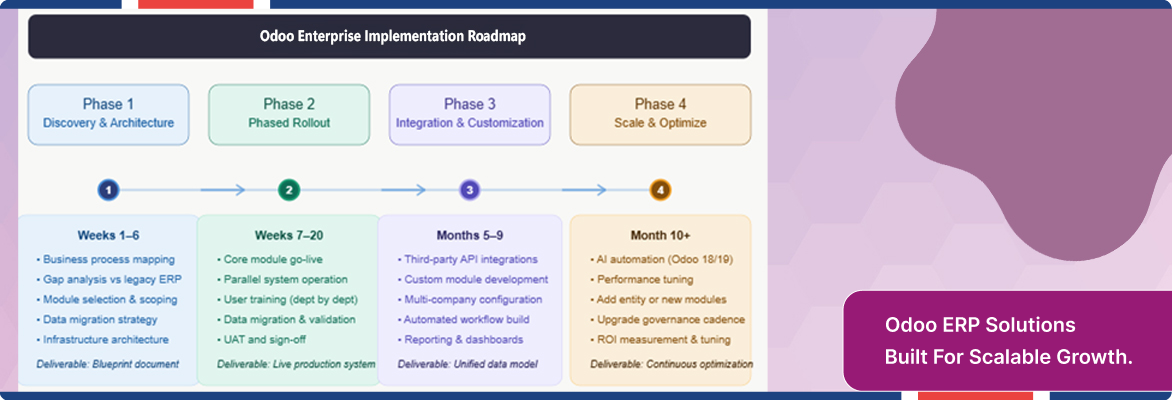
Legacy ERP replacement strategy must also account for data migration complexity. Organizations running SAP or Oracle for 10+ years have accumulated data structures, custom reports, and embedded process logic that do not translate cleanly into any new platform. A phased migration – running parallel systems for one to two quarters – is almost always the right call for companies above 500 employees, even if it temporarily increases operating costs.
Performance at the very top end of the scale – organizations with 10,000+ concurrent users and real-time global transaction volumes – is achievable on Odoo but requires deliberate Cloud Engineering Services. Cloud hosting through Odoo.sh provides managed scalability, but very large deployments may require dedicated database clusters and CDN configuration that the standard subscription does not include.
One more constraint worth naming: Odoo’s upgrade cadence is annual. Each major version brings significant UI and module changes. Organizations that have invested heavily in custom modules need a structured upgrade governance process, or they will find themselves on an increasingly outdated version within two to three years of their initial go-live.
People Also Ask:
Is Odoo ERP integration suitable for medium and large companies, or only for small businesses? Odoo Enterprise is purpose-built for organizations with complex, multi-entity operations. The platform currently serves clients with 300,000+ users in a single deployment, including Toyota and Sodexo.
How does Odoo ERP implementation differ for a large company versus an SME? Large company implementations follow a phased methodology with dedicated MMC account teams, longer pre-sales discovery, and parallel system migration periods. SME deployments typically go live in 8-12 weeks with packaged implementation offers.
What is the cost difference between Odoo Enterprise and SAP S/4HANA for a 200-person company? Odoo Enterprise runs approximately $24 per user per month versus SAP’s $270-$625 per user per month. For 200 users, that is a potential annual saving of $590,000 to $1.45 million in licensing alone before implementation costs.
Can Odoo ERP for SMBs handle multi-company financial consolidation? Odoo 18 supports consolidated balance sheets, P&L statements, and real-time reporting across multiple legal entities from a single database instance. Each entity retains separate charts of accounts and tax configurations.
How long does an Odoo ERP implementation take for a company with 500+ employees? A phased deployment for a 500+ employee organization typically runs 6-18 months depending on the number of modules, data migration complexity, and integration requirements. Discovery and architecture alone typically take 4-8 weeks.
What industries use Odoo ERP solutions at enterprise scale? Manufacturing, retail, distribution, professional services, eCommerce, hospitality, and healthcare verticals have adopted Odoo at enterprise scale. Named clients include Toyota subsidiaries, Danone divisions, and global logistics operators.
Flexsin has delivered Odoo ERP implementations for enterprises across healthcare, manufacturing, retail, and professional services – from initial architecture through phased go-live and post-deployment optimization. If your organization is evaluating Odoo ERP for medium and large companies, or if you are already on Odoo and need it to perform at a higher level, our team will give you an honest assessment of what it takes and what it delivers.
Talk to a Flexsin’s Odoo expert – and start the conversation with data, not a demo.
Frequently Asked Questions
1. What is Odoo Enterprise and how is it different from the Community edition? Odoo Enterprise is the paid, officially supported edition of the platform, including multi-company management, advanced accounting, mobile apps, Odoo Studio for no-code customization, and SLA-backed technical support. The Community edition is free and open source but lacks these enterprise-grade capabilities.
2: What modules does a large company typically deploy first with Odoo ERP integration? Most enterprise deployments begin with Accounting, Inventory, and Odoo CRM integration as the foundational layer, then phase in Manufacturing, Purchase, HR, Project Management, and eCommerce based on business priority. The phased approach reduces go-live risk and allows teams to develop system fluency before adding complexity.
3. How do Odoo ERP solutions handle regulatory compliance for international operations? Odoo Enterprise supports localized accounting rules, tax configurations, and reporting formats for over 80 countries. Each company entity within a multi-company setup can carry its own chart of accounts, tax structure, and fiscal year configuration, enabling global operations to maintain local compliance while generating consolidated group-level reporting.
4. Can Odoo ERP integrate with existing third-party systems like Salesforce, SAP, or custom warehouse management systems?Odoo provides a RESTful API and XML-RPC interface for bi-directional integration with third-party platforms. Flexsin has implemented Odoo integrations with payment gateways, eCommerce platforms, ERP systems, and custom WMS solutions. The integration complexity and timeline depend on the third-party system’s API maturity and data structure.
5. Is Odoo available as an on-premise deployment for companies with data sovereignty requirements? Odoo Enterprise supports on-premise deployment, cloud hosting through Odoo.sh, and private cloud configurations. Organizations in regulated industries with data residency or sovereignty requirements can deploy on infrastructure they control, with Odoo’s technical team providing support under the Enterprise agreement.
6. How does Odoo’s open-source foundation affect the long-term support and upgrade path for enterprise clients? Odoo releases a major version annually, with each version receiving official bug fixes and security patches for three years post-release. The open-source core means that enterprise clients are never locked into a proprietary upgrade path – partners and internal teams can access and modify any part of the codebase, and the broader community actively maintains thousands of additional modules through the Odoo App Store, which now contains over 16,000 published applications.
