

 +1.844.3539.746
 info@flexsin.com
Your Warehouse Data Is Drifting – How Odoo Inventory Management System Resolves It
 Tarun Malhotra
Let's talk
Table of Contents:
- The Operational Risks of Relying on Standard ERP Configurations
- Core Design of Odoo Inventory Management System
- Odoo Inventory Management System: A Warehouse Powerhouse
- What Determines Odoo Inventory Management System’s Implementation Success
- Practical Boundaries of Odoo Inventory Management System Integration
- People Also Ask
- Key Questions Answered
Most warehouse operators believe their system is accurate. Most are wrong.
Research from Braincuber’s 2026 warehouse audit data found that average inventory accuracy across mid-market US warehouses sits at 71% – meaning for every ten units a system claims are in stock, nearly three are either misallocated, ghost stock, or quietly gone. Shrinkage rates in the same sample more than doubled between 2024 and 2025. These aren’t edge cases. They’re the baseline.
The real cost isn’t the lost product. It’s the cascade: over-promise to customers, emergency air freight, production halts, and the sales rep who closed a deal on inventory that doesn’t exist. According to Global Growth Insights, over 45% of businesses faced inventory shortages in 2023 alone, and the gap between what companies think they have and what they actually have is getting wider, not narrower.
Legacy systems capture data. Odoo Inventory acts on it. That distinction is where mid-market operations are either winning or hemorrhaging margin.
The Operational Risks of Relying on Standard ERP Configurations
The ERP market is full of platforms that look impressive in a demo and underperform in a real warehouse.
Most mid-market Enterprise Solutions were architected in the early 2000s around a simple premise: capture every transaction, report on it weekly, and let a human figure out what to do next. That worked when supply chains moved slowly and customer expectations were low. It doesn’t work now. Global supply chain management software revenue reached $19 billion in 2024, and yet the fundamental decision logic in most platforms hasn’t changed.
Three structural failures show up repeatedly. First, warehouse rules are rigid – most ERP platforms offer a static location hierarchy with no intelligent put-away or routing logic. Second, replenishment is reactive – systems fire a purchase order only after a stockout is recorded, not before one is probable. Third, integration is duct-taped – inventory data lives in one module, procurement in another, and sales in a third, with synchronization happening on a schedule, not in real time.
Odoo inventory management system was built with a different assumption: that inventory decisions are continuous, not periodic. The architecture reflects that.
Core Design of Odoo Inventory Management System
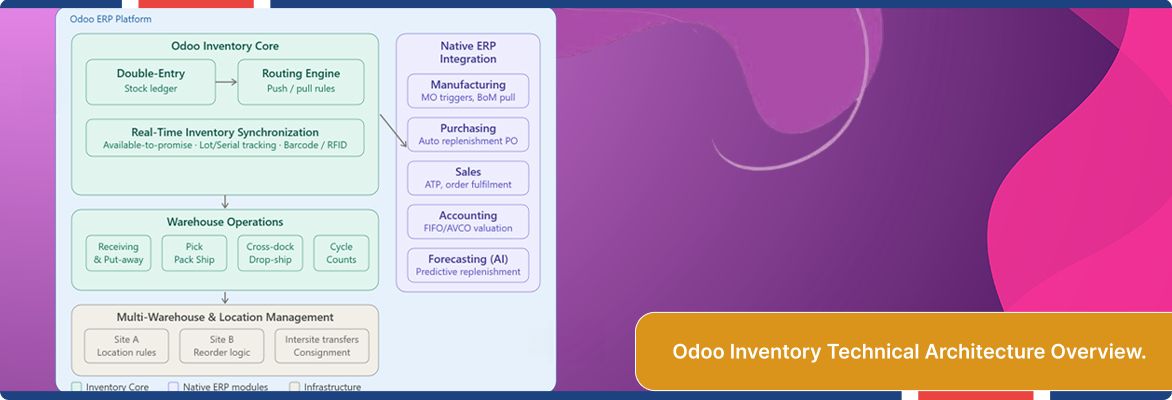
The engine underneath Odoo inventory management system is a double-entry stock system – an idea borrowed directly from double-entry accounting – where every inventory move is a transaction between two locations. Nothing disappears into a void. Every unit has a source and a destination, and the ledger is always balanced.
This matters operationally because it makes discrepancy tracing exact. When a unit is lost, the system can trace its last recorded location without running a manual audit. When a return arrives, it re-enters the location hierarchy cleanly rather than landing in a catch-all adjustment account.
Push and Pull Rules
Odoo’s routing engine runs on configurable push and pull rules. Pull rules trigger movement when demand is created – a sales order pulls product from a bin, which triggers a pick from a storage zone, which can trigger a replenishment order from a supplier. Push rules fire on receipt – goods arriving at receiving dock get automatically routed to a staging zone, QC area, or bin based on pre-defined logic.
Odoo 18 multi warehouse management refined this system significantly, tightening stock flow management and improving how push/pull rules interact across multi-step routes. The result is a warehouse that can handle cross-docking, drop-shipping, and three-step pick-pack-ship workflows without custom code.
Real-Time Inventory Synchronization
Every transaction – receipt, issue, transfer, return, adjustment – updates stock levels immediately in Odoo inventory management system. Available-to-promise calculations reflect current reality, not last night’s batch run. This is not a minor technical detail. In a manufacturing environment where a production order can consume 200 units in a single shift, a four-hour lag in inventory visibility is the difference between a filled order and an apologetic phone call.
Odoo Inventory Management System: A Warehouse Powerhouse
Odoo Multi-Warehouse Management
Odoo inventory real time tracking manages stock across warehouses, retail locations, consignment positions, and in-transit inventory within a single platform. Location-specific reorder rules allow each site to operate with its own replenishment logic while consolidated dashboards give operations managers a unified view. Intersite transfer workflows handle the mechanics automatically – no manual journal entries, no spreadsheet reconciliation.
Odoo Barcode Scanning and RFID Integration
Native support for 1D and 2D barcodes, plus RFID reading, eliminates manual data entry at every touchpoint – receiving, put-away, picking, packing, counting, and shipping. Odoo 18 introduced Multi-Scan and Barcode Lookup, allowing warehouse staff to scan multiple items in a single session rather than item by item. According to ERP Research, this class of automation typically accelerates warehouse throughput by 20-40%.
Odoo Lot and Serial Number Tracking
Full forward and backward traceability by lot or serial number runs through every stage: receiving, production, storage, and shipment. For regulated industries – food, pharma, medical devices – this isn’t a nice-to-have. It’s the difference between passing an audit and failing one. Odoo supply chain integration’s traceability reports surface the full chain of custody in seconds, not hours.
Odoo Predictive Replenishment and Demand Forecasting
The expected Odoo 20 release signals a significant deepening here: predictive replenishment that analyzes sales velocity, supplier lead times, and seasonal demand patterns to generate purchase orders before stockouts occur – not after. This is a qualitative shift from the reorder-point rules most platforms offer. Current Odoo inventory management system already supports demand-driven safety stock optimization, slow-moving stock identification, and inventory turn analysis. Odoo 20 is expected to take this from rule-based to ML-driven.
Odoo Supply Chain Integration Across the Module Stack
Because Odoo inventory management system is a native module inside the Odoo ERP stack integration with Manufacturing, Purchasing, Sales, and Accounting is structural, not built via API. A confirmed sales order pulls from available stock, triggers a production order if stock is insufficient, fires a purchase request if raw materials are short, and posts the valuation to accounting – automatically, without middleware. This is the operational advantage of Odoo predictive replenishment that point-solution inventory tools cannot replicate.
Odoo Inventory Stock Valuation Methods
Odoo supports FIFO, AVCO (average cost), and standard price valuation out of the box, with automatic journal entries generated at every stock movement when the perpetual valuation method is enabled. Finance teams get real-time COGS without a month-end reconciliation ritual. For companies carrying significant inventory value, this alone justifies a serious look at the platform.
What Determines Odoo Inventory Management System’s Implementation Success
After delivering Odoo Development Services across manufacturing, retail, healthcare, and logistics clients, the pattern is consistent: companies that treat Odoo as a technology project fail. Companies that treat it as a business transformation initiative succeed.
The non-obvious truth about open-source Odoo ERP inventory module integration is that its competitive advantage isn’t the feature list. It’s the data architecture. When inventory, purchasing, sales, and finance share the same database schema, reporting is real, reconciliation is automatic, and the decisions managers make are based on numbers that reflect what actually happened, not what a sync job transmitted six hours ago.
In one manufacturing client engagement, a correctly architected Odoo inventory management system deployment delivered a 40% reduction in manual procurement tasks within the first six months. A retail client saw a 30% reduction in stockouts and a 25% improvement in customer satisfaction scores in the first quarter post-launch. These outcomes weren’t accidental – they were the result of phased go-live milestones, executive sponsorship, and documented process maps before a single module was configured.
The implementation decisions for Odoo inventory management system that matter most aren’t which features to turn on. They’re which business processes to redesign before going live.
Practical Boundaries of Odoo Inventory Management System Integration
Odoo Inventory is not the right answer for every situation, and an honest evaluation requires naming the gaps.
For very large-scale warehouse operations – think distribution centers processing tens of thousands of lines per day – Odoo’s WMS capabilities, while strong for mid-market, may hit ceiling constraints around advanced slotting optimization and labor management that purpose-built WMS platforms like Manhattan or Blue Yonder address at enterprise scale.
The Community edition, while free, removes several advanced inventory features including batch picking, multi-step routes, and valuation reporting. Organizations that need these capabilities require the Enterprise license, which changes the total Odoo inventory implementation cost of ownership calculation significantly.
Implementation complexity of Odoo inventory management system is real. Push/pull routing rules are powerful and correspondingly difficult to configure correctly. A misconfigured reorder rule on a high-velocity SKU can trigger unnecessary purchasing that takes weeks to unwind. The margin for configuration error is lower than most ERP projects teams expect.
Over 30% of enterprises have reported cybersecurity-related disruptions in their inventory systems, according to Global Growth Insights. Odoo’s cloud deployment mitigates some of this through Odoo’s managed infrastructure, but on-premise deployments carry the same security obligations as any ERP system.
People Also Ask:
What is Odoo Inventory used for? Odoo inventory management system is a warehouse and stock management module within the Odoo ERP inventory module. It manages receiving, storage, picking, shipping, and replenishment across single or multiple warehouse locations.
How does Odoo Inventory management compare to SAP? Odoo offers significantly lower total cost of ownership and faster implementation timelines than SAP for mid-market businesses. In SAP vs Odoo Inventory, SAP holds advantages in ultra-large enterprise complexity and global compliance coverage.
What is the cost of Odoo Inventory implementation? Odoo pricing starts at $24.90 per user per month. Total implementation costs, including configuration and support, typically fall between $10,000 and $80,000 depending on scope and customization requirements.
Does Odoo Inventory support barcode scanning? Yes. Odoo inventory management system supports 1D and 2D barcode scanning and RFID reading natively, with no third-party middleware required. Odoo 18 introduced multi-scan capability for higher-throughput warehouse environments.
How long does an Odoo Inventory implementation take? A standard Odoo Inventory deployment typically takes 8 to 16 weeks from kickoff to go-live. Complex multi-warehouse environments with advanced routing rules can extend to 6 months.
Does Odoo Inventory support lot and serial number tracking?Yes. Odoo Inventory provides full lot and serial number traceability from receiving through production to shipment. Traceability reports surface complete chain-of-custody data for compliance audits.
What makes Odoo Inventory different from standalone WMS solutions? Odoo inventory management system shares a native database with Manufacturing, Sales, Purchasing, and Accounting modules. This eliminates the API synchronization gaps that cause data lag and reconciliation failures in standalone WMS platforms.
Ready to See What Odoo Inventory Integration Delivers in Your Environment?
Odoo Inventory is not a product you configure in an afternoon. Done right, it becomes the operational backbone your warehouse has never had – real-time stock visibility, intelligent replenishment, and end-to-end traceability that doesn’t require a team of analysts to interpret.
Flexsin has delivered Odoo Inventory implementations for industrial manufacturers, healthcare distributors, retail chains, and logistics operators. Our implementation methodology is built around one non-negotiable: business process redesign before system configuration.
Talk to a Flexsin Odoo architect. Get a scoped assessment of your current inventory gaps and a phased deployment plan built around your operations – not a vendor template.
Key Questions Answered:
1. Can Odoo Inventory handle drop-shipping and cross-docking? Yes. Both workflows are supported through Odoo’s routing rule engine. Drop-shipping routes purchase orders directly to customers without passing through your warehouse. Cross-docking routes incoming shipments to outbound carriers with minimal storage time, and both workflows are configurable without custom development.
2: What inventory valuation methods does Odoo support? Odoo Inventory supports First In First Out (FIFO), average cost (AVCO), and standard price valuation methods. Perpetual valuation generates automatic accounting entries at every stock movement, eliminating manual month-end reconciliation for most mid-market operations.
3. Is the Odoo Community edition sufficient for warehouse management? For very basic single-location inventory tracking, Community is functional. For multi-step routing, batch picking, advanced reporting, and perpetual valuation, Enterprise edition is required. Most mid-market warehouse operations need Enterprise capabilities.
4. How does Odoo Inventory integrate with third-party shipping carriers? Odoo inventory management system supports direct carrier integration for rate shopping, label generation, and shipment tracking through its carrier connector framework. Supported carriers include FedEx, UPS, DHL, and others via Odoo’s shipping module, with additional carriers accessible through third-party add-ons.
5. What are Odoo Inventory’s AI capabilities currently and on the roadmap?Current Odoo inventory management system uses algorithmic demand planning for safety stock optimization and slow-mover identification. The Odoo 20 roadmap, based on signals from Odoo Partner Days 2026, includes predictive replenishment driven by ML models that incorporate sales velocity, supplier lead time variance, and seasonal patterns.
6. Can Odoo Inventory manage consignment stock? Yes. Odoo warehouse management features support consignment inventory tracking for stock owned by suppliers but stored in your facility. Ownership is tracked separately from physical location, and the system can handle consignment receipts, consumption, and
7. What does Odoo Inventory cost compared to standalone WMS platforms? Odoo inventory management software is licensed at $24.90 per user per month for the Enterprise edition. Purpose-built WMS platforms typically start at $500 to $1,500 per user per month for equivalent capabilities, with additional integration costs for ERP connectivity. For mid-market operations, Odoo’s total cost of ownership is meaningfully lower.
