

 +1.844.3539.746
 info@flexsin.com
Your Stack Has 1,000 Apps. Only 28% Are Talking – The CRM Integration Solution.
 Mahendra Singh Panwar
Let's talk
Table of Contents:
- CRM Integration Has Evolved. Has Your Understanding Kept Up?
- 5 CRM Integration Types That Eliminate Data Silos
- API-Led CRM Integration: The Foundation for Connected Enterprises
- CRM Integration Best Practices Before You Build
- People Also Ask
- Work With Flexsin to Build Integrations That Last
- Frequently Asked Questions: CRM Integration
The average enterprise runs nearly 1,000 separate applications – and most of them have never exchanged a single byte of data with each other. That is not a technology problem. It is a CRM integration problem, and it is quietly bleeding your revenue.
This matters because your CRM is the closest thing your company has to a nerve center. It logs every sales interaction, every support ticket, every marketing touchpoint. But none of that intelligence means anything if your ERP runs in isolation, your billing system is on its own island, and your sales reps are copy-pasting data between tabs every morning. That is where CRM integration becomes not just useful, but operationally urgent.
CRM Integration Has Evolved. Has Your Understanding Kept Up?
CRM integration is the process of connecting your third-party applications – legacy systems, cloud tools, on-premise databases – to your CRM so data flows automatically and without human intervention. That is the textbook answer. However, most organizations treat CRM integration challenges as a one-time IT project, not a living architecture. That mindset is exactly what creates data silos.
Over 60% of enterprises still operate with fragmented data environments where poor interoperability slows growth and degrades decision-making, according to Avasant’s Cloud CRM Suites RadarView research. And according to MuleSoft’s Connectivity Benchmark Report, businesses have integrated only 28% of their applications on average. The result: 80% of IT leaders report that data silos are actively blocking their digital transformation efforts.
CRM integration service fixes this at the root. When done right, it makes your CRM the authoritative record across sales, service, marketing, commerce, and finance – not just a place where one department stores contact notes.
5 CRM Integration Types That Eliminate Data Silos
Not all CRM integration strategies carry equal weight. Here are the five that consistently deliver measurable outcomes:
1. CRM Marketing Integration
When your CRM shares data with marketing automation software, every campaign interaction – email opens, form fills, web behavior – flows directly into the contact record. That means your marketing team segments audiences on real-time behavioral signals, not stale lists. Personalized campaigns built on CRM insights can boost conversion rates by 80%, according to AnswerIQ (2025).
2. Sales CRM Integration
Sales CRM integration pulls buyer intent signals – web interactions, campaign engagement, social activity – directly into the CRM, surfacing the hottest leads automatically. Businesses using generative AI in an integrated CRM are 83% more likely to exceed their sales goals, per CRM.org (2026, citing multiple analyst sources).
3. ERP CRM Integration
This is the CRM software integration most organizations delay the longest – and it delivers the sharpest ROI when they finally do it. Connecting your ERP with your CRM gives sales reps real-time inventory visibility, triggers billing workflows automatically, and eliminates the manual handoffs that quietly absorb hours every week. OECD research links ERP CRM integration to a 23% improvement in customer retention for SMEs.
4. Service CRM Integration
A connected service desk gives every support rep the complete customer history – not just the open ticket, but the purchase record, the renewal date, and every prior interaction across every channel. Integrated data also enables AI agents to resolve tier-1 inquiries autonomously. Salesforce reports that its Agentforce resolves over 70% of routine inquiries without human handoff.
5. Collaboration and Commerce CRM Integration
CRM integrating tools like Slack with your CRM keeps cross-functional communication anchored to the deal or case record – not buried in an email thread. On the commerce side, connected inventory and order management data triggers back-in-stock alerts, powers personalized product recommendations, and automates service case creation when fulfillment issues arise.
API-Led CRM Integration: The Foundation for Connected Enterprises
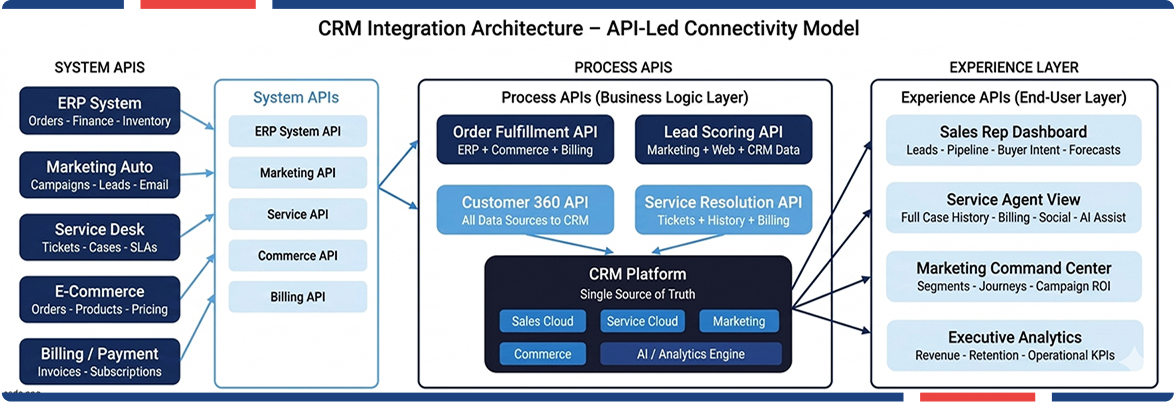
Writing point-to-point code to force two systems to talk is the fastest way to create a fragile integration that breaks every time either system releases an update. The smarter CRM API integration strategy works in three layers:
System APIs: Extract data from specific systems – your ERP, billing platform, or payment processor. Each system gets one clean API that owns the data extraction logic.
Process APIs: Combine system APIs for a business purpose. A delivery update, for example, might draw from a logistics system API and an internal fulfillment API simultaneously.
Experience APIs: Expose assembled data to end users or customer-facing interfaces. A service rep sees the full customer picture – sales history, marketing touchpoints, billing disputes – because experience APIs stitch it all together in real time.
This three-tier model protects your IT investments. When one system changes, only the relevant system API needs updating – not every downstream integration that touches it. That is the difference between an integration that ages well and one that creates emergency tickets every quarter.
CRM Integration Best Practices Before You Build
-
- Map data ownership first. Know which system is the authoritative source for each data type before you design the sync logic. Conflicts at this level cause the failures that show up six months into production.
-
- Prioritize bidirectional sync. Read-only integrations create second-class systems. Real-time bidirectional data flow is what turns CRM integration into a genuine CRM single source of truth.
-
- Design for change. Your stack will evolve. Build integrations that accommodate new applications without requiring a rearchitecture. An integration platform with a library of prebuilt connectors is far more durable than custom-coded point solutions.
- Govern the data. Integration amplifies both good data and bad data. A data governance policy – covering validation rules, deduplication logic, and access controls – is not optional; it is the foundation that everything else sits on.
People Also Ask:
What is CRM integration in simple terms?CRM integration connects your CRM platform to other business applications so data syncs automatically. It eliminates manual data entry and gives every team access to the same accurate customer information.
What are the main benefits of CRM integration?The primary CRM integration benefits include improved CRM data integration accuracy, better team collaboration, and faster sales cycles. Integrated CRM systems also enable AI-driven insights that disconnected platforms simply cannot produce.
How does API-led CRM integration differ from point-to-point integration?API-led CRM integration uses a structured three-tier architecture – system, process, and experience APIs – that is built to scale and survive system updates. Point-to-point integration creates brittle, hard-to-maintain code that breaks whenever either connected system changes.
What is the typical cost of CRM integration?CRM integration costs vary based on the number of systems, complexity of data flows, and whether you use prebuilt connectors or custom development. Despite the upfront investment, integrated CRM delivers an average ROI of $8.71 per dollar spent according to Nucleus Research.
How long does a CRM integration project take?Simple integrations using prebuilt connectors can be completed in days. Complex, multi-system ERP CRM integration projects typically run four to twelve weeks, depending on data mapping complexity and change management requirements.
Work With Flexsin to Build Integrations That Last
Disconnected systems are a strategic liability. Flexsin‘s Salesforce CRM integration consulting practice has helped more than 500 global businesses design and deploy CRM integration architectures that unify their technology stack, eliminate data silos, and unlock the AI capabilities their platforms were built to deliver.
Whether you are connecting Salesforce with your ERP, building API-led integration across a multi-cloud environment, or migrating data from a legacy CRM, Flexsin brings the certified expertise and the delivery discipline to make it work the first time.
Explore Flexsin’s Salesforce Development and CRM Integration Services:
Your integration architecture is either a competitive advantage or a hidden cost center. Flexsin makes it the former.
Frequently Asked Questions: CRM Integration
1. Can a small business benefit from CRM integration? Absolutely – in fact, OECD research shows that SMEs with integrated CRM systems improve customer retention by 23% compared to those running disconnected platforms. Integration scales down as effectively as it scales up, and the operational efficiency gains hit proportionally harder for smaller teams managing limited resources.
2. What is the difference between CRM integration and CRM implementation?CRM implementation is the process of deploying and configuring your CRM platform for the first time. CRM integration is the ongoing work of connecting that CRM to the rest of your technology stack – it begins after implementation and evolves as your application environment changes.
3. Do I need custom development for CRM integration?Not always. Modern customer data integration platforms offer libraries of prebuilt connectors for the most common business applications – ERP, marketing automation CRM, e-commerce, billing, and more. Custom development becomes necessary when a proprietary system has no prebuilt connector or when your data flows require logic that out-of-the-box tools cannot handle.
4. How does CRM integration affect data security? Properly architected CRM integration actually improves data security by centralizing access controls and reducing the number of manual data transfer points – which are the most common entry points for data breaches. API-led CRM integration platforms include built-in authentication, encryption in transit, and permission-based access governance.
