

 +1.844.3539.746
 info@flexsin.com
Your Margins Are Under Pressure – Agentic AI in Retail Offers a Smarter Response
 Munesh Singh
Let's talk
Table of Contents:
- Why Retail Innovation Outpaces ERP-Centric Thinking
- How Agentic AI Actually Works in a Retail Stack
- Three Lines of Business. Real Economics.
- Flexsin’s Take on Agentic AI in Retail Transformation
- Challenges and Considerations
- People Also Ask
- Ready to Move from Pilot to Production
- Frequently Asked Questions
Most retail AI investments of the last decade were sophisticated research tools disguised as productivity plays. They analyzed. They recommended. They produced dashboards that required a human to interpret, decide, and then manually execute. That hand-off – from insight to action – is exactly where margin was leaking.
Agentic AI in retail eliminates that hand-off. These systems don’t surface a recommendation and wait. They execute autonomously across multi-step workflows, monitor outcomes, detect anomalies, and adjust course – all without requiring a human to push a button at every junction. That is a structurally different capability, and the economics reflect it.
The directive from C-suites is no longer “explore AI.” It is “prove the number and scale it.” Forrester’s recent Total Economic Impact study of Microsoft AI solutions for retail and consumer goods organizations projects 124% to 282% ROI over three years, with $7.7 million to $17.6 million in net present value for a composite $5 billion enterprise. That is not an aspiration – that is auditable P&L impact.
Why Retail Innovation Outpaces ERP-Centric Thinking
The failure mode most retail technology leaders have lived through looks like this: a capable ERP system is deployed, AI agent workflows retail are configured, and then a separate analytics layer is bolted on to extract meaning from the data it generates. Generative AI consumer goods applications followed the same architectural pattern – intelligence sits above the transactional layer, never inside it.
Agentic commerce platforms break this model. Rather than querying the ERP for data to analyze offline, AI agents are now embedded as operating entities within the transactional environment itself. They read catalog state, pricing rules, inventory positions, and fulfillment constraints – and they act on that state in real time.
This distinction matters practically. An ERP with AI dashboards tells your planning team what is wrong with demand by Thursday morning. An agentic retail stack detects the anomaly Monday night, queries the constraint set, selects the optimal response, and executes the allocation adjustment before the Tuesday replenishment cycle runs.
How Agentic AI Actually Works in a Retail Stack
The architecture behind agentic AI in retail is less exotic than the term implies, and more consequential than most implementation briefs acknowledge.
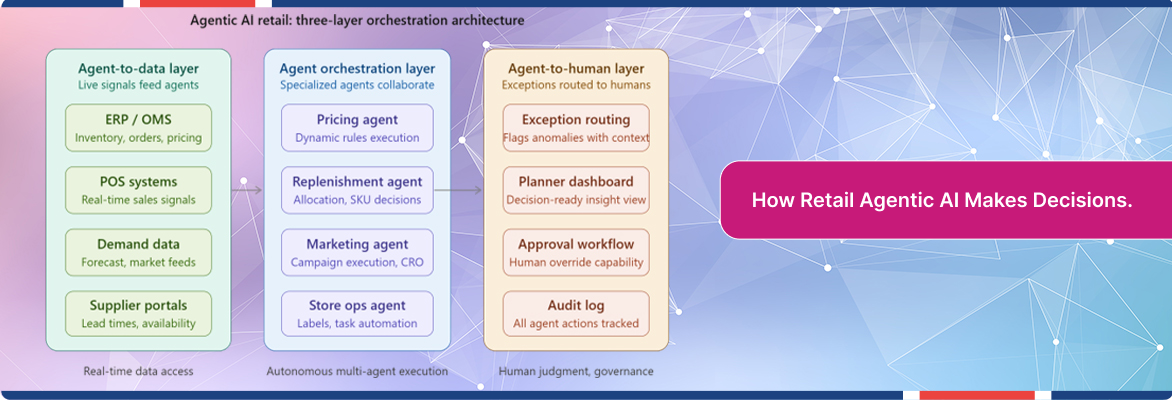
At its core, an agentic system combines three components that traditional automation tools keep separate: a reasoning engine that interprets context and determines the appropriate next action, a memory layer that preserves state across workflow steps, and a tool-execution interface that connects to real systems – ERPs, order management platforms, marketing clouds, and point-of-sale environments.
What makes this architecture different from a rules engine or an RPA bot is the reasoning capability. Rule-based automation breaks when conditions fall outside a predefined parameter. Agentic systems apply contextual judgment to novel situations, which means they can handle the exception-handling tasks that previously required a human analyst.
Agent-to-data connections allow autonomous agents to pull live signals from POS systems, supplier portals, and third-party demand data. Agent-to-agent orchestration enables specialized agents – one for pricing, one for replenishment, one for promotion execution – to collaborate on decisions that cross functional boundaries. The human is not removed from the system. The human is freed from the system’s lowest-value tasks.
Three Lines of Business. Real Economics.
The Forrester TEI study commissioned by Microsoft isolates where verified financial impact is showing up across retail and consumer goods organizations. Three functions carry the majority of the return.
Marketing: From Campaign Operators to Revenue Architects
AI shopping assistants embedded in digital commerce properties delivered up to a 4% improvement in conversion rate for the composite organization studied, generating $1.5 million to $3.4 million in incremental digital revenue over three years. Cart abandonment declined. Average order value improved.
The 2026 Microsoft Work Trend Index frames this shift clearly: 66% of AI users report spending more time on high-value work, and 58% say they are producing output that would not have been possible the previous year. That is not marketing efficiency. That is marketing capability expansion.
Supply Chain: Margin Protection at Forecast Speed
AI demand forecasting retail applications are where supply chain economics become tangible. The Forrester TEI data shows $3 million to $6.3 million in three-year benefits driven by improved forecast accuracy, sharper buy decisions, and earlier detection of demand shifts. One consumer goods leader cited a 10-point improvement in forecast accuracy against traditional statistical models.
AI inventory optimization retail tools for retail AI are also reshaping planning headcount economics. Routine tasks – data reconciliation, SKU-store allocation, replenishment modeling – that previously consumed 6 to 12 hours per planner per month are now handled autonomously.
Store Operations: Where Labor Hours Become Customer Hours
Retail frontline automation AI is delivering a return type that finance teams find easy to model: hours eliminated from low-value tasks and redeployed to customer-facing activity. Retail digital shelf label systems are the clearest illustration. By eliminating manual price changes, they recover an estimated 200 labor hours per store per year.
Agentic AI store operations productivity improvements are, functionally, a people strategy delivered through a technology platform. That reframing – from automation project to workforce quality initiative – is the most underutilized argument in retail AI business cases.
Flexsin’s Take on Agentic AI in Retail Transformation
The organizations Flexsin works with are not short on AI enthusiasm. They are short on AI architecture that survives contact with real operational complexity – messy data models, fragmented system landscapes, and business processes that evolved over decades without integration in mind.
The critical success factor for agentic AI in retail is not the model selection or the compute layer. It is the data foundation and the tool-execution interface. An agent operating on stale inventory positions will optimize the wrong problem. An agent without read-write access to the ERP is a recommendation engine in disguise.
Flexsin’s work in enterprise AI retail transformation focuses specifically on the integration layer – mapping agent action surfaces to live transactional systems, establishing governance controls around autonomous execution, and building the exception-routing workflows that preserve human judgment where it genuinely adds value.
Challenges and Considerations:
Agentic AI in retail carries real deployment risk that the ROI projections do not eliminate. Organizations entering production deployments should understand where the failure modes concentrate.
Data quality is the binding constraint: Autonomous AI agents retail systems execute at machine speed against the data they are given. Garbage data at input produces wrong decisions at output – but unlike a human analyst who might flag a suspicious number, an agent will execute on it. Data governance must precede agent deployment, not follow it.
Governance gaps are widespread: Only 21% of organizations currently have a mature governance model for autonomous AI agents, per recent research. Defining escalation thresholds, maintaining human override capability, and auditing agent decision logs are not optional practices – they are operational requirements for production deployments.
Integration debt will surface: Agentic systems need read-write access to live systems. Retailers with fragmented system landscapes, legacy ERP versions, or proprietary data formats will face integration costs that are not reflected in standard ROI projections. Budget accordingly.
People Also Ask:
What is agentic AI in retail and how is it different from standard AI? Agentic AI executes multi-step workflows autonomously across live systems rather than generating recommendations for humans to act on. Standard retail AI tools analyze and surface insights; agentic systems decide and execute.
What ROI can retailers realistically expect from agentic AI? Forrester’s TEI study projects 124% to 282% ROI over three years for a composite $5 billion retail enterprise. Returns concentrate in marketing productivity, AI retail supply chain disruption forecast accuracy, and frontline labor redeployment.
How does agentic AI in retail compare to traditional ERP automation? Traditional ERP automation follows predefined rules and breaks on exceptions. Agentic AI applies contextual reasoning to novel situations, enabling it to handle the exception-handling tasks that previously required human judgment.
What does agentic AI for retail implementation typically take to deploy? Costs vary significantly based on integration complexity, data readiness, and deployment scope. Most enterprise AI retail deployments involve a 6-to-12 month phased implementation.
Which retail functions deliver the fastest ROI from agentic AI deployments? Multi-agent AI supply chain demand forecasting and AI store operations frontline automation typically yield the fastest measurable returns.
What are the biggest risks of deploying autonomous AI agents in retail? Data quality gaps, immature governance models, and inadequate integration with live transactional systems are the leading failure vectors.
Ready to Move from Pilot to Production?
Most retail organizations have run the AI pilots. The question now is which ones will convert that experimentation into durable, compounding operational advantage – and which ones will keep restarting the cycle.
Flexsin’s AI and digital transformation practice works with retail and consumer goods organizations to design and deploy agentic AI architectures that are built to survive integration complexity and scale beyond the pilot phase. From data foundation work through agent deployment and operating model redesign, Flexsin brings the engineering depth and retail domain expertise that bridge the gap between ROI projections and actual P&L impact.
Explore Flexsin’s AI development and retail transformation capabilities and connect with a specialist to scope what a production-grade agentic AI deployment looks like for your organization. The economics are proven. The implementation window is now. Flexsin AI retail implementation partner builds what survives the real world.
Frequently Asked Questions:
1. Does agentic AI require replacing our existing ERP system? No. Agentic AI systems are designed to integrate with existing ERP platforms via API and tool-execution interfaces. The integration complexity depends on your ERP version and data model, not on replacing core systems.
2. What data infrastructure do we need before deploying autonomous retail agents? At minimum, you need a clean, real-time feed from your inventory management system, your demand signal sources, and your transactional data layer. Historical data quality directly determines agent decision quality in production.
3. How do we maintain human oversight of agentic AI decisions in retail operations?Production deployments use exception-based escalation frameworks: the agent executes within defined parameters and routes decisions outside those parameters to the appropriate human decision-maker with context already assembled.
4. Which agentic AI retail use cases are best suited for a first deployment? Supply chain exception-based planning and digital shelf label automation typically offer the cleanest first deployment surfaces – well-defined data inputs, measurable outputs, and contained blast radius if an agent makes a suboptimal decision.
5. How does Flexsin approach agentic AI implementation for retail clients? Flexsin begins with a data readiness and integration architecture assessment before any agent deployment work. Implementation follows a phased model: data foundation, agent configuration and testing in sandboxed environments, and then scaled rollout with operating model redesign support.
