

 +1.844.3539.746
 info@flexsin.com
Your ERP Can’t Think. Your Procurement Process Needs One That Can.
 Sudhir K Srivastava
Let's talk
Table of Contents:
- Why Traditional Source-to-Pay Automation Has Hit Its Ceiling
- How Agentic ERP Source-to-Pay Works Inside Dynamics 365
- Closing the Gaps Standard ERP Leaves Open
- What an Agentic ERP Source-to-Pay Implementation Requires
- People Also Ask
- Transform Your Source-to-Pay Operations with Flexsin
- Frequently Asked Questions
Most procurement teams are one supplier delay away from a production stoppage – and their ERP has no idea it’s coming. That is the real problem no dashboard or workflow tool has solved: not the volume of transactions, but the gap between what the data knows and what the team can act on before the impact lands.
The concept of agentic ERP source-to-pay automation is changing that equation. Rather than passively recording what happened, AI agents embedded inside ERP systems can now monitor conditions, reason over supplier signals, and take coordinated action across the entire source-to-pay lifecycle – while keeping procurement automation teams squarely in control.
The numbers are beginning to reflect this shift towards AI procurement agents. According to Gartner, supply chain management software with agentic AI capabilities will grow from under $2 billion in spend in recent years to $53 billion by 2030 – with 60% of enterprises expected to adopt agentic AI features within that window, up from just 5% currently. (Source: Gartner, April 2026).
Why Traditional Source-to-Pay Automation Has Hit Its Ceiling
Traditional ERP automation was built on a simple premise: if condition X, execute workflow Y. That logic works beautifully when your AI supplier evaluation ERP ecosystem is stable, your lead times are predictable, and your contract terms stay put. None of those things are reliably true anymore.
What is pushing them there is not a technology trend for enterprise procurement transformation – it is the recognition that procurement functions currently use less than 20% of the available data to support decisions, according to McKinsey research. The rest sits in email threads, supplier portals, PDF confirmations, and disconnected systems.
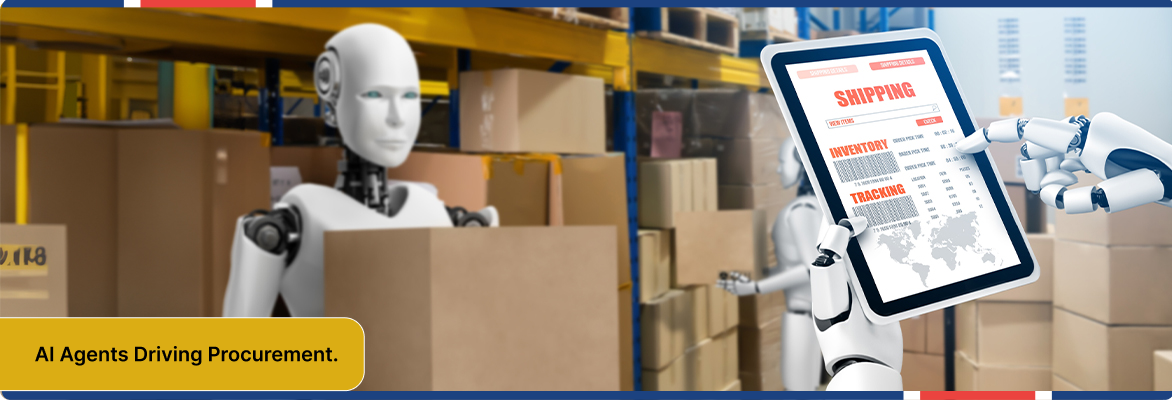
This is where the difference between task automation and agentic AI procurement agents becomes operational. Task automation executes predefined rules. Agentic AI perceives context, plans intelligent procurement automation, acts autonomously, and learns continuously.
How Agentic ERP Source-to-Pay Works Inside Dynamics 365
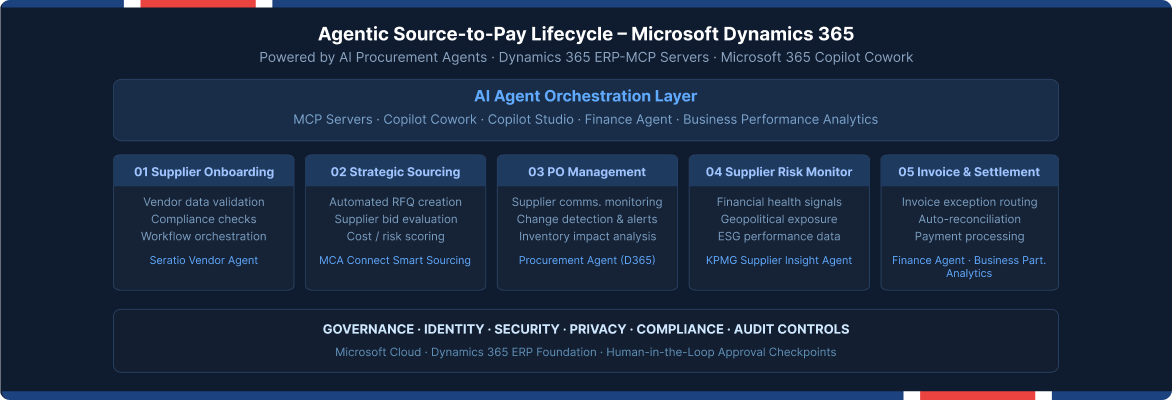
Microsoft Dynamics 365 Supply Chain Management delivers agentic ERP source-to-pay automation capabilities through a combination of the Procurement Agent, Dynamics 365 ERP Model Context Protocol (MCP) servers, and Microsoft 365 Copilot Cowork. Each layer serves a distinct function.
The Procurement Agent: Handling the Volume That Drains Teams
Now in public preview within Dynamics 365 Supply Chain Management, the Procurement Agent monitors supplier communications at scale, detects changes in purchase order confirmations, flags delivery shifts, and provides real-time impact analysis across inventory levels, production schedules, and customer commitments.
Farmlands Cooperative, New Zealand’s largest farmer-owned rural supplier, deployed this capability after consolidating seven ERP systems onto Dynamics 365. The Procurement Agent now automates half of their purchase order email traffic and is on track to save the team approximately 20 hours per week.
Copilot Cowork and MCP Servers: Bringing ERP Intelligence to Where Work Happens
The Dynamics 365 ERP MCP servers provide a standardized, secure interface through which AI agents can access live ERP data without requiring users to navigate ERP screens. When a procurement manager evaluates a supplier bid inside Microsoft 365 Copilot Cowork procurement, they can pull ERP data, compare vendor performance history, analyze tradeoffs from supplier emails, and execute the award process.
Finance Agent and Business Performance Analytics: Connecting Sourcing to P&L Outcomes
Every sourcing decision for AI procurement agents carries financial consequences that ripple into margins, cash flow, and working capital. The Finance Agent in Microsoft 365 Copilot, built on Business Performance Analytics in Dynamics 365, allows leaders to interrogate those consequences using natural language.
Closing the Gaps Standard ERP Leaves Open
No platform covers every procurement edge case, and Dynamics 365’s agent-ready architecture was designed with that reality in mind. The Microsoft partner ecosystem has built specialized agents that plug into the same MCP server foundation – Sonata’s Vendor Onboarding Agent, MCA Connect’s Smart Sourcing Agent, and KPMG’s Supplier Insight Agent each address high-friction scenarios.
Beyond partner agents, Copilot Studio allows organizations to build custom agents for unique workflows: specialized approval structures, industry-specific compliance requirements, or supplier ecosystems that operate outside standard procurement taxonomies.
What an Agentic ERP Source-to-Pay Implementation Requires
Three conditions separate fast-scaling deployments from stalled pilots:
- Data architecture first: Agentic AI implementation is only as reliable as the underlying ERP AI agents supply chain data model. Fragmented supplier master data, inconsistent purchase category hierarchies, and disconnected invoice records produce poor recommendations, not good ones.
- Defined human-in-the-loop checkpoints: Agentic systems work best when governance guardrails specify which decisions agents can execute autonomously and which require human approval before action.
- Starting with high-volume, high-friction Dynamics 365 procurement workflows: Supplier email management and invoice exception routing produce the fastest measurable ROI in agentic source-to-pay deployments.
People Also Ask:
What is agentic ERP source-to-pay?Agentic ERP source-to-pay automation is the use of procurement AI agents Dynamics 365 embedded inside ERP platforms – such as Dynamics 365 Supply Chain Management – to autonomously monitor, analyze, and act across procurement workflows from supplier sourcing through invoice settlement.
How does the Procurement Agent in Dynamics 365 reduce manual work?The Procurement Agent in Dynamics 365 Supply Chain Management monitors incoming supplier communications, detects purchase order changes, and generates impact analysis across inventory and production schedules.
What is an MCP server in the context of agentic ERP?An MCP (Model Context Protocol) server in Dynamics 365 provides AI agents with a standardized, secure interface to access live ERP data, business processes, and financial records.
How does agentic AI in procurement reduce costs?Organizations using AI procurement agents have reported up to 45% reduction, across source-to-pay workflows, according to Automation Anywhere research. Savings come from faster cycle times, fewer invoice exceptions, reduced maverick spend, and earlier supplier risk monitoring AI and intervention.
Transform Your Source-to-Pay Operations with Flexsin
Flexsin is a Microsoft Solutions Partner with certified expertise in Dynamics 365 Supply Chain Management, Copilot, and AI agent implementation across manufacturing, logistics, and enterprise procurement environments. Our engagements are designed to move your source-to-pay automation from reactive transaction processing to proactive, agent-led operations – with governance controls and human-in-the-loop checkpoints built in from day one.
Flexsin’s Dynamics 365 consultants are ready to scope your agentic ERP implementation – starting with the workflows that deliver measurable ROI fastest.
Frequently Asked Questions:
1. Is agentic ERP the same as regular ERP automation?No. Traditional ERP automation executes predefined rules when specific conditions are met. Agentic ERP uses AI agents that can perceive real-time context, reason over multiple data sources, plan multi-step actions, and learn from outcomes.
2. Does Dynamics 365 Supply Chain Management support agent customization without replacing existing configurations? Yes. Microsoft’s open platform provides over 5,000 developer extensibility points that allow organizations to add custom agents built in Copilot Studio without replacing existing Dynamics 365 configurations.
3. What data does the Procurement Agent in Dynamics 365 access to generate impact analysis?The Procurement Agent accesses live ERP data via Dynamics 365 ERP MCP servers, including purchase orders, inventory levels, production schedules, and customer order commitments. AI procurement agents correlate supplier communication signals against this data.
4. How does governance work when AI agents take actions inside Dynamics 365?All agents deployed through Microsoft’s agent-ready ERP architecture operate under the same identity, security, privacy, and compliance controls as the Dynamics 365 environment. Organizations configure human-in-the-loop approval thresholds that define which actions agents execute autonomously.
