

 +1.844.3539.746
 info@flexsin.com
Your Energy Network Sees the Risk. Can Your Software Act on It?
 Munesh Singh
Table of Contents:
- The Real Bottleneck Isn't Data - It's Decision Latency
- Where AI in Energy and Utilities Is Already Paying Off
- Storage and Dispatch Add a New Layer of Precision
- Why Utilities Are Moving Faster on Grid Intelligence
- What Slows Deployment Down
- The Change Redefining Energy Operations
- Frequently Asked Questions
- When Every Second Matters, Can Your Systems Keep Up?
- People Also Ask
Let's talk
A compressor never fails without warning – it just warns in a frequency band nobody happens to be watching. That is the uncomfortable truth sitting underneath most unplanned downtime across oil, gas, and utility operations today. Sensors already capture the signal. Humans just cannot process it fast enough. This is where AI in energy and utilities stops being a slide in an innovation deck and starts being the difference between a scheduled shutdown and an emergency one.
The Real Bottleneck Isn’t Data - It’s Decision Latency
Upstream, midstream, and downstream operators have spent the past decade wiring plants with sensors. Vibration monitors, thermal cameras, SCADA historians – the data is there. What’s missing for SCADA data integration is the layer that turns a spike in bearing temperature into a work order before the bearing seizes.
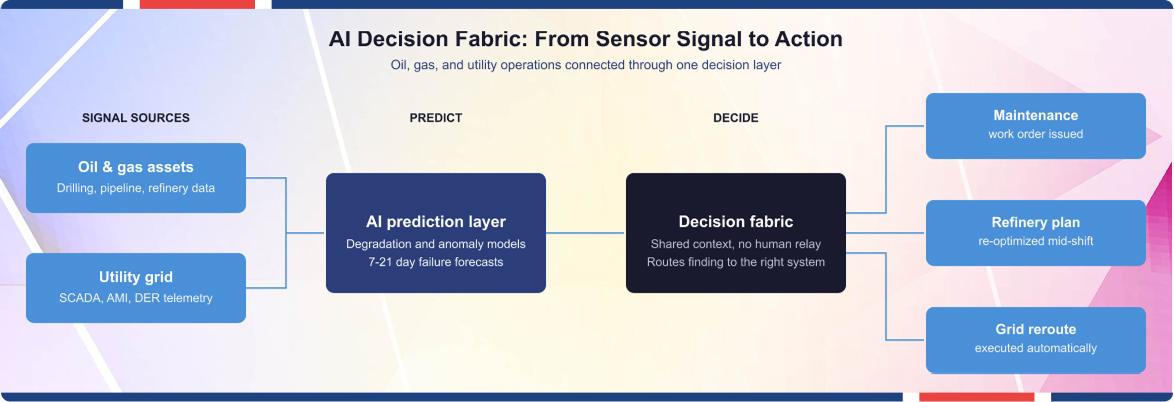
The fix isn’t more dashboards. It’s models trained to spot degradation patterns seven to twenty-one days before failure, then route the finding straight into a maintenance grid connection queue without waiting for a human to notice the trend line. Building these predictive and decision-making systems requires specialized AI Development Services that connect machine-learning models with live operational data and maintenance workflows. ADNOC proved the model at scale, rolling out AI-driven predictive maintenance across hundreds of machines and cutting maintenance costs by 20 percent while reducing unplanned stoppages.
Separately, industry-wide downtime data for AI in energy and utilities, tracked across large manufacturers, oil and gas included, shows average monthly downtime falling from 39 hours to 27 hours over five years as predictive tools matured.
Where AI in Energy and Utilities Is Already Paying Off
Three use cases have moved past the pilot stage. Together, these use cases demonstrate how Digital Solutions can connect predictive analytics, operational data, and automated decision-making across energy and utility environments. Predictive maintenance, real-time drilling surveillance AI, and digital twins for pipelines now run in production at major operators, not in a lab. Drilling teams use machine learning to catch stuck-pipe and torque-drag signals in the data stream before they escalate into non-productive time, cutting the guesswork out of a decision that used to rely on a driller’s instinct.
Refining tells a slightly different story. Agentic AI is starting to replace static, rule-based planning with systems that re-plan a schedule mid-shift when a feedstock delivery slips or a unit trips offline. That is a genuinely different capability from dashboards that simply report what already happened. The software is now making a call, not just displaying a number, and that distinction is exactly what separates a pilot from a production system for AI in energy and utilities industry.

Storage and Dispatch Add a New Layer of Precision
Energy storage optimization now behaves less like a backup asset and more like a trading desk. AI-driven forecasting and automated dispatch let operators absorb oversupply from wind and solar, cut curtailment sharply, and stack multiple revenue streams – capacity, energy, and ancillary services – from the same battery fleet. Advanced analytics consulting for AI in energy and utilities push this further, extending battery life through charge cycles tuned to real degradation curves rather than a fixed replacement schedule.
Why Utilities Are Moving Faster on Grid Intelligence
Utilities are answering with intelligence rather than concrete. Roughly 750 to 900 gigawatts of stalled capacity could be unlocked through non-firm connection agreements and grid-enhancing technologies such as dynamic line rating, which uses real-time weather and line-condition data to push more power through existing wires (Source: IEA, “Electricity 2026 – Grids)
Virtual power plants take the same logic further, aggregating distributed batteries and rooftop solar into a single dispatchable resource that behaves like a power plant without the concrete pour. Self-healing grid intelligence utilities technology closes the loop on the distribution side, rerouting power automatically the moment a fault is detected instead of waiting for a truck roll and a service call.
None of this is speculative.
What Slows Deployment Down
None of this happens by installing a model and walking away. Operational technology and information technology have lived in separate worlds for decades, and most predictive maintenance pilots stall the moment they try to pull live data out of a historian that was never built to share it. Cybersecurity consulting services adds another layer of caution, and rightly so – utilities report more security incidents than most other sectors.
That is also why the fastest-moving operators start narrow for implementing AI in energy and utilities. A single asset class, a single pipeline segment, one substation – prove the loop closes, then expand. Trying to modernize the entire fleet in one program is how AI initiatives end up stuck in pilot purgatory for years, burning budget without ever reaching the assets that actually move the reliability numbers.
The Change Redefining Energy Operations
Here is what most trend reports miss: predictive maintenance in oil and gas and grid orchestration in utilities are the same problem wearing different coveralls. Both are about compressing the time between a sensor reading and a decision that changes physical operations. That is a stronger argument than the tired claim that AI simply improves efficiency.
This shift matters because siloed AI hits a ceiling fast. A predictive maintenance model that can’t talk to the planning system just creates another alert nobody actioned in time. In contrast, a decision fabric AI turns that same alert into a rescheduled work order, an adjusted agentic AI refinery planning, or a rerouted power flow – automatically, and within minutes rather than days.
Getting there takes more than a model; it takes OT and IT systems that finally talk to each other, which is precisely the piece most operators still underestimate. For energy and utility operators, this is increasingly part of broader Digital Transformation Services, where operational systems, data platforms, AI models, and automation are brought together around measurable business outcomes. AI in energy and utilities earns its budget line the moment it moves from reporting the past to shaping what happens next.
Frequently Asked Questions:
What is AI foresight in oil, gas, and utilities?AI foresight uses machine learning models to detect early warning signals in equipment and grid data so operators can act before failures happen.
How does AI in energy and utilities reduce downtime? It analyzes sensor data continuously to flag degradation patterns days or weeks before a failure occurs, turning surprise outages into scheduled maintenance.
What is a virtual power plant?A virtual power plant aggregates distributed batteries, solar panels, and other small energy resources into a single resource that grid operators can dispatch like a traditional power plant.
Is AI predictive maintenance expensive to implement?Costs vary by asset base, but most operators recover their investment within 8 to 14 months through reduced downtime and maintenance spend.
What’s the biggest barrier to scaling AI in energy and utilities?The biggest barrier is usually OT and IT data integration, not the AI models themselves.
When Every Second Matters, Can Your Systems Keep Up?
Flexsin has spent years helping energy and utility operators close exactly this gap, building AI systems that move from insight to action across grid, plant, and field operations. Flexsin is an AI Development Company helping energy and utility operators close exactly this gap, building AI systems that move from insight to action across grid, plant, and field operations. Our energy industry team combines predictive analytics, smart grid technology consulting, and AI-driven asset management to turn scattered sensor data into a working decision fabric.
Explore Flexsin’s energy industry solutions at flexsin.com/industry_focus/energy. Talk to Flexsin’s team to map where decision latency is costing your operation the most.
People Also Ask:
1. What does AI foresight mean in the energy sector?It refers to using predictive analytics to anticipate equipment and grid issues before they disrupt operations.
2. How do oil and gas companies implement predictive maintenance?They connect vibration, temperature, and pressure sensors to machine learning models that flag anomalies for the maintenance team.
3. What’s the difference between predictive maintenance and preventive maintenance? Preventive maintenance follows a fixed schedule, while predictive maintenance acts only when sensor data shows real signs of wear.
4. How long does it take to see ROI from AI predictive maintenance?Most facilities see a return within 8 to 14 months of deployment, depending on the size of the asset base.
5. Why are utilities adopting dynamic line rating technology? Dynamic line rating uses real-time weather data to safely push more power through existing lines, easing grid capacity limits without new construction.
