

 +1.844.3539.746
 info@flexsin.com
Your 90-Day Azure App Modernization Is Broken Before Day One
 Sudhir K Srivastava
Let's talk
Table of Contents:
- What You Should Know First
- The Complexity Every Enterprise Walks Into
- Where Azure App Modernization and Migration Programs Commonly Break
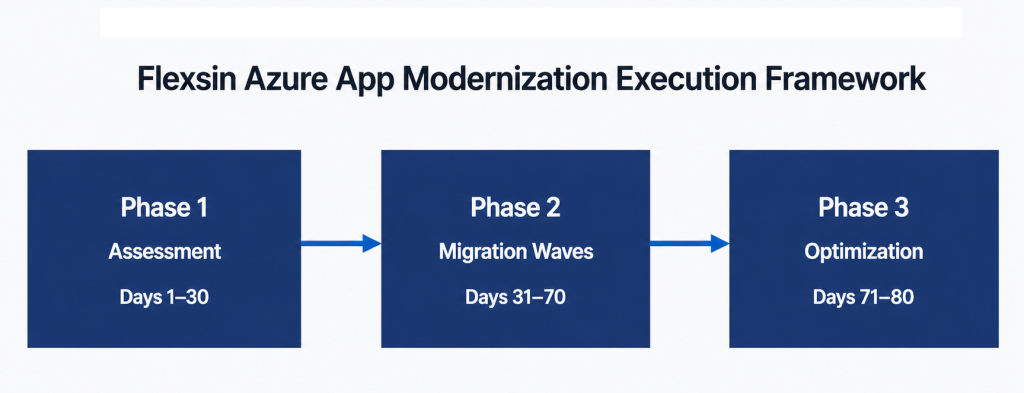
- The Flexsin Azure App Modernization Execution Framework
- Flexsin’s Approach to Azure App Modernization
- What to Validate Before Day One: Critical Prerequisites
- Azure App Modernization: What to Consider
- People Also Ask
- What Leaders Ask Us
Azure app modernization follows a predictable pattern in most enterprises. The business case clears, the project kicks off, and eighteen months later the team is running the same legacy workloads on cloud infrastructure at higher cost. That outcome is not a technology failure. It is a sequencing failure-and the gap almost always appears in the first thirty days of an Azure migration roadmap.
Most enterprises that miss their Azure app modernization targets make critical mistakes during assessment, not migration. They scope the wrong workloads first, skip dependency mapping in cloud migration, and retrofit governance after the first wave is already live. The costs show up later as over-provisioned infrastructure, audit exposure, and a cloud bill that exceeds the baseline.
The financial pressure behind cloud application modernization is real. Organizations spend up to 70% of IT budgets maintaining legacy systems, leaving little room for innovation. Modernizing applications using a structured Azure cloud migration strategy can deliver significant ROI. The difference isn’t ambition. It’s execution sequence.
This piece skips the “why.” That decision is already made. It focuses on the execution architecture that separates successful Azure app modernization programs from those that regret their first 90 days.
What You Should Know First
Five things that change how you execute this Azure app modernization roadmap:
- Legacy application modernization consumes 70–80% of IT budgets-this is a structural issue, not just cost management.
- Azure cloud cost optimization post-migration can unlock an additional 15–25% savings.
- The six Rs (rehost, replatform, refactor, etc.) define your cloud migration strategy-not all workloads should be treated equally.
- Governance using Azure Policy should be established before migration-not after.
- Cloud ROI optimization depends heavily on post-migration decisions, not just migration success.
The Complexity Every Enterprise Walks Into
Azure migration looks simple on paper. It rarely is in execution. Most enterprises underestimate cloud migration challenges and solutions required at scale. Applications labeled “standalone” often have deep, undocumented dependencies. Dependency mapping in cloud migration becomes the difference between a smooth transition and a failed cutover.
However, most enterprise inventories are wrong. That breaks your Azure migration strategy before it even begins. When dependency mapping fails, enterprise cloud migration programs fail at the integration layer, not during lift, but during cutover.
Azure app modernization also introduces multiple paths. You can rehost, replatform, or refactor. Each path affects cost, speed, and scalability differently. Choosing the wrong path is the most common reason enterprise Azure modernization strategy fails to deliver ROI.
What complicates this further is the lack of standardized documentation across teams and business units. Legacy systems often evolve over years without proper visibility, making accurate assessment even more difficult. Without a clear understanding of the current state, even the most well-planned modernization efforts can face unexpected delays and cost escalations.
Where Azure App Modernization and Migration Programs Break
Even well-funded Azure migration initiatives can struggle if foundational steps are overlooked. In most cases, failures are not due to technology limitations but due to gaps in planning, governance, and visibility.
Three failure points define most cloud migration challenges:
1. Skipping Portfolio Segmentation
Migration based on infrastructure age ignores actual risk and business impact. Azure migration best practices for enterprises recommend structuring Azure migration phases based on business criticality and architectural complexity-not hardware lifecycle. Without proper segmentation, high-risk or tightly coupled applications may be migrated too early, increasing the chances of disruption.
2. Retrofitting Governance
Azure Policy governance is not optional. Without establishing governance early, enterprises lose visibility, cost control, and compliance alignment. This directly impacts cloud infrastructure optimization and can lead to security gaps, budget overruns, and inconsistent resource management across environments.
3. Ignoring Monitoring Setup
Azure Monitor and Application Insights must be implemented from the beginning. Without baseline telemetry, performance comparisons post-migration become guesswork, making it difficult to identify issues or validate improvements. Early monitoring ensures proactive issue detection, better user experience, and continuous performance optimization.

Flexsin’s Azure App Modernization Framework
Flexsin’s Azure app modernization framework is built around one core principle: risk lives in dependencies, not infrastructure. While infrastructure can be scaled and managed with relative ease in the cloud, unmanaged dependencies between applications, data, and services can create hidden challenges if not addressed early.
An effective Azure app modernization service framework combines automation-using tools like Azure Migrate, cost baselining, and policy enforcement-with strong architectural decision-making, including wave planning and selecting the right modernization approach (rehost, refactor, or rearchitect). This balance ensures both speed and stability throughout the transformation journey.
Phase 1: Application Assessment (Days 1–30)
Use the Azure Migrate tool for discovery and dependency mapping in cloud migration. This phase defines your Azure application migration phases through clear workload segmentation, helping identify which applications can move quickly and which require deeper modernization planning.
Phase 2: Migrate by Wave (Days 31–70)
Follow a structured Azure migration step-by-step approach. Begin with low-risk workloads to validate your Microsoft Azure migration setup, refine processes, and build confidence before scaling to more complex and business-critical systems.
Phase 3: Optimize Post-Migration (Days 71–90)
Cost optimization after Azure migration is where real ROI is realized. Azure Cost Management tools help identify inefficiencies, right-size resources, and reduce waste, ensuring long-term value from your application modernization services. Continuous monitoring and performance tuning further enhance scalability and reliability.
Flexsin’s Approach to Azure App Modernization
Flexsin delivers comprehensive Azure app modernization services across diverse enterprise environments, helping organizations transition from legacy systems to scalable, cloud-native architectures. Their approach combines strategic planning with hands-on execution, ensuring minimal disruption and maximum performance improvement. Key capabilities include cloud migration consulting services, Azure DevOps implementation for streamlined CI/CD pipelines, and hybrid cloud enablement to balance flexibility with control.
As a Microsoft Azure consulting company, Flexsin supports end-to-end enterprise cloud migration services using structured frameworks, proven methodologies, and best practices. They focus on optimizing application performance, enhancing security, and reducing operational costs while ensuring seamless integration with existing systems. With a strong emphasis on measurable ROI, Flexsin enables businesses to accelerate digital transformation, improve agility, and stay competitive in a rapidly evolving technological landscape.
What to Validate Before Day One: Critical Prerequisites
A successful Azure app modernization initiative begins long before the first workload is migrated. Laying the right foundation ensures smoother execution, fewer risks, and better alignment with business goals.
Before starting your Azure app modernization roadmap, validate:
• Executive ownership
• Application ownership clarity
• Network readiness for cloud migration
• Governance and compliance frameworks
These prerequisites help eliminate ambiguity and ensure that all stakeholders are aligned from the outset. These are core Azure migration best practices-not optional steps. Ignoring them can lead to delays, increased costs, and unnecessary complexity during execution.
Azure App Modernization: What to Consider
A 90-day Azure app modernization roadmap can be effective for smaller application portfolios or well-defined workloads, where dependencies are limited and quick wins are achievable. However, larger enterprise cloud migration programs typically involve complex architectures, legacy integrations, and multiple stakeholders-making extended timelines not just common, but necessary for success.
What often goes unspoken is this: speed, while desirable, can introduce significant risk if the sequencing of migration and modernization efforts is not carefully planned. Rushing into cloud adoption without properly assessing application dependencies, security requirements, and data integrity can lead to performance issues, downtime, or cost overruns.
An effective enterprise Azure modernization strategy must strike the right balance between urgency and control. This means prioritizing applications based on business impact, adopting a phased or wave-based migration approach, and incorporating continuous testing and validation at every stage. Governance, compliance, and cost management should be embedded into the process from the beginning to avoid rework later.
In practice, sustainable modernization is less about moving fast and more about moving smart-ensuring that each step builds a stable foundation for long-term scalability, resilience, and innovation
People Also Ask
How long does Azure app modernization take for an enterprise?
A structured program covering assessment, migration, and optimization typically runs 90 days for portfolios under 40 applications. Larger or more complex portfolios require extended timelines – usually 6 to 12 months for full execution.
What is the difference between Azure migration and Azure modernization?
Migration moves a workload to Azure infrastructure. Modernization changes how the workload is architected – replatforming to PaaS, containerizing to AKS, or rebuilding with cloud-native components. Migration without modernization captures only a fraction of the available cloud ROI.
What does Azure Migrate do in an app modernization program?
Azure Migrate scans on-premises servers, databases, and web applications to produce dependency maps, readiness assessments, and cost estimates. It assigns each workload a modernization strategy recommendation and integrates with third-party tools through the Azure Migrate hub.
How do enterprises measure ROI on Azure app modernization?
Track infrastructure cost per workload at 30, 60, and 90 days post-migration against the pre-migration TCO baseline. Layer in developer velocity improvements and reduced incident frequency to build the full financial picture.
Most Azure modernization programs fail not because the technology is wrong, but because the execution sequence is. Flexsin’s Azure app modernization practice brings a structured phased framework, Microsoft Azure MSP delivery capability, and the governance architecture that turns a 90-day roadmap into a realized financial outcome – not a project that requires a second engagement to fix. If your IT budget is weighted too heavily toward legacy maintenance, that is the problem Flexsin solves.
Connect with Flexsin’s Azure modernization team for a free quote.
What Leaders Ask Us
1. What is Azure app modernization? Azure app modernization is the process of transforming legacy applications to run on Azure using rehosting, replatforming, refactoring, or rebuilding. The goal is replacing maintenance-heavy architectures with managed, cloud-native equivalents that reduce cost.
2. Why choose Azure over AWS for app modernization? Azure integrates directly with Microsoft investments including Active Directory, Dynamics 365, and Microsoft 365. It also offers Azure Arc for hybrid management – which is critical for enterprises that can’t move everything to the public cloud at once.
3. What are the 6 Rs of Azure app modernization? The six Rs are rehost, replatform, repurchase, refactor, re-architect, and retire. Most enterprise portfolios weight toward replatforming and refactoring, with a subset of applications that are better retired than migrated.
4. How much does Azure app modernization cost? Costs depend on portfolio size, application complexity, and the modernization track selected. Forrester research documents a 228% three-year ROI on Azure PaaS migration – costs are typically recovered within the first year for replatforming-weighted programs.
5. What is Azure Kubernetes Service (AKS) used for in modernization? AKS is the migration target for applications being containerized or re-architected into microservices. It provides managed Kubernetes infrastructure – reducing the operational burden of container orchestration at enterprise scale.
6. How does Azure Arc support legacy migrations? Azure Arc extends Azure management capabilities – policy, security, monitoring – to on-premises servers and Kubernetes clusters outside Azure. This makes phased migration operationally coherent without requiring a hard cutover.
7. What governance tools does Azure provide for migration programs? Azure Policy enforces configuration standards continuously. Azure Blueprints package governance constructs into deployable templates. Azure Management Groups organize governance across subscriptions and business units at enterprise scale.
8. What is the Azure Well-Architected Framework? It is Microsoft’s five-pillar framework covering reliability, security, cost optimization, operational excellence, and performance efficiency. It maps directly to enterprise governance, compliance, and financial management requirements for cloud programs.
9. How does Flexsin approach Azure app modernization? Flexsin executes Azure modernization through a three-phase framework – portfolio assessment, phased migration waves, and post-migration optimization – operating as a certified Azure MSP with expertise across PaaS, IaaS, DevOps, and hybrid infrastructure.
10. What are the prerequisites for a 90-day Azure migration program? Executive ownership of the business case, named application owners, network provisioning in progress from Day 1, and agreed compliance scope. Missing any of these extends the timeline and increases post-migration remediation costs.
