

 +1.844.3539.746
 info@flexsin.com
Why Multi-Cloud Success Requires More Than Adding More Clouds
 Munesh Singh
Table of Contents:
- Spend Is Outrunning Governance
- Migration Without a Strategy Costs Twice
- Where Expert Cloud Consulting Makes the Biggest Difference
- The FinOps Layer Most Roadmaps Skip
- The Metrics That Matter After Cloud Migration
- Security and Compliance Are Not Optional Extensions
- Picking a Partner Over a Platform
- Frequently Asked Questions
- Ready to Build a Cloud Strategy That Pays for Itself?
- People Also Ask
Let's talk
Eighty-seven percent of enterprises now run multi-cloud architectures, yet most finance teams cannot trace where a third of that spend actually goes. That gap – between adoption and control – is where most cloud strategies quietly fail. Cloud consulting services exist precisely to close it, but only when the engagement goes deeper than a migration checklist. The real work starts after the workloads land, not before.
Most companies did not choose multi-cloud management as a deliberate enterprise cloud strategy. They inherited it through shadow IT, acquisitions, and developer teams picking whichever platform shipped fastest. Flexera’s 2026 State of the Cloud Report puts hybrid cloud adoption at 73% of organizations, with roughly a third of those blending multiple public clouds on top of it.
Treating that architecture as an accident, rather than a deliberate design choice, is where the trouble begins. Workloads scattered across three providers without a shared governance model create blind spots no single dashboard can close.
Spend Is Outrunning Governance
Quarterly enterprise cloud infrastructure spending reached $129 billion in the first quarter of this year, an annual run rate above half a trillion dollars, according to Synergy Research Group. Gartner separately forecasts public cloud end-user spending of $850 billion this year, an increase of more than 21% over the prior year.
The result shows up directly on the balance sheet. Wasted cloud spend climbed back up to 29% in the latest Flexera survey, reversing five straight years of steady improvement. Cost models built for single-cloud, single-region workloads cannot account for the way AI workloads multiply compute consumption across providers.
Migration Without a Strategy Costs Twice
Roughly 38% of cloud migration projects run over budget, averaging 14% above the original estimate, based on tracking data compiled by Gartner and IDC. The pattern is rarely a technology failure. Effective Cloud Migration Services begin with sequencing, dependency mapping, total cost analysis, and compliance assessment before workloads move. It is a sequencing failure: lifting workloads before assessing total cost of ownership, mapping dependencies, or checking compliance exposure.
A landing zone built without governance baked in gets rebuilt within 18 months. Which means the business pays for the same migration twice – once to move fast, once to fix what moving fast broke. In our experience advising enterprise clients, the deciding factor is rarely which cloud platform gets chosen. It is whether the organization mapped its application dependencies before the first workload moved, a step skipped in nearly half the failed migrations we have reviewed.

Where Expert Cloud Consulting Makes the Biggest Difference
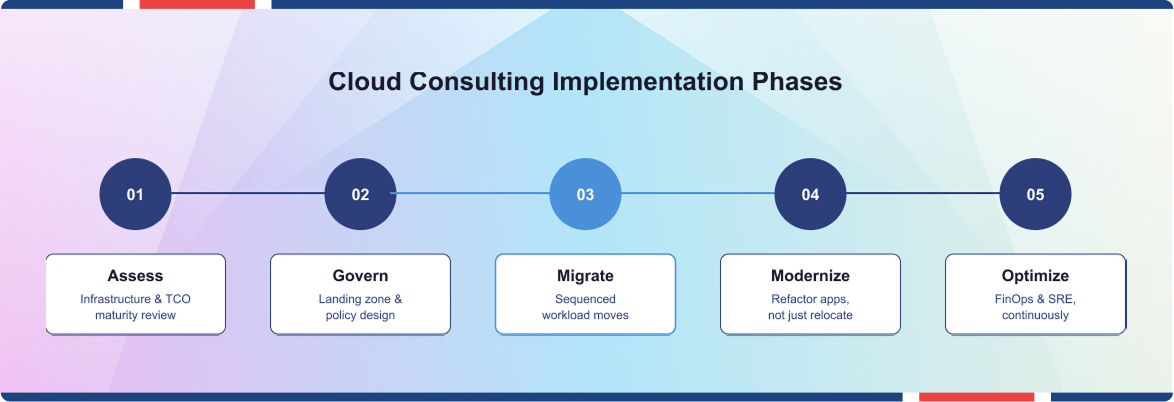
A capable cloud consulting company does five things in sequence: assess infrastructure and application maturity, design a governance and landing zone model, plan the migration roadmap, cloud application modernization that need it, then run FinOps and site reliability practices once live. Skip the assessment step and the rest of the roadmap rests on guesswork. For larger organizations, these capabilities become part of broader Enterprise Solutions, connecting infrastructure, applications, governance, security, and financial controls across the cloud estate.
Here is what that looks like in practice for hybrid cloud strategy – the highest-performing cloud programs assign a named cost owner to every workload before migration begins, not after. That single accountability shift, more than any tooling investment, separates organizations that hit their savings targets from those still chasing them a year later.
The FinOps Layer Most Roadmaps Skip
FinOps consulting services exist to answer one question continuously: is this workload still earning its keep? Most organizations ask that question once a year, during budget season, long after the spend has already compounded. By then, the savings opportunity has shrunk to whatever is left after the contracts renew automatically.
Running FinOps as a continuous practice – not an annual audit – requires the same discipline as any other engineering function: dashboards reviewed weekly, tagging enforced at deployment, and a named owner accountable for every line item. Organizations using disciplined FinOps practices report significant cloud waste reductions within the first year, a number worth chasing given how fast AI workloads are inflating baseline spend.
The Metrics That Matter After Cloud Migration
A migration that hits its deadline but misses its business case is still a failure. Post-migration audits should track three numbers: infrastructure cost change, application performance against baseline, and time-to-deploy for new features. Organizations that complete a structured migration typically report close to a 20% reduction in infrastructure costs within the first year – but only when the modernization step was not skipped to save time.
Skipping modernization is the most common shortcut, and it is the one that costs the most later. A lift-and-shift migration without refactoring simply moves the same inefficiencies onto a more expensive bill. The businesses that get this right treat cloud migration as part of broader Digital Transformation Services, using modernization and continuous cloud cost optimization rather than viewing migration as the finish line.
Security and Compliance Are Not Optional Extensions
Misconfiguration causes 65% of cloud security incidents, and 71% of organizations cite security as the primary barrier to further migration, according to Flexera’s 2026 benchmarking data. A cloud consulting engagement that treats security as a final-stage audit, rather than a design constraint from day one, builds risk straight into the architecture.
That is why cloud governance framework comes before code . Landing zones, identity policy, and encryption standards belong in the blueprint stage, not bolted on after the first production incident. Enterprises that build a cloud security assessment into the earliest planning workshop spend less time firefighting later.
Picking a Partner Over a Platform
The hyperscaler choice – AWS, Microsoft Azure, or Google Cloud – matters less than most procurement teams assume. Each platform now covers the same baseline capabilities; the differentiation lives in how a partner designs the landing zone, structures the RACI matrix, and runs cloud disaster recovery planning drills before they are ever needed.
A genuinely strategic cloud consulting partner builds for the next three years of workload growth, not the current quarter’s migration deadline. An experienced IT Consulting Company can also help align cloud architecture with application dependencies, business requirements, security policies, and long-term operating models. They bring FinOps discipline, DevSecOps cloud services and practices, and a cloud adoption framework and cloud governance framework tuned to the client’s regulatory footprint, not a generic template repurposed across every industry vertical.
The businesses pulling ahead this year with enterprise cloud transformation are not the ones using the most cloud platforms – they are the ones whose cloud consulting services partner built cost ownership, security, and governance into the architecture from the first workshop.
Frequently Asked Questions:
What are cloud consulting services?Cloud consulting services help enterprises assess, migrate, secure, and optimize workloads across AWS, Azure, and Google Cloud.
How much do cloud consulting services typically cost? Engagement cost scales with workload count and complexity, ranging from a focused cloud security assessment to a multi-year managed roadmap.
How long does a typical cloud migration take?Most enterprise migrations take 18 to 24 months to move the majority of workloads.
Is multi-cloud more expensive than single-cloud?Multi-cloud costs more to govern but reduces vendor lock-in and improves resilience when managed with FinOps consulting services.
Do cloud consulting services include security and compliance?Yes, a proper engagement builds security and compliance into the landing zone design from the first planning stage.
Ready to Build a Cloud Strategy That Pays for Itself?
Flexsin’s cloud consulting services bring certified Azure cloud consulting experts, AWS cloud consulting partners, and Google Cloud expertise to every stage of the journey – assessment, governance, migration, and FinOps. Explore Flexsin’s cloud consulting services at and put a governed, cost-accountable cloud architecture in place.

People Also Ask:
1. What is the difference between cloud consulting and cloud migration?Cloud consulting covers strategy, governance, and optimization, while migration is just the workload-moving phase within it.
2. How do I choose a cloud consulting company?Compare hyperscaler partnerships, FinOps maturity, and industry-specific compliance experience before signing a contract.
3. Which is better for enterprises: AWS, Azure, or Google Cloud? No platform wins outright; the right choice depends on existing Microsoft, data, or AI tooling investments already in place.
4. How much can cloud cost optimization actually save a business?Disciplined FinOps practices typically cut cloud waste by 20% to 30% within the first year.
5. What is a cloud landing zone? A landing zone is the pre-configured, governed environment a workload moves into during migration.
