

 +1.844.3539.746
 info@flexsin.com
Why Most Legacy Applications Modernization Programs Stall Before They Deliver
 Munesh Singh
Let's talk
Table of Contents:
- What to Keep in Mind First
- Why Enterprise Applications Modernization Programs Stall
- The Six Core Legacy Software Modernization Strategies
- The Six Core Legacy Software Modernization Strategies
- Flexsin’s Legacy Application Modernization Framework
- How Flexsin Delivers Results
- What to Validate for Legacy Applications Modernization
- Where Businesses Face Friction
- People Also Ask
- Common Questions Answered
Every CIO knows the number. Enterprises spend 60 to 80 percent of their IT budget keeping legacy systems running – not improving them, not extending them, just keeping them alive. That is the hidden tax on every new initiative that gets delayed, every integration that cannot ship on time, and every AI capability the business cannot access because the data is locked inside a system built before the iPhone existed. The modernization decision is rarely the hard part. According to a Saritasa survey of 504 US IT professionals, 62 percent of organizations still rely on legacy software – and 50 percent say the primary reason they have not upgraded is because the current system still works. That logic is understandable.
It is also why so many modernization programs launch late, run over budget, or stall mid-execution. The real question is not whether to pursue legacy software modernization, or legacy system migration. It is which approach to Digital Engineering Services fits your system, your timeline for application modernization services, and your risk tolerance – and what you need to get right before the first line of code moves.
What to Keep in Mind First
- Enterprise IT modernization strategy budgets lose 60-80% to legacy maintenance, leaving little room for innovation or AI readiness.
- Six distinct legacy applications’ modernization strategies exist; picking the wrong one can cost more than staying on the legacy system.
- Most failed modernization programs share a common cause: the execution methodology was chosen before the dependency map was built.
- Data migration is the cost driver enterprises least anticipate – and the one that kills the most timelines.
- Running old and new systems in parallel during legacy system migration is not optional; it is the mechanism that protects business continuity.
Why Enterprise Applications Modernization Programs Stall
Most enterprise applications modernization programs do not fail for technical reasons. They fail because the complexity the reader is already facing – disconnected data, brittle integrations, undocumented business logic – was underestimated before the program launched. The global legacy software modernization market reached $15.14 billion in 2025, growing at 16.2% annually, and is projected to hit $27.3 billion by 2029 according to Research and Markets. That growth reflects accelerating enterprise demand. What it does not show is the execution gap between intent and delivery.
Three failure modes appear repeatedly. First, scope is defined before dependencies are mapped. Second, data migration is treated as a Phase 4 problem rather than a parallel workstream. Third, the rebuild recommendation gets made before the codebase is assessed honestly.
The Complexity Enterprises Are Already Carrying
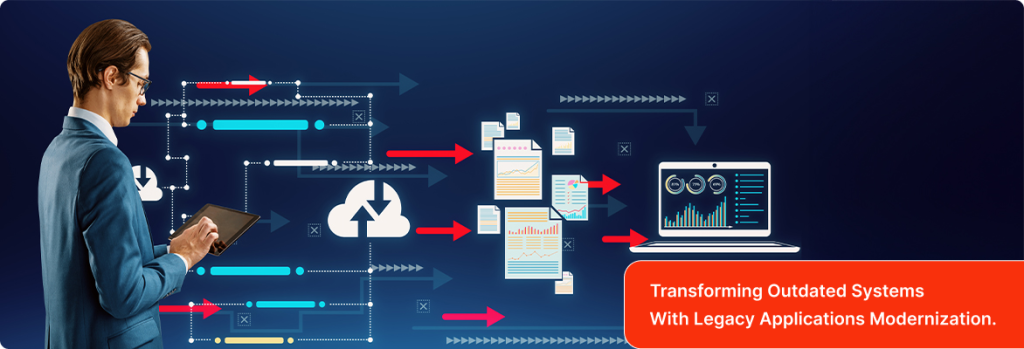
Legacy systems accumulate complexity in layers. The original architecture gets extended with patches, wrappers, and workarounds. Integrations with ERP, CRM, and third-party platforms multiply. Business logic gets buried in undocumented code that only two engineers fully understand – and those engineers are often nearing retirement. A mid-size financial services firm in Chicago – around 800 employees, 40 engineers – spent 14 months attempting to add a payment channel to a monolithic application built in 2003. Not because the feature was technically complex. Because the monolith had no separation between business logic and data access, and touching one-layer cascaded failures into three others.
The instinct is to patch. Add a wrapper API. Build an adapter layer. These approaches to legacy applications modernization buy time – they do not buy architecture. The systems that accumulate the most technical debt are precisely the ones that received the most patches.
Where Modernization Programs Most Commonly Fail
Budget constraints for IT modernization strategy delay 44% of modernization projects and fear of downtime disrupts 38%, according to industry tracking. Both are legitimate concerns – and both are manageable when the program is structured correctly. They become unmanageable when the program starts without a foundation. The most common structural failure for legacy system migration: choosing between rehost, refactor, or rebuild before completing the assessment that would determine which one is right. The rebuild option for modernization of legacy applications looks decisive. It rarely is.
The Six Core Legacy Software Modernization Strategies
There is no single method to modernize a legacy system. The right approach depends on your current system condition, your budget, and where this application sits in your three-to-five-year roadmap. Here are the six approaches most enterprises choose from.
| Strategy | What It Means | Best For |
|---|---|---|
| Rehost | Lift and shift to cloud; no code changes | Quick data center exit, minimal risk |
| Replatform | Migrate with targeted optimizations | Cost-efficient improvements without full overhaul |
| Refactor | Restructure code without changing functionality | Valuable apps that are slow and costly to maintain |
| Rearchitect | Redesign core architecture (e.g. microservices) | Systems blocking scale or integration |
| Rebuild | New codebase, same functionality | Systems where fix cost exceeds replacement cost |
| Replace | Retire and adopt a modern third-party solution | When a strong commercial product already exists |
Rehost
Move the application to the cloud exactly as it is. No code changes, no rearchitecting – just a different home. It is the fastest option with the least technical risk. What it does not do is fix anything. A slow system running on-premises becomes a slow system in the cloud. Rehosting buys time and reduces infrastructure overhead, which makes it the right choice when you need to exit a data center quickly or when full software modernization service is being phased.
Replatform
Similar to rehosting, but with targeted improvements made during migration. Switching from a self-managed database to a managed cloud service while moving the application is the classic replatform move. The application stays largely intact, but performance and maintenance costs improve. According to recent market data, replatforming accounts for 32.45% of modernization approaches – the largest single share of any strategy.
Refactor
The code stays. The functionality stays. The structure gets cleaned up. Refactoring is about making an application that still has real business value easier to work with and cheaper to maintain. What nobody says out loud is that a significant share of enterprises that come in asking for a rebuild actually need a refactor. The system is not broken – it is poorly structured. That is a different problem for application modernization services, with a much less expensive solution.
Rearchitect
This goes deeper. You are not cleaning up code; you are redesigning how the entire application is structured. Breaking a monolithic system of enterprise applications modernization into microservices is the canonical example. Rearchitecting is projected to grow at 23.1% CAGR through 2030 – the fastest of all legacy applications modernization approaches – reflecting where enterprise demand is heading for systems that need to scale.
Rebuild and Replace
Rebuild for a legacy modernization company means starting from scratch with the same business functionality on a modern codebase. It is the most expensive, most time-consuming, and highest-risk option. The use case exists – when a system is genuinely unsalvageable – but it is rarer than vendors suggest. Pressure-test any rebuild recommendation before committing. Replace means retiring the system entirely and moving to a modern third-party solution. It works when a strong commercial product covers your requirements for software modernization service, and the build-vs-buy math favors buying.
Flexsin’s Legacy Application Modernization Framework
Choosing the right legacy modernization company and strategy for legacy systems modernization is necessary but not sufficient. The program delivery methodology determines whether the strategy actually executes without disrupting operations. The Flexsin Legacy Modernization Framework sequences the work in four phases, each with a defined entry criterion and a measurable exit gate.
Phase 1: Dependency Mapping and Risk Stratification
You cannot plan a modernization program without knowing exactly what you are dealing with. Map every dependency, integration point, and data flow in the current system. Identify what is broken, what is slow, and what the business genuinely relies on. Use automated static analysis tools and team interviews to surface what documentation misses in enterprise modernization solutions.
This phase feels slow. Most Digital Engineering Consulting teams want to skip it. That is exactly why most modernization consulting service programs go over budget. Every modernization program that stalls mid-execution either skipped this phase or treated it as a formality.
Phase 2: Strategy Selection and Pilot Execution
Use the dependency map to select the right approach from the six strategies above. Then apply it first to the most painful module in the current system – not the easiest one, the most painful. Modernize that component, validate the approach, measure outcomes, and build internal confidence before committing the entire organization to the new architecture.
A large logistics company – 2,000 employees, operating across six US states – approached Flexsin after a failed in-house modernization attempt left them with two partially-migrated systems that could not communicate with each other. The restart used risk-level sequencing from Phase 1: dependencies mapped first, core platform stabilized before microservices were extracted, parallel operations maintained throughout. The program recovered in 11 months.
Phase 3: Parallel Operations and Data Migration
Do not switch off the legacy system until the new one has proven stable in a live environment. The team working on enterprise application modernization services should run both simultaneously during transition. Set clear, measurable criteria for when the legacy system gets retired – then hold to them.
Data migration and Cloud Migration Services deserve its own parallel workstream from day one. Moving years of legacy data to a new system is not a simple export and import. Data quality issues, compliance requirements, and mapping problems all add time and cost when discovered late. Modernization of legacy applications programs that treat data migration as a Phase 4 problem consistently exceed both budget and timeline.
Phase 4: Optimization and Decommission
Legacy systems do not disappear in Phase 4 – they get decommissioned on a schedule, service by service. Performance tuning, cost optimization, and security hardening continue throughout. The enterprise applications’ modernization program is not finished when the new system is live. It is finished when the old one is off.
How Flexsin Delivers Results
Digital Product Engineering Company cover the full program lifecycle – from assessment through decommission. Our legacy system migration practice combines automated dependency analysis with hands-on architectural review to give enterprise teams an honest picture of what they are working with before a single migration decision gets made. That assessment of legacy software migration services determines whether the right move is refactor, rearchitect, or something else entirely – and it prevents programs from committing to a rebuild that the codebase does not require.
Working with a US-based transportation and logistics company with operations across six states, Flexsin recovered a stalled modernization program that had left two half-migrated systems unable to communicate. Using phased risk-level sequencing of enterprise legacy systems, and parallel operations throughout the transition, the program delivered a stable, integrated architecture in 11 months. What our team does not do is recommend rebuilds for systems that do not need them – because that recommendation almost always costs more than it saves.
What to Validate for Legacy Applications Modernization
A modernization program that launches without these inputs in place is running without a foundation. Each one prevents a distinct class of failure.
- Executive alignment on phased delivery vs. big-bang cutover. Legacy applications modernization programs that lack this agreement encounter scope reversals mid-execution.
- A complete dependency map of the legacy system, including undocumented integrations. Use automated static analysis and team interviews.
- A parallel data plan for enterprise migration strategy. Build it alongside the modernization plan, not after the program is already underway.
- Defined KPIs before go-live. You need a baseline to measure against during the first 90 days of parallel operations by legacy software migration services.
Team training scheduled before go-live, not after. A modernized system your enterprise cloud migration team does not know how to use delivers zero value on day one.
Where Businesses Face Friction
Legacy software modernization carries real trade-offs that any honest program assessment should surface upfront.
- Phased modernization extends timelines. Running old and new systems in parallel adds operational overhead that shorter programs do not carry.
- Refactoring has limits. If the codebase is genuinely unsalvageable – missing documentation, unsupported language, no separation of concerns – refactoring costs more than rebuilding.
- Talent gaps compound mid-program. Within the next few years, the majority of COBOL-era developers will have retired. Programs that depend on legacy specialist knowledge face continuity risk that gets harder to manage as timelines extend.
- Off-the-shelf replacement for enterprise modernization solutions rarely maps cleanly. Replace decisions often require significant customization, which narrows the cost advantage that made replacement attractive in the first place.
The most common mistake is treating legacy software modernization as a technology decision. It is a business decision that happens to involve technology – and the constraints that matter most are usually organizational, not architectural.
People Also Ask
Q: What does legacy software modernization mean?
It is the process of updating or restructuring outdated enterprise systems using strategies like rehosting, refactoring, or rearchitecting. The goal is to improve performance, reduce maintenance costs, and enable modern integrations.
Q: Is cloud migration the same as legacy software modernization?
Cloud migration is one path within modernization. Rehosting by application modernization consulting moves a legacy system to the cloud unchanged; full software modernization service may involve rearchitecting or rebuilding the system entirely.
Q: How long does legacy application modernization take?
A rehost for legacy applications’ migration can complete in weeks; refactoring or application replatforming services typically runs three to six months. A full rearchitect or rebuild for a large enterprise system runs 12 to 24 months.
Q: What drives the cost of legacy software modernization?
The complexity of enterprise legacy systems, strategy selected, number of integrations, and data migration complexity are the four primary cost drivers. Data migration is the one most businesses underestimate.
Ready to turn your legacy system into a competitive asset? Flexsin application modernization services cover the full program lifecycle – from system assessment and dependency mapping through phased migration and decommission. We work with mid-size and enterprise organizations across manufacturing, financial services, and logistics to modernize systems that still run the business.
Start with a no-obligation system assessment. Contact Flexsin Technologies to start your assessment.
Common Questions Answered
1. What is the difference between rehosting and replatforming? Rehosting moves an application to cloud infrastructure with no code changes. Replatforming moves it with targeted optimizations, like switching to a managed database service
2. When does refactoring make more sense than rebuilding? When the system core functionality is still valuable and its structure – not its logic – is the problem. Rebuilding is appropriate only when the codebase is genuinely unsalvageable.
3. What is the strangler fig pattern in legacy application modernization? It means progressively replacing legacy components while the system stays live. New functionality ships on modern infrastructure while legacy handles existing traffic until full cutover.
4. Can legacy software modernization happen without downtime? A phased approach to digital transformation services with parallel operations during transition protects business continuity. Big-bang cutovers without parallel running are the primary cause of operational disruption.
5. What are the biggest risks in legacy application modernization? Data migration failure, undocumented integrations, and scope expansion are the three most common risk categories. Each becomes harder to manage the longer it goes unaddressed.
6. How do I know which modernization strategy is right for my system? Start with an third-party assessment of your codebase and enterprise legacy systems. The IT modernization strategy follows from what the assessment reveals, not from what the budget allows.
7. What does legacy system migration cost for a mid-size enterprise? Modernization of legacy applications varies significantly by system complexity and strategy. Any vendor quoting a fixed number without an assessment is guessing.
8. How does technical debt affect modernization timelines? Technical debt compresses the aperture for what each fix can safely do. Systems with high debt require more time in the dependency mapping phase and carry higher risk of mid-program scope expansion.
9. What secondary keywords signal legacy modernization intent? Enterprise buyers search for terms like legacy application modernization, cloud migration strategy, IT modernization roadmap, and application replatforming. They are looking for execution guidance, not definitions.
10. What should I ask any legacy modernization vendor before signing? Ask how they handle undocumented dependencies and what their data migration methodology is. Ask whether they will recommend against a rebuild when refactoring is the right answer.
