

 +1.844.3539.746
 info@flexsin.com
Why Most Enterprise GenAI Adoption Programs Stall Before They Scale
 Munesh Singh
Let's talk
Table of Contents:
- What You Should Know First
- The Insight Most AI Strategies Get Backwards
- Why Enterprise AI Programs Stall at the Same Point
- Flexsin’s Approach to Enterprise GenAI Adoption Framework
- Flexsin’s Take on Enterprise GenAI Adoption
- Where The Real Challenges Begin
- People Also Ask
- Common Questions Answered
Digital Engineering Services for enterprise GenAI have moved past proof-of-concept. The question now isn’t whether agentic AI delivers value -it’s why so many well-funded programs still plateau after the first two or three use cases. Five patterns separate the organizations that scale from the ones that stall, and none of them are about the model.
There’s a number that should make every enterprise AI lead uncomfortable. Gartner projects that 40% of enterprise applications will embed task-specific AI agents by next year -up from less than 5% today. Meanwhile, McKinsey’s State of AI research finds that less than 10% of organizations have actually scaled AI agents in any individual business function. That gap is where most enterprise programs disappear into.
Think of it as the airline analogy. Every carrier now uses AI for pricing, scheduling, and predictive maintenance. But the ones that built lasting competitive advantage didn’t do it by running fifteen disconnected pilots -they redesigned ground operations, not just the cockpit interface. The same logic applies to enterprise GenAI. The technology is no longer the hard part. The operating model is.
What follows isn’t another survey of what’s theoretically possible. These are five patterns already proven in production environments -with the organizational logic that makes each one hold.
What You Should Know First:
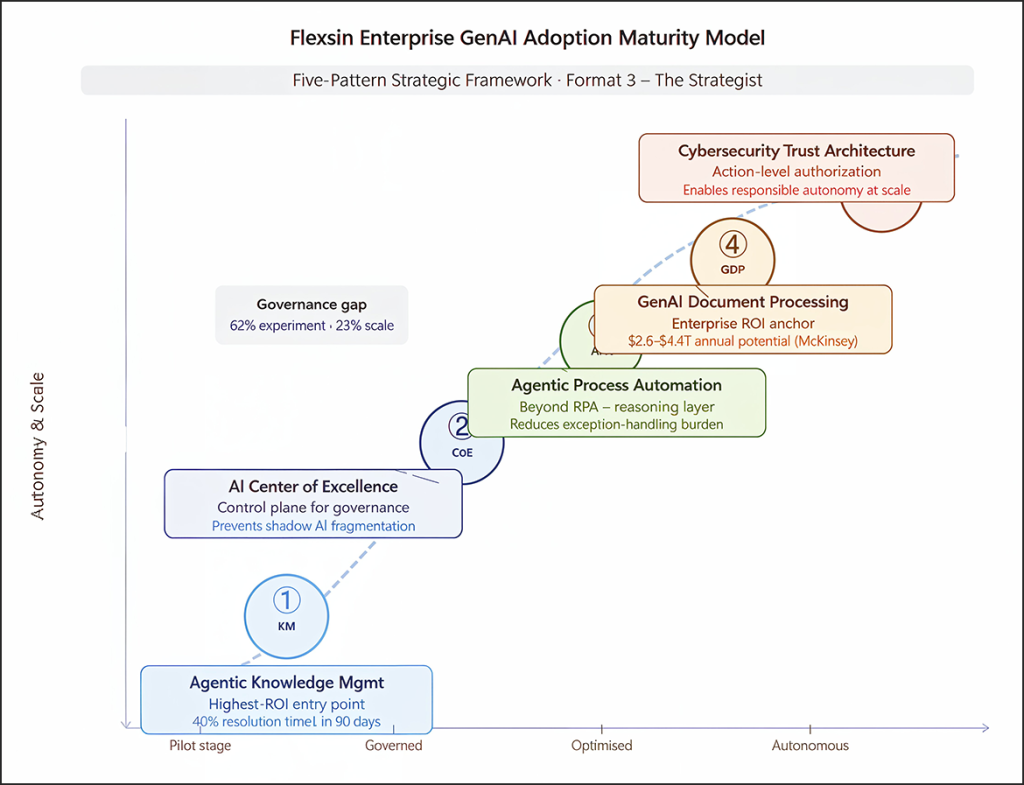
- Pattern 1: Agentic knowledge management is the highest-frequency, clearest-ROI entry point for enterprise GenAI adoption.
- Pattern 2: An AI Center of Excellence is not overhead -it’s the mechanism that prevents shadow AI from fragmenting your architecture.
- Pattern 3: The shift from RPA to agentic process automation removes the two biggest pain points: brittle bots and high exception-handling burden.
- Pattern 4: GenAI document processing is the most dependable ROI engine in the enterprise portfolio -measurable, fast to deploy, and cross-industry.
- Pattern 5: Cybersecurity isn’t a perimeter around agentic AI. It’s the trust architecture that determines how far autonomy is permitted to go.All five patterns share one requirement: intentional design from the start, not governance bolted on after deployment.
The Insight Most AI Strategies Get Backwards
The standard enterprise GenAI adoption narrative runs like this: identify use cases, pilot the most promising ones, then scale what works. It’s also why most programs plateau.
What nobody says out loud is that the piloting model is structurally incompatible with agentic AI. Pilots are designed to prove a technology, not to redesign an operating model. Agentic systems require operating model redesign from day one -shared data standards, governed autonomy levels, and defined escalation paths. When those decisions get deferred to ‘post-pilot,’ they never get made, and the agent never gets trusted with anything consequential.
The organizations actually scaling agentic AI started and AI transformation with the governance architecture, not the model selection. Enterprise GenAI adoption isn’t a technology problem masquerading as a business problem. It’s an operating model problem that happens to require technology to solve.
Why Enterprise GenAI Adoption Programs Stall at the Same Point
McKinsey’s latest State of AI data shows that 62% of organizations are experimenting with AI agents, but only 23% are scaling any agentic system in even a single function. That 39-point gap has a name: the governance gap.
Most programs hit the same three walls, when it comes to the use of generative AI in enterprises. First, fragmented architecture -five business units building separate agents on different models, different data access rules, and different security policies. Second, the trust deficit -agents that behave unpredictably under edge cases, which means humans stop delegating to the AI operating model. Third, the measurement problem -no baseline, no performance tracking, no way to prove or disprove ROI to the budget committee.
Deloitte’s research on the topic is instructive: enterprise AI adoption, they found, moves at the speed of business, not the speed of technology. The organizations that close the governance gap faster do so through Cloud Engineering Services and governed AI infrastructure decisions -model standards, agent autonomy tiers, data access governance -as architectural commitments, not configuration questions to revisit later.

Patterns for GenAI Adoption Framework
Pattern 1 – Enterprise GenAI Adoption’s Highest-ROI Entry Point
Knowledge functions are the natural entry point for enterprise GenAI adoption. High query frequency, clear success metrics, and governance complexity low enough to move fast -it’s the cleanest risk-adjusted starting position available.
What separates effective knowledge agents from the ones that get abandoned after three months is managed intelligence. The agent isn’t just a search tool. It unifies internal repositories -runbooks, incident histories, policy documents -with external sources, through governed, context-aware retrieval. Managed AI services layer on top: standardized deployment, access control, continuous model optimization. The AI operating model doesn’t degrade as content and business context evolve; it improves.
A mid-size financial services firm in Singapore -running a 2,000-person service engineering function -deployed an agentic knowledge system and measured a 40% reduction in average time-to-resolution on Tier 2 support incidents in the first 90 days. The AI ROI case was closed before the pilot budget expired.
Pattern 2 -The AI Center of Excellence (CoE) as Control Plane
The fastest path to fragmented, ungovernable AI scaling and infrastructure is letting every business unit build independently. That’s not a prediction – it’s the current state in most large enterprises, and it’s expensive to unwind.
An AI Center of Excellence solves this with structure, not restriction. It defines the shared LLM platform, establishes data access governance, sets agent autonomy tiers, and runs the lifecycle management process. Individual teams still build their own use cases -but faster, cheaper, and within guardrails that prevent architecture debt from compounding.
Crucially, the CoE also owns maturity progression. It runs feedback loops, outcome measurement, and risk reviews that allow the enterprise to move deliberately from assisted intelligence to agentic execution -not because the technology is ready, but because trust, AI governance, and organizational capability have been built to support it.
Pattern 3 – Agentic Process Automation Beyond RPA
Traditional Digital Engineering Consulting approaches – RPA bots, BPM workflows, iPaaS integrations -were built for deterministic environments. They break on exceptions, and enterprise processes are full of exceptions.
Agentic Process Automation addresses this by embedding reasoning into the execution layer. An order-to-cash agent, for example, doesn’t just extract invoice data -it detects missing fields, initiates customer outreach, updates the ERP, and escalates only genuinely ambiguous cases to finance. Human teams intervene less often, but at higher-value decision points. Automation coverage increases, maintenance overhead drops, and the system improves on edge cases over time.
Pattern 4 – The Enterprise GenAI Adoption ROI Anchor
Document processing is where enterprise GenAI integration delivers the most reliable, fastest-to-quantify returns in the enterprise portfolio. The problem space is consistent across industries: unstructured inputs, domain-specific language, and high manual processing cost.
GenAI changes the economics. Traditional intelligent document processing required weeks of training, hundreds of templates, and ongoing human review for anything outside the training distribution. LLM-driven extraction handles that ambiguity natively. A claims processor that uploads a mix of handwritten forms, scanned PDFs, and email attachments gets classified documents, extracted fields, policy-validated data, and a drafted claim summary -in minutes rather than days.
According to McKinsey’s analysis of GenAI economic potential, generative AI could add between $2.6 and $4.4 trillion annually across business use cases -and document-intensive workflows sit squarely at the center of that estimate. The math works at the use-case level of AI scaling, before you need enterprise-wide deployment to justify it.
Pattern 5 -Cybersecurity as the Enterprise AI Governance Trust Architecture
Agentic AI doesn’t just process data. It takes actions, coordinates across applications, and operates with delegated authority. That’s a fundamentally different risk profile than any AI model deployed before it.
The organizations extending agentic autonomy and generative AI in enterprises responsibly aren’t treating security as a perimeter concern -they’re embedding it into agent design. Least-privilege access at the action level, not just the data level. Intent validation before execution. Continuous behavioral monitoring, not audit-log review after the fact. Every action observable, every decision auditable.
This is what allows autonomy and AI governance to expand over time. A finance agent that can analyze spend patterns and recommend cost-saving actions gets upgraded to autonomous execution only after the security architecture can verify -in real time -that every action is authorized, logged, and recoverable. Without that infrastructure and AI cybersecurity, autonomy stays theoretical. With it, it becomes the competitive advantage.
Flexsin’s Take on Enterprise GenAI Adoption
Most enterprise AI programs we encounter are stuck in the same place: they’ve got working pilots and a paralyzed roadmap. The pilots demonstrated the technology. What they didn’t demonstrate is the operating model, the governance architecture, or the trust infrastructure that agentic scale actually requires.
One example: a software and technology firm with 400 engineers came to Flexsin after their RPA-based automation stack had reached coverage limits that no additional configuration could fix. Within six months, Flexsin’s AI adoption framework had deployed a two-agent architecture -one customer-facing, one engineering-facing -integrated across service desk, incident management, and knowledge management. Ticket deflection rates exceeded 40%. Acknowledgement time on critical incidents dropped from 22 minutes to under 4. Those aren’t projections for AI agents in business; they’re operational baselines for AI transformation, from a production environment.
Where the Real Challenges Begin
None of these five patterns are plug-and-play. Each carries real organizational and technical constraints that executive teams should map before committing budget.
- Agentic knowledge systems and AI operating models require clean, governed data. If your enterprise repositories are fragmented or poorly tagged, the agent inherits that fragmentation -and makes it visible in ways that are harder to explain than spreadsheet errors.
- AI CoEs require sustained executive sponsorship. Without it, they become advisory bodies that business units route around.
- Autonomous process automation demands process re-engineering, not just automation layering. If the underlying process for enterprise AI maturity model has structural defects, the agent will execute those defects faster.
- GenAI document processing accuracy degrades on highly domain-specific or regulatory documents. Human-in-the-loop validation remains mandatory for high-stakes outputs in healthcare and financial services.
- AI cybersecurity architecture for agentic AI and generative AI in enterprises is still maturing. Behavioral monitoring tooling, action-level authorization frameworks, and agent identity standards are not yet standardized across enterprise platforms.
The organizations that scale enterprise GenAI adoption and AI governance are the ones that account for these constraints in the design phase, not after deployment.
People Also Ask
What is enterprise GenAI adoption?
Enterprise GenAI adoption is the structured deployment of generative AI across business functions. It covers strategy, governance, model selection, and scaling from pilots to production.
What is agentic AI in enterprise?
Agentic AI refers to systems that plan, reason, and act across enterprise workflows with minimal human input. Unlike assistants, agents initiate and execute multi-step processes without continuous prompting.
How do enterprises scale generative AI?
Enterprises scale GenAI by establishing a governed AI architecture and centralizing standards through a CoE. Use cases expand where trust and performance are proven.
What is an AI Center of Excellence?
An AI Center of Excellence (CoE) defines shared AI standards and prioritizes use cases across the organization. It manages architecture decisions and drives enterprise-wide AI maturity.
As an IT Consulting Company, Flexsin works with enterprise technology leaders to design, build, and scale GenAI and agentic AI systems that move from pilot to production -with the governance architecture and technical rigor that makes scale sustainable. If your program has hit the governance gap or the trust ceiling, that’s precisely where our GenAI consulting and AI development services team engages. Contact Flexsin Technologies to start with a structured readiness assessment.
Common Questions Answered
1. What are the five enterprise GenAI adoption patterns?The five patterns are agentic knowledge management, AI CoE governance, agentic process automation, GenAI document processing, and cybersecurity as trust architecture.
2. What is the difference between GenAI and agentic AI?GenAI generates content or analysis on request. Agentic AI takes autonomous, multi-step actions across enterprise systems without continuous human prompting.
3. How long does enterprise GenAI adoption take?Initial use cases typically reach production in 60 to 90 days. Enterprise-wide scaling with governance architecture takes 12 to 18 months depending on data maturity.
4. What is an agentic AI Center of Excellence?An agentic AI CoE defines shared LLM standards, agent autonomy tiers, and data governance policies. It prevents shadow AI adoption from fragmenting your architecture.
5. How do enterprises measure GenAI ROI?AI ROI is measured through use-case metrics: resolution time, processing volume, error reduction, and cost per transaction. Enterprise-level impact typically appears 12 to 18 months post-deployment.
6. What is agentic process automation?Agentic process automation replaces brittle RPA bots with reasoning-capable agents that handle exceptions and escalate only genuinely ambiguous decisions to human reviewers.
7. Is GenAI document processing accurate enough for enterprise use?Yes, for most document types. Accuracy on standard formats exceeds 95% with LLM-driven extraction. Regulatory documents require human-in-the-loop validation.
8. How does cybersecurity apply to agentic AI?Agentic AI requires action-level authorization, not just data-level access control. Every agent action must be observable, auditable, and recoverable to meet compliance standards.
9. What industries are leading in GenAI adoption?Financial services, healthcare, and technology lead GenAI adoption. Manufacturing, insurance, and retail are scaling quickly in document processing and supply chain automation.
10. What does Flexsin’s GenAI consulting service include?Flexsin’s enterprise GenAI adoption framework and GenAI consulting covers readiness assessment, use-case prioritization, architecture design, agent development, and governance setup for enterprise clients.
