

 +1.844.3539.746
 info@flexsin.com
Why Intelligent Apps Adoption – Not Faster Agents, Win the AI Era
 Sudhir K Srivastava
Let's talk
Table of Contents:
- Getting Started with Intelligent Apps Adoption
- Speed Is the Wrong Race for Intelligent Apps Adoption
- Why Enterprise AI Stalls at the Same Junction
- The Strategic Framework for Intelligent Apps Adoption
- Flexsin’s Perspective on Intelligent Apps Adoption
- How Intelligent Apps Adoption Architecture Delivers Outcomes
- Where Complexity Moves in Intelligent Apps Adoption
- People Also Ask
- Common Questions Answered
Intelligent apps are not a feature upgrade. They are the operational layer where agents, data, and human judgment converge – and the companies that design that layer deliberately will own their categories. The ones treating agents as a standalone sprint will spend the next two years rebuilding what they skipped.
Most boardroom enterprise AI strategy conversations about enterprise AI start in the wrong place. They open with speed – how fast an agent responds, how many tasks it processes per minute, how quickly a pilot went live.
Tiffany Treacy, VP of Product for Power Platform at Microsoft, made this visible in a recent conversation with Futurum Group’s Keith Kirkpatrick. The real shift, she argued, isn’t about agents acting faster. It’s about humans moving into higher-value roles – designing the flow, defining the rules, deciding where judgment must live.
Gartner projects that 40% of enterprise applications will include task-specific AI agents by the end of this year, up from less than 5% last year. The infrastructure race is already over for intelligent applications enterprise. The design race is just starting for intelligent automation platforms.
Getting Started with Intelligent Apps Adoption
- Agents don’t replace AI enterprise applications – they operate inside them, with context, data, and AI governance framework already in place.
- Human-in-the-loop is a design decision for AI app architecture, not a safety net; the boundaries must be visible, intentional, and adjustable.
- Multiagent orchestration – not one monolithic agent – is what scales. Specialization creates resilience and reuse.
- Inclusion is an underappreciated dividend: intelligent assistance lowers cognitive barriers and lets more contributors participate.
- The organizations moving fastest on intelligent apps adoption aren’t reckless – they’re deliberate, deploying with governance from day one.
Speed Is the Wrong Race for Intelligent Apps Adoption
What’s Rarely Said About Enterprise AI Applications: optimizing for agent speed before you’ve designed the decision architecture almost guarantees a rebuild. A fast agent with bad boundaries is just fast failure.
Business users are moving away from executing step-by-step processes toward designing the flow for AI enterprise apps, defining the rules, and locating where judgment matters. Intelligent apps adoption becomes the operating surface where that happens – an adaptive environment where agents show up with the right context, inside workflows people already use. Most enterprise AI strategies get this backwards.
They build the agent first, then discover the AI app architecture context is missing. The result is a capable agent stranded without the AI governance framework, data, or UX it needs to operate at scale.
Why Enterprise AI Stalls at the Same Junction
An intelligent applications enterprise deploys an AI pilot, achieves early wins, then tries to extend it across departments – and watches the system buckle. The reason isn’t model quality. It’s architecture. When transaction thresholds in AI decision architecture and risk parameters are hardcoded and forgotten, the system drifts. When these are visible and adjustable, the system matures with the business.
Deloitte finds that poorly orchestrated agents limit business value significantly – yet well-orchestrated multiagent AI systems could push autonomous AI market value to $45 billion by 2030. When Agentic AI handles meeting transcripts and surface the right data, more people can contribute meaningfully regardless of cognitive bandwidth. Organizations treating intelligent apps adoption inclusion as a side benefit are leaving a core output of the AI app architecture on the table.
The Strategic Framework for Intelligent Apps Adoption Maturity Model
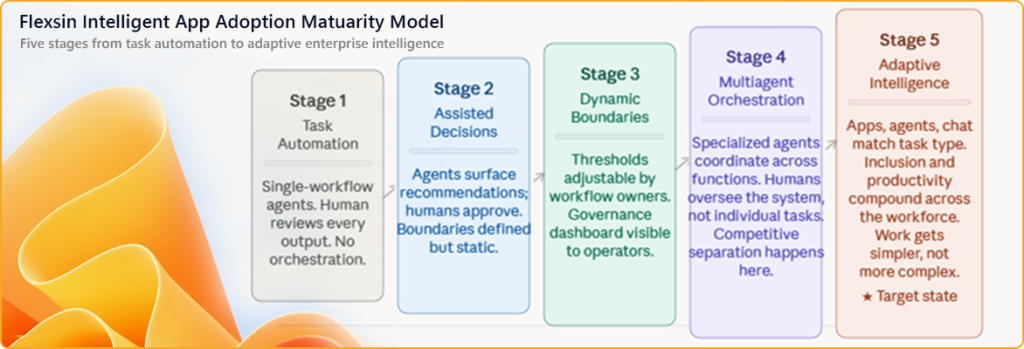
Flexsin’s Intelligent App Adoption Maturity Model maps where organizations sit and where the design work actually happens. It runs five stages, each requiring different decisions before progression makes sense.
| Stage | Posture | What the design work looks like |
|---|---|---|
| 1 | Task Automation | Single-workflow agents. Human reviews every output. No orchestration layer. |
| 3 | Adjustable Boundaries | Thresholds adjustable by workflow owners. Governance dashboard visible to operators. |
| 4 | Multiagent Orchestration | Specialized agents coordinate across functions. Humans oversee the system, not individual tasks. |
| 5 | Adaptive Intelligence | Apps, agents, and chat match task type. Inclusion and productivity compound across the workforce. |
Most mid-market enterprises enter at Stage 1 or 2 of enterprise AI applications and mistake that for completion. Architecture debt accumulates quietly until the first cross-departmental deployment surfaces it. Stage 4 for AI enterprise apps adoption is where competitive separation happens. Specialized agents – one validating data, another checking records, another recommending an outcome – create resilience and reuse. One change of AI app architecture updates one component; an agent built for one process often supports adjacent ones.
The right tool for each task matters as much as the orchestration. Apps, agents, and chat each earn their place – and when they work together, work gets simpler. Most enterprises working on AI business applications aren’t at Stage 5 yet, which is precisely where the opportunity sits.
Flexsin’s Perspective on Intelligent Apps Adoption
We’ve seen the architecture failure repeat across verticals. A mid-sized US financial services firm – 800 employees, operations across three states – came to Flexsin intelligent apps development company, after deploying two independent AI agents producing conflicting outputs on compliance workflows. The agents weren’t broken. The orchestration layer didn’t exist. Six weeks of Flexsin’s intelligent app design work on Microsoft Power Platform – Power Apps, Power Automate, and Copilot Studio – produced a multiagent architecture with visible decision boundaries and a governance dashboard the compliance team could actually operate. Manual review time on flagged cases dropped 38%.
Flexsin’s Agentic AI development and Power Platform practices approach intelligent apps adoption design as an architecture problem first. Define decision boundaries before deploying automation. Design the governance layer for intelligent apps adoption before expanding scope. Build reuse into agent structure from the start. Organizations that skip this sequence for enterprise AI applications spend 18 months rebuilding.
How Intelligent Apps Adoption Architecture Delivers Outcomes
Well-designed intelligent apps adoption produces specific, measurable outcomes. Logistics organizations coordinating forecasting and procurement through multiagent AI systems deployment report delays cut by up to 40%. Customer support organizations using orchestrated agent architectures reduce call times by nearly 25% and transfers by up to 60%, according to recent industry benchmarks. JPMorgan’s multiagent orchestration deployment produced 83% faster research cycles and automated over 360,000 manual hours annually.
These outcomes of enterprise AI strategy aren’t from more capable models for intelligent apps adoption. They’re from better architecture. Organizations achieving 18%+ ROI from agentic deployments share one characteristic – AI governance framework built in from day one.
Where Complexity Moves in Intelligent Apps Adoption
Intelligent app design doesn’t remove complexity – it relocates it. The operational decisions that used to live in individual workflows now live in the architecture. That requires skills many enterprise IT teams don’t currently have: orchestration design, decision-boundary governance, and multiagent state management.
- Low-code platforms lower the technical barrier, but not the design barrier. An organization that doesn’t know where human judgment belongs will replicate that confusion in the agent layer.
- Multiagent AI systems introduce new failure modes. Poorly structured data, enterprise AI deployment strategy, or weak orchestration can produce conflicting actions at scale – eroding stakeholder confidence rapidly.
- Human-in-the-loop is not free. Review workflows require design time, change management, and ongoing calibration.
- Governance built as a retrofit costs three to four times as much as governance built from the start.
People Also Ask
What is an intelligent app in enterprise AI?
An intelligent app is an operating surface where agents, data, and human oversight work together inside existing workflows. It goes beyond embedding a chatbot – it’s the adaptive environment where judgment, automation, and governance meet.
How does human-in-the-loop work with AI agents?
Organizations define transaction thresholds and risk parameters for intelligent apps adoption that determine when agents act autonomously and when humans review. These boundaries about intelligent apps adoption are visible, adjustable, and tied to business risk rather than arbitrary technical limits.
Why is multiagent orchestration better than a single AI agent?
Specialized agents create resilience – one change updates one component, not everything. They also create reuse: an agent built for one process often supports adjacent workflows, compounding value over time.
What role does Microsoft Power Platform play in intelligent app design?
Power Platform provides the low-code operating environment where apps, agents, Power Automate flows, and Copilot Studio agents converge. It enables teams working on intelligent automation platforms to build apps with governance and data access built in, not bolted on.
Ready to design the architecture, not just the agent?
Flexsin’s AI development and Microsoft Power Platform teams help enterprise and mid-market organizations build intelligent apps with real decision boundaries, multiagent orchestration, and governance that scales.
Contact Flexsin Technologies today.

Common Questions Answered
1. What are intelligent apps?Intelligent apps enterprise applications are AI agents that operate inside existing workflows. They provide agents with context, data, and governance rather than running in isolation.
2. How do intelligent apps differ from traditional automation? Traditional automation follows fixed rules. Intelligent apps adapt: agents reason, recommend, and escalate based on defined decision parameters that teams working on AI business applications can adjust
3. What is multiagent orchestration?Multiagent orchestration coordinates specialized AI agents so each handles a specific function. One validates data, another checks records, another recommends outcomes – all overseen by humans.
4. How long does intelligent app deployment take with Power Platform?Structured deployments on Power Platform typically achieve production-ready multiagent workflows in six to twelve weeks. Complex governance layers require additional time for intelligent apps adoption.
5. What does human-in-the-loop cost in practice? Review workflows, change management, and calibration add 20-35% to initial intelligent apps adoption scope. Organizations that skip this in AI business applications deployment pay three to four times more in retrofits later.
6. Can low-code platforms support enterprise-grade intelligent apps?Yes. Microsoft Power Platform supports multiagent orchestration, Dataverse governance, and Copilot Studio integration. Low-code lowers technical barriers; design decisions still require expertise.
7. What is the ROI of intelligent apps?Organizations report average 171% ROI from well-designed agentic AI deployments. Top performers exceed 18% ROI. Poorly orchestrated deployments return closer to 7%.
8. How does Flexsin approach intelligent app strategy?Flexsin defines decision boundaries and governance architecture before deploying agents. The sequence – design first, automate second – prevents the most common rebuild scenarios.
9. What industries benefit most from intelligent apps?Financial services, healthcare, manufacturing, and logistics show the strongest early returns. Any industry with high-volume decision workflows and regulatory review requirements is a strong candidate.
10. How do intelligent apps support workforce inclusion?When agents handle meeting summaries, data retrieval, and routine decisions, cognitive load drops. More contributors participate effectively regardless of working style or information access.
