

 +1.844.3539.746
 info@flexsin.com
 Munesh Singh
Enterprise teams are increasingly adopting Odoo CRM software because it unifies sales execution and forecasting into a single, adaptable system that scales with operational complexity. Instead of managing disconnected tools for pipeline tracking, reporting, and planning, leadership teams gain one coherent view of revenue performance. This shift enables real-time sales visibility, more predictable revenue planning, and data-backed decision-making across the full customer lifecycle.
Sales leaders today face a structural problem rather than a tooling problem. Pipeline data is fragmented across CRMs, spreadsheets, email systems, and finance tools. Forecasts are still driven by manual rollups, subjective judgment calls, and last-minute revisions. Automation exists, but it often sits on top of broken processes instead of improving them. Odoo CRM software is gaining traction because it addresses these challenges as an integrated system, not a collection of features layered together.
Unlike point CRMs that optimize only for sales activity, Odoo Customer Relationship Management (CRM) software is designed as part of a broader enterprise platform. Sales forecasting is not treated as a standalone report produced at the end of the quarter. Instead, it emerges naturally from clean data, consistent process design, CRM automation, and tight integration across finance, operations, and customer touchpoints. This systemic alignment by the CRM development company is what enterprise teams are responding to as forecasting accuracy becomes a business-critical requirement.
The Strategic Role of Odoo CRM Software in Sales
Odoo CRM software plays a foundational role in how organizations structure, measure, and scale revenue operations. It moves CRM beyond the boundaries of a sales department and positions it as a shared operational layer that connects strategy, execution, and outcomes.
By standardizing how opportunities are created, progressed, and closed, Odoo CRM solutions provide a common revenue language across teams. Sales, finance, leadership, and operations all work from the same dataset, reducing internal friction and improving trust in reported numbers.
From Activity Tracking to Revenue Intelligence
Traditional CRMs focus on logging calls, emails, and deals. While useful, this activity-centric approach provides limited strategic insight. An Odoo CRM company reframes CRM as a revenue intelligence engine. Every lead, opportunity, quotation, and customer interaction contributes to a continuously updated sales and forecasting model.
Sales forecasts become living outputs rather than quarterly exercises. Pipeline health, deal velocity, win probability, and expected revenue are calculated from actual activity patterns instead of static assumptions. Leaders can identify risks early, understand which deals truly matter, and intervene before performance gaps widen.
Why Sales and Forecasting Must Be Built Together?
Sales and forecasting often fail when they are treated as separate functions. Sales teams focus on closing deals, while forecasting becomes a reporting obligation handled after the fact. Odoo CRM software embeds forecasting logic directly into the sales workflow itself.
Stage definitions, probability rules, expected close dates, and revenue weighting are enforced through system configuration rather than policy documents. This ensures consistency across teams and regions. As a result, forecast variance is reduced, accountability is built into every pipeline stage, and leadership gains confidence in forward-looking numbers.
Core Architecture of Odoo CRM Software
Understanding the architecture of Odoo CRM software explains why it performs effectively at enterprise scale while remaining flexible as organizations grow and evolve. The platform is designed around a unified data foundation, modular application layers, and configurable business logic. This architectural approach by the CRM development company allows enterprises to standardize sales operations without sacrificing adaptability.
At its core, Odoo CRM software operates on a single, shared data model that connects leads, opportunities, quotations, customers, and revenue events. This eliminates data silos that typically distort sales forecasts and reporting. Every sales action updates the same system of record, ensuring consistency across teams, regions, and reporting views.
Modular Design with Enterprise Control
The Odoo CRM module operates within a modular architecture. Sales teams can activate only the components they need while maintaining a shared, enterprise-wide data model. This modularity of Odoo development solutions allow CRM for small businesses to evolve into enterprise-grade deployments without replatforming or data migration.
Modules for invoicing, subscriptions, inventory, marketing, and customer support connect natively. Odoo development consulting eliminates integration debt, reduces reliance on third-party connectors, and ensures that revenue data flows cleanly across the organization.
Data Model Built for Forecast Accuracy
Odoo CRM consulting firm uses a unified object model for leads, opportunities, quotations, and orders. Each stage represents a measurable business event rather than an abstract status. This consistency ensures that sales forecasts are derived from transactional truth instead of estimates or duplicated records.
Forecast rollups can be analyzed by team, geography, product line, or time horizon without data duplication. Leadership can drill down from high-level revenue projections to individual deal assumptions with full transparency.
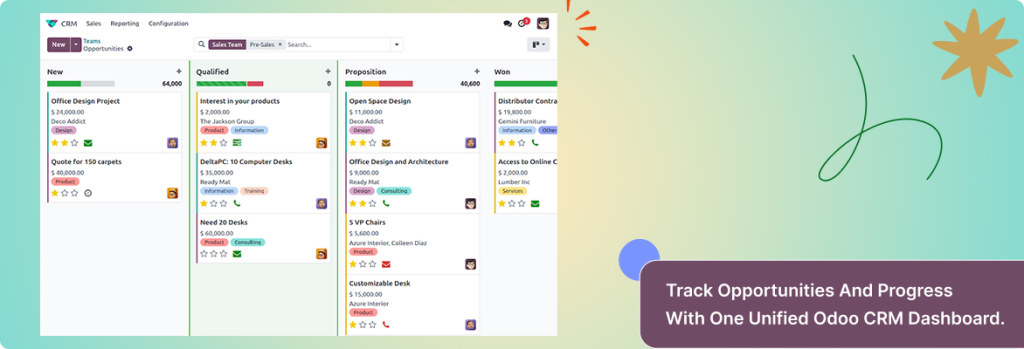 Source: Odoo
CRM Automation as a Forecasting Accelerator
CRM automation is not just about efficiency. Within Odoo CRM ecosystem, automation directly improves forecast reliability by enforcing discipline and reducing human bias.
Automated Lead Qualification and Scoring
Lead scoring rules ensure that only qualified opportunities enter the active pipeline. Scoring models can factor in source quality, engagement behavior, deal size, and historical performance. This reduces noise in sales and forecasting and increases confidence in forward-looking numbers.
Unqualified leads are filtered early, allowing sales teams to focus effort where it has the highest impact.
Activity Predictions and Pipeline Hygiene
Automated reminders, stage progression rules, and inactivity alerts keep pipelines accurate and current. Deals that stall are flagged automatically. Sales managers no longer rely on manual reviews to identify risk.
A clean pipeline is the foundation of accurate sales forecasts. Odoo CRM consultants enforce that cleanliness through system logic rather than constant oversight.
CRM Integration as an Enterprise Multiplier
CRM integration determines whether forecasts reflect operational reality or sales optimism. In enterprise environments, forecasting accuracy depends less on individual deal updates and more on how tightly sales data is connected to finance, delivery, and customer operations. Odoo CRM software treats integration as a core capability rather than a secondary enhancement, which is why it functions effectively at scale.
Finance and Revenue Alignment
Odoo CRM software integrates sales data with accounting and billing systems. When a deal closes, it translates into actual revenue records rather than remaining a projected number. Forecast-to-actual variance can be tracked automatically over time.
This alignment by Odoo development services allow finance teams to trust sales forecasts and enables leadership to make capital and hiring decisions with greater confidence.
Operations and Delivery Signals
For service-driven enterprises, CRM integration with project and resource modules ensures that forecasted revenue aligns with delivery capacity. Sales forecasts are evaluated alongside workload, staffing, and timelines, preventing overcommitment and execution risk.
Odoo CRM Software for Decision Makers
CTO and CIO:
CTOs and CIOs focus on architecture, scalability, and CRM integration across the enterprise technology stack. They evaluate Odoo CRM solutions for their ability to serve as a long-term platform rather than a short-term tool.
IT DirectorIT Directors are concerned with CRM implementation effort, customization control, upgrade paths, and long-term maintenance. The modular design of Odoo reduces technical complexity while preserving flexibility.
Founder and Business HeadFounders and business leaders prioritize predictable sales forecasts, improved pipeline visibility, and faster revenue realization. Odoo CRM company supports these outcomes by connecting strategy to execution.
Digital Transformation LeadDigital transformation leaders evaluate Odoo CRM software as part of a broader modernization roadmap. Its ability to unify data, sales and forecasting, and support future analytics makes it a strong foundation for transformation initiatives.
How Flexsin Delivers Enterprise Value with Odoo CRM Software
At Flexsin, we see Odoo development solutions succeed when it is treated as a revenue system, not just a sales tool. The strongest outcomes come from aligning CRM automation, CRM integration, and forecasting logic with how the business actually operates. Odoo CRM implementation works best when architectural decisions are made upfront, rather than patched later through customization.
Enterprise teams are not choosing Odoo CRM development for novelty. They are choosing it because it brings discipline, transparency, and predictability to sales and forecasting within a single operational system.
If you are evaluating Odoo CRM software as part of a broader enterprise transformation, Flexsin Technologies helps organizations design, implement, and scale CRM platforms that deliver measurable business outcomes across sales, forecasting, and operations.
Frequently Asked Questions
1. What makes Odoo CRM software suitable for enterprise forecasting?Odoo CRM software is built to generate forecasts as a byproduct of daily sales activity rather than as a separate reporting exercise. Real-time activity data, standardized pipeline stages, and probability-based revenue weighting ensure that forecasts continuously adjust as deals progress. Native integration with finance and billing systems allows forecasted revenue to be validated against actual outcomes, improving confidence in forward-looking numbers.
2. Can Odoo CRM support complex enterprise sales models?Yes. The Odoo CRM module supports multi-stage pipelines, multi-entity organizations, region-specific sales processes, and advanced probability rules. Enterprises can model long sales cycles, account-based selling, channel partners, and recurring revenue structures without fragmenting data. This flexibility allows organizations to reflect real-world selling behavior while maintaining forecast consistency.
3. Is Odoo CRM only for small businesses?No. While CRM for small businesses is a common entry point, Odoo CRM software is designed to scale into enterprise environments. Its modular architecture allows organizations to start lean and progressively activate advanced capabilities such as automation, integrations, and analytics. This eliminates the need for costly platform migrations as complexity increases.
4. How long does Odoo CRM implementation typically take?An enterprise-grade Odoo CRM implementation typically takes between 8 and 16 weeks. The timeline depends on the number of integrations, data migration requirements, and level of process standardization. Organizations that invest time upfront in process design and forecasting logic often see faster adoption and stronger outcomes.
5. Does Odoo CRM software require heavy customization?Most enterprise requirements can be met through configuration rather than custom development. Odoo CRM software offers flexible stage definitions, automation rules, and reporting models out of the box. Custom development by CRM consulting firm should be reserved for strategic differentiators or unique business workflows, not core CRM functionality. This approach reduces long-term maintenance risk.
6. How does CRM automation improve forecast accuracy?CRM automation enforces data discipline across the sales lifecycle. Automated lead qualification, activity reminders, stage progression rules, and inactivity alerts reduce pipeline decay and manual manipulation. As a result, forecast inputs remain current and consistent, leading to more reliable sales forecasts without additional management overhead.
7. What systems can Odoo CRM integrate with?Odoo CRM software integrates with finance, ERP, marketing, customer support, inventory, and external systems through native connectors and APIs. This ensures that sales forecasts reflect operational and financial reality rather than isolated sales projections. Integration also enables cross-functional reporting and end-to-end revenue visibility.
8. Is Odoo CRM software suitable for global sales teams?Yes. Odoo CRM software supports multi-currency transactions, multi-language interfaces, and region-specific reporting structures. Global sales teams can operate within localized processes while leadership maintains centralized forecast visibility across regions, products, and business units.
9. Should enterprises work with a CRM consulting partner?Yes. A CRM consulting partner helps enterprises avoid structural design mistakes, align CRM implementation with business objectives, and accelerate value realization. Experienced partners also ensure that forecasting logic, integrations, and automation are designed for scale rather than short-term convenience.