

 +1.844.3539.746
 info@flexsin.com
 Munesh Singh
Table of Contents:
- The Complexity Startup Teams Are Already Facing
- Where MVP Programs Most Commonly Break Down
- The Flexsin Startup MVP Execution Framework
- The Flexsin Take
- What to Validate Before Your MVP Development for Startups Begins
- Where It Gets Harder
- People Also Ask
- What Leaders Ask Us
Most startup launch strategies don’t fail because the idea was bad. They fail because the team built too much before anyone confirmed real demand. According to CB Insights, 42% of startup failures trace to no market need – a gap that disciplined MVP development for startups would have caught in weeks. This guide gives you the execution architecture that closes that gap.
The minimum viable product has become one of the most misapplied ideas in early-stage product development. Founders hear “ship fast” and interpret it as ship anything. That instinct burns budget, poisons early-adopter goodwill, and produces data that can’t answer the question you need answered: does this solution solve this problem well enough that someone will pay for it? The honest answer is that most MVPs fail not because they were lean, but because they weren’t strategic.
Think of it like opening a restaurant. You don’t start by perfecting every dish on a forty-item menu. You launch with five dishes, watch which ones sell out by Wednesday, and build the full menu around what you know works. The founders who win are not the ones who ship fastest – they are the ones who learn fastest. That distinction in startup software development drives every decision in the framework below.
Before You Read On:
- Approximately 90% of startups fail globally – and a disciplined MVP reduces that exposure significantly by testing demand before full investment.
- The top three investor-ready MVP killers are misidentified target users, skipped budget validation, and premature startup feature scoping – each addressable before a single line of code is written.
- Tech stack for MVP decisions made about early-stage product validation in week one routinely determine whether the product can grow in year two – treat them accordingly.
- Feedback loops that close within 48 hours of user contact produce decisions that feedback loops closing in two weeks cannot.
- Startups that integrate user hypothesis testing analytics from launch day are twice as likely to iterate successfully than those adding them post-launch.
- An MVP is not a prototype – it is a functional, user-facing product designed to generate real behavioral data from real paying or near-paying users.
The Complexity Startup Teams Are Already Facing
Every startup MVP development company arrives at the MVP stage carrying three conflicting pressures: the investor who wants traction, the engineer who wants more time, and the customer who hasn’t confirmed what they need.
Managing all three simultaneously is the actual job for any startup MVP development company. Most early teams aren’t structured about how to build an MVP for a startup.
The data is unforgiving. A recent study of startup cohorts found that 67% of failures happened because teams built products nobody wanted – not because of technical problems, but because validation steps were skipped. Premature scaling compounds the issue: over 70% of startups that collapse between year two and year five attribute the failure to scaling before product-market fit was confirmed.
There is a counterintuitive insight buried in these numbers about product market fit validation. Most founders believe their biggest risk is moving too slowly. The actual risk in startup launch strategy is moving too fast in the wrong direction – building toward a definition of “done” that the market never agreed to for product market fit validation.
Where MVP Development for Startups Commonly Break Down
The failure patterns are consistent enough to read like a minimum viable product checklist of what not to do.
Fuzzy Problem Definition
Teams that can’t articulate their user’s core problem in a single sentence can’t build a focused MVP. What ships is a product that solves five medium problems and none of them well. Define the problem narrowly enough to validate one hypothesis per launch cycle.
Underspecified User Personas
“SMB owners” is not a persona. “A solo-founder running a US-based e-commerce store on Shopify with under $500K annual revenue who manages customer support manually” is a persona. That specificity makes UX decisions defensible, MVP feature prioritization rational, and the launch channel obvious.
Budget Validated Too Late
Founders of MVP startup development company frequently underfund post-launch iteration in startup product development services – the phase where actual learning happens. MVP development cost for startups ranges between $30,000 and $300,000 depending on complexity. Teams that run out of runway treated the launch as the finish line, not the starting gun.
Wrong Team Structure
The choice between in-house and outsourced custom software development for startups matters less than the clarity of communication between builder and decision-maker. Agile MVP development process with genuine sprint reviews – not theatrical ones – are the structural fix for this failure mode.
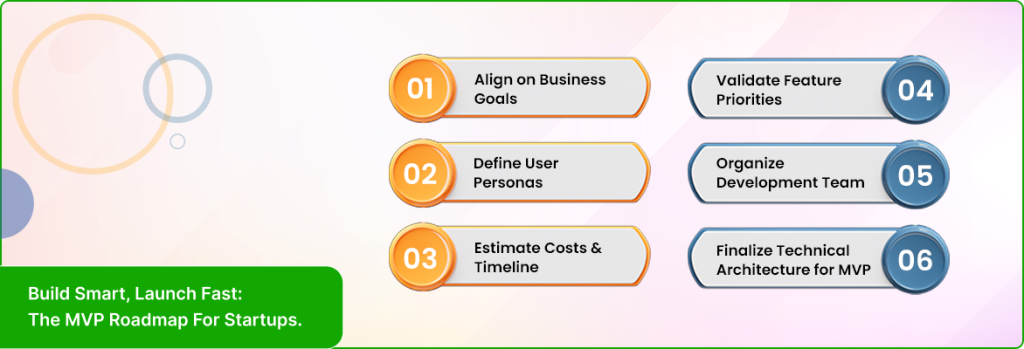
Our Framework for MVP Development for Startups
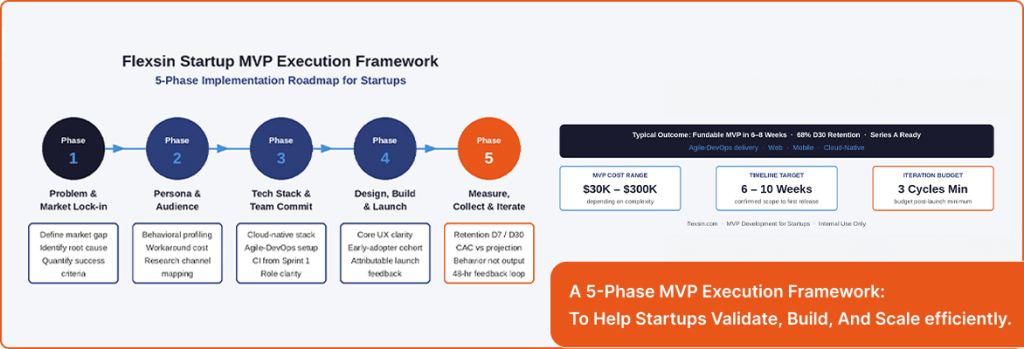
What follows is the Flexsin Startup MVP Execution Framework – a phased lean startup methodology for moving from raw idea to a funded-ready product with minimum wasted motion.
Phase 1 – Problem and Market Lock-in
Before any design work for MVP development for startup begins, answer three questions with evidence: What market gap does this product address? Why does this problem lack a good solution? What does success look like in quantifiable terms for sprint-based development? Founders who can’t answer all three with data are not ready to proceed to outsource MVP development.
Phase 2 – Persona and Audience Sharpening
Generic audiences produce generic products. The persona work here goes beyond demographics and product market fit validation into behavioral specifics: How does this person currently solve the problem? What is the cost of their workaround for user hypothesis testing? Where do they research solutions for product market fit validation? A well-constructed persona for startup software development makes every design and prioritization decision faster.
Phase 3 – Tech Stack and Team Commitment
The tech stack chosen for an MVP startup product development services rarely matches the stack the final product runs on – but it determines the refactoring cost later. Cost-effective, cloud-native options that align with the product’s growth requirements are the target. Agile-DevOps delivery structures, with a well-defined product development roadmap startup from the first sprint,-based development reduce the compounding cost of technical debt.
Phase 4 – Design, Build, and Launch
UX at the MVP user testing and iteration stage is not decoration – it is the mechanism through which you learn. A design that confuses users corrupts the data you collect from them. The goal is clarity and completeness for the core user journey, not visual richness. Launch to a defined early-adopter cohort so that feedback is attributable and usable.
Phase 5 – Measure, Collect, and Iterate
The metrics that matter about MVP vs prototype difference here are narrow: user acquisition rate, day-7 and day-30 retention, conversion from trial behavior to committed use, and Customer Acquisition Cost against initial projections. Most startup MVP development companies get this backwards – they measure outputs instead of behaviors. Behavior data tells you what to build next; output data tells you what you already built.
The Flexsin Take
At Flexsin, we have delivered product engineering and custom software development for startup clients across healthcare, fintech, and logistics – including a Metaverse MVP for Fujairah Police in the UAE that redesigned citizen-facing public services from scratch. The consistent pattern across successful engagements is not the tech stack or the budget. It is the clarity of the problem definition in week one. Teams that arrive with a well-tested hypothesis for lean startup methodology ship a fundable MVP in six to eight weeks. Teams that arrive with a feature list ship something that satisfies no one.
Our Agile-DevOps delivery model, applied across web, mobile, and cloud-native architectures, is built to compress learning cycles – not just delivery cycles. When a mid-size US-based logistics startup engaged Flexsin startup app development company for MVP development, the initial feature set was cut by 40% in the product discovery phase. The leaner product launched in seven weeks, retained 68% of beta users at day 30, and secured its Series A within four months of launch. What nobody says out loud is that the features cut were the ones the founding team was most emotionally attached to. The market didn’t miss them.
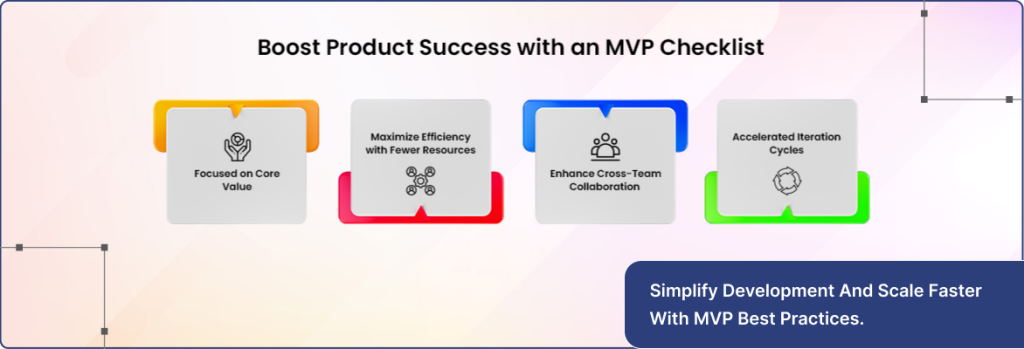
What to Validate Before MVP Development for Startups Begins
The execution of minimum viable product checklist below by startup app development company represents the critical prerequisites every startup team should clear before moving from ideation to build.
- The problem statement passes the one-sentence test.
- The target persona is named, behavioral, and verified through at least five real user conversations.
- The budget covers not just build, but three full iteration cycles post-launch.
- The team structure includes a clear owner for product decisions and a clear owner for technical decisions related to product discovery phase – and they are not the same person.
- The tech stack for MVP feature prioritization is confirmed by the development team against scale requirements, not chosen by the founder based on familiarity.
- The success criteria are quantified, time-bound, and agreed upon before the first sprint.
- What this comes down to is a single discipline: the willingness to answer hard questions before they become expensive answers.
MVP Development for Startups: Where It Gets Harder
No MVP development framework eliminates the core risk of a startup. Even a well-executed MVP can validate the wrong learning – especially when the early-adopter cohort is too small, too friendly, or too different from the actual target customer. This is not an edge case; it is a documented failure mode.
Outsourced MVP development for startups introduces a communication overhead that in-house teams avoid. That overhead is manageable with the right engagement model and genuinely agile MVP development process – but founders who treat the external team as a vendor rather than a product partner will pay for it in misaligned output. Budget discipline is also harder in practice than in planning: research from a recent year found that 82% of businesses that collapsed did so because of financial mismanagement, not market misread. The MVP checklist discipline about MVP vs prototype difference described in this article is a countermeasure, not a guarantee.
People Also Ask:
What is an MVP in startup development?An MVP is a functional product with only the core startup feature scoring needed to test a specific user problem with real customers. It’s not a prototype – it is designed to generate real behavioral data, not internal feedback.
How long does it take to build an MVP?Most MVPs built under a disciplined Agile-DevOps process take six to ten weeks from confirmed startup feature scoping to first user release. Scope inflation is the primary cause of timelines extending past twelve weeks.
What is the average cost of MVP development for startups?MVP development cost for startups typically range from $30,000 to $300,000 depending on complexity and team structure. Budget for at least two post-launch iteration cycles.
Should I outsource MVP development for startups, or hire in-house?Both work when the communication model is right. The deciding factor is usually runway length and team structure.
Flexsin has helped startups across the US, UAE, and Europe move from user hypothesis testing to investor-ready MVP – in six to eight weeks, on budget, with real user traction. Our MVP development for startups engagements run inside Agile-DevOps delivery models built specifically for early-stage product velocity. If your founding team is ready to stop guessing and start learning, talk to Flexsin Technologies – the earliest decision you make determines the quality of every decision that follows it.
What Leaders Ask Us
1. What makes an MVP different from a prototype? A prototype is an internal concept model for testing design or functionality within the team. An MVP is a live product released to real external users to generate behavioral and market data.
2. How do I prioritize MVP features? Use the MoSCoW method: categorize every proposed feature as Must-have, Should-have, Could-have, or Won’t-have. Only Must-haves ship in the first release.
3. What tech stack should a startup app development company use?Choose a tech stack for MVP feature prioritization that your core team can ship in and that your cloud provider supports natively. Avoid proprietary infrastructure at MVP stage – buy or rent, build later.
4. How do I measure whether my MVP development for startups is working?Track day-7 retention, net promoter score from early adopters, and conversion from trial to return use. These three together indicate whether the core value hypothesis is holding.
5. When should I stop iterating on the MVP and build the full product?When you have repeatable acquisition, measurable retention above 40% at day 30, and at least one revenue signal. That signal can be a paid user, a signed letter of intent, or a committed investor.
6. What is the biggest mistake founders make with their MVP development for startups?Treating the launch as the finish line rather than the starting point. The MVP delivers its value in iteration cycles after launch, not on the day it ships.
7. How do I choose the right partner for my MVP development for startups? Evaluate on communication cadence and sprint review quality, not portfolio size. A partner who shows working software every two weeks is worth more than one with an impressive logo wall.
8. Does my MVP for startups need a full QA process?Yes – but scoped to the core user journey. Testing the critical path for your primary persona and startup feature scoping keeps early-adopter feedback clean and usable.
9. Can I build an MVP with no-code or low-code tools?For validation-stage MVPs in low-complexity domains, yes. For products where the technology is the value proposition – fintech, healthtech, logistics – custom software development for startups avoids costly rebuilds later.
10. How does Flexsin approach MVP development for startups?Flexsin runs startup MVPs through a five-phase agile MVP development process: problem validation, persona sharpening, tech stack confirmation, design-build-launch, and instrumented iteration. Every phase has a defined output before the next starts.