

 +1.844.3539.746
 info@flexsin.com
 Munesh Singh
The most sought after open-source licenses in 2026 are those that balance freedom to innovate with legal clarity for enterprise deployment, especially in AI-driven platforms. As Agentic analytics, cloud-native systems, and AI-first service strategy models mature, licence selection has become a core part of enterprise software licensing models rather than a legal afterthought.
Open-source adoption is no longer limited to experimentation or developer tooling. It underpins mission-critical platforms across analytics, automation, and service operations management. In line with open-source licensing trends 2026, enterprises evaluate licences based on scalability, commercial safety, license compatibility, and enterprise open-source governance readiness.
The demand curve has shifted away from ideological purity toward operational pragmatism. Popular open source licenses today are those that enable collaboration without constraining downstream commercial models, making them suitable for large-scale enterprise open source licensing.
Increased enterprise demand for reshaped open-source licenses in 2026
Enterprise demand has fundamentally reshaped how open-source licenses are evaluated and applied by 2026. As software development shifted toward microservices, managed cloud platforms, and AI-centric architectures, traditional assumptions about distribution, ownership, and reuse no longer held. These changes forced organizations to reassess risk across modern software licensing models, moving beyond simple usage rights to a deeper focus on compliance, governance, and long-term sustainability.
Commercial AI and service platforms drove permissive adoption
The rapid growth of commercial AI and service platforms has been a major driver behind the widespread adoption of permissive licences. AI-first service strategy initiatives increasingly depend on combining open-source cores with proprietary intelligence layers, including models, optimization logic, and decision engines. Permissive licences make this hybridization possible by allowing organizations to build, extend, and commercialize open-source components without triggering mandatory source code disclosure.
The most sought after open-source licenses in 2026
Demand concentration in 2026 reveals a clear and consistent pattern across enterprise technology environments. A relatively small group of the most popular open source licenses continues to dominate large-scale deployments due to their predictability, ecosystem maturity, and legal simplicity. These licences have been battle-tested across cloud, AI, and enterprise software platforms, giving CIOs and architects confidence in their long-term stability. As a result, open source license comparison has become a strategic decision-making exercise, focused on balancing innovation speed, compliance risk, and commercial flexibility.
Permissive licences leading enterprise adoption
Permissive licences allow reuse with minimal restrictions, making them ideal for cloud platforms, analytics engines, and service orchestration layers.
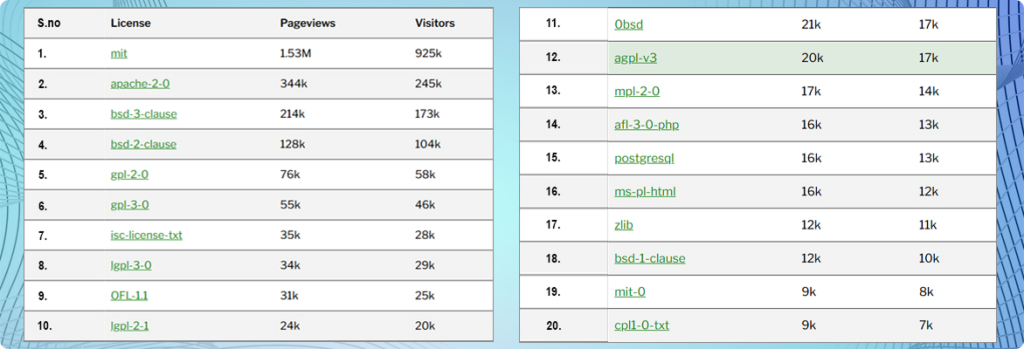
Apache License 2.0 is widely favored due to its explicit patent protections and enterprise-safe language, positioning it among the best open source licenses for commercial use. MIT License remains popular for libraries and tooling due to its simplicity and low compliance overhead. BSD-style licences continue to appear in infrastructure components where flexibility outweighs governance needs.
Copyleft licences with controlled enterprise use
Copyleft licences still play a role where community reciprocity is desired. GPLv3 remains relevant for standalone systems and internal platforms but is carefully evaluated when deployed in customer-facing or SaaS environments due to open-source compliance implications.
LGPL maintains niche relevance where shared improvements are beneficial without forcing full code disclosure, particularly in shared libraries.
Open-source licenses architecture considerations for enterprises
Licence choice now aligns with architectural layers rather than entire platforms, reinforcing structured enterprise open-source governance and reducing downstream compliance risk. Instead of applying a single licensing philosophy across the stack, enterprises evaluate how each layer contributes to scalability, differentiation, and commercial exposure, then select licences accordingly to maintain control and flexibility.
Core infrastructure layer
At the core infrastructure layer, operating systems, container orchestration platforms, and networking components typically favor permissive or weak copyleft licences. This approach ensures license compatibility across multiple cloud providers and deployment models, enabling portability and avoiding vendor lock-in. For enterprises operating hybrid or multi-cloud environments, these licences provide the legal clarity needed to scale foundational services without introducing restrictive redistribution obligations.
Intelligence and analytics layer
Within the intelligence and analytics layer, analytics engines, Agentic analytics frameworks, and optimization modules prioritize licences that allow extensive internal modification while avoiding mandatory external disclosure. These components often embed proprietary logic, decision models, or performance optimizations that directly impact competitive advantage.
Application and experience layer
In the application and experience layer, user-facing services and field service management applications commonly integrate open-source components under permissive terms. This enables rapid development and ecosystem integration while protecting differentiation at the experience and workflow level. From a governance perspective, permissive licensing at this layer also simplifies open-source compliance management.
Use cases shaping open-source license demand
Enterprise AI platforms, analytics engines, and large-scale data processing frameworks typically rely on permissive licences to ensure scalability and vendor neutrality. In secondary contexts, field service optimization tools, service operations dashboards, and conversational analytics interfaces favor open-source libraries governed by licences that simplify audits and open-source compliance workflows.
Niche deployments such as embedded systems and edge analytics tend to adopt lightweight licences with minimal attribution requirements to reduce overhead, while industry-specific environments including healthcare, manufacturing, and utilities prioritize licences that support regulated operations without limiting AI-driven innovation.
Here’s the top 20 OSI-approved licenses in 2026 (Pageviews)
Best practices for selecting open-source licenses in 2026
Selecting the right open-source licenses in 2026 requires a deliberate, architecture-led approach rather than ad hoc dependency decisions. Enterprises should map licences to specific architectural layers, evaluate downstream commercial exposure, and ensure alignment with broader AI-first service strategy objectives. Legal, engineering, and platform teams must collaborate early to embed open-source compliance into design and procurement workflows, rather than addressing it reactively.
Limitations and emerging risks
Despite growing maturity, open-source licensing presents ongoing challenges. Licence sprawl across modern stacks increases compliance complexity and makes dependency tracking more difficult at scale. Ambiguity around AI-generated artifacts, model outputs, and autonomous decision systems remains unresolved in many existing licences, creating interpretive and legal uncertainty. Flexsin supports organizations by identifying high-risk dependencies, rationalizing licence portfolios, and implementing open-source compliance management practices that scale with platform growth.
Licensing as a strategic AI enabler
Flexsin approaches open-source licenses as a foundational architectural decision rather than a routine legal requirement. In AI-driven platforms, licence choices directly shape scalability, monetization potential, and ecosystem participation for both SMBs and large enterprises. Leveraging deep expertise in enterprise AI, cloud modernization, and digital transformation, we help organizations evaluate, select, and govern open-source licences across their technology stacks. Flexsin enables organizations to innovate rapidly with open source development services while preserving commercial control, ensuring compliance, and building resilient, future-ready platforms.
Frequently Asked Questions (FAQs)
1. Why are permissive licences more popular in 2026?
Permissive licences have gained popularity because they minimize legal friction while enabling broad commercial reuse across complex enterprise environments. They allow organizations to modify, integrate, and distribute software without triggering extensive disclosure obligations, making them well suited for AI-driven platforms, cloud-native architectures, and multi-vendor ecosystems where speed, scalability, and compliance simplicity are critical.
2. Are copyleft licences declining in relevance?
Copyleft licences are not disappearing, but their use has become more selective. They remain relevant for community-driven projects, internal systems, and scenarios where shared innovation is a strategic goal. However, the rise of SaaS and cloud delivery models has reduced their appeal in customer-facing platforms, where mandatory source code disclosure can complicate commercialization and procurement.
3. How does Agentic analytics impact licence selection?
Agentic analytics introduces autonomous decision-making into production systems, increasing the importance of licence clarity around derivative works, redistribution, and patent rights. Enterprises deploying these systems must ensure that proprietary algorithms, decision logic, and optimization models remain protected, making licences with explicit boundaries and safeguards more attractive.
4. Can open-source licences affect AI-first service strategy?
Yes, licence terms can directly influence how AI-first services are designed, deployed, and monetized. Restrictive licences may limit deployment models, constrain revenue strategies, or complicate integrations with proprietary systems, while well-chosen licences support flexibility, ecosystem growth, and long-term platform evolution.
5. Which licences are safest for field service management platforms?
For field service management platforms, permissive licences with explicit patent protections are generally the safest choice. These licences reduce compliance risk, support integration with proprietary workflows, and allow organizations to embed analytics and automation capabilities without exposing core intellectual property.
6. Do open-source licences cover AI model outputs?
Most existing open-source licences do not explicitly address AI model outputs, training data, or generated artifacts. This creates interpretive risk for enterprises deploying AI systems at scale, requiring additional governance, contractual safeguards, or internal policies to manage ownership and usage rights.
7. How often should enterprises review licence strategy?
Licence strategy should be reviewed whenever there are significant architectural changes, platform expansions, or shifts in deployment models. Regular reviews help organizations stay aligned with evolving compliance requirements, emerging licence interpretations, and changes in how open-source components are used across the stack.
8. Is MIT licence always better than Apache?
MIT is not always better than Apache. While MIT offers simplicity and minimal obligations, Apache provides explicit patent protections that are highly valued in enterprise AI and analytics environments. The choice depends on risk tolerance, commercial intent, and the strategic importance of patent safeguards.