

 +1.844.3539.746
 info@flexsin.com
The Numbers That Prove How AI In Venture Building Is Rewriting Economics
 Sudhir K Srivastava
Let's talk
Table of Contents:
- What You Should Know First
- The Data Most Corporate Leaders Haven’t Internalized Yet
- Why Traditional Venture Cadences Are Now a Structural Disadvantage
- Flexsin’s AI Venture Maturity Framework
- Flexsin’s Take on the Use of AI in Venture Building
- Strategic Outcomes and Proof Indicators
- What This Really Means
- People Also Ask
- What Leaders Ask Us
AI-driven corporate venture building is no longer a competitive edge – it’s the new baseline. Recent McKinsey data shows that corporate ventures using AI are reaching revenue milestones seven months faster than their predecessors, at lower capital cost, and with materially smaller teams. The question for every enterprise leader today is not whether to use AI in venture building, but how fast to rewire the whole system.Here’s what most strategic planning decks still get wrong: they treat AI as one more tool in the venture toolkit, right next to market research and financial modeling.
The evidence now suggests AI functions as a foundational operating system for new-business creation – one that compresses every phase of the venture life cycle simultaneously.
A McKinsey review of hundreds of ventures launched between 2018 and 2024 found that those created in the AI era (2023-24) are producing higher output per person and per dollar, while reaching the $10 million revenue threshold faster. Among ventures that reached break-even, 61 percent did so within two years – a figure that would have seemed optimistic in 2021. The implications for how companies structure teams for AI integration in corporate venture building, set performance expectations, and deploy capital are significant.
What You Should Know First
- AI-era ventures reach $10M revenue in 31 months on average, down from 38 months in 2023 – a 7-month compression that changes break-even math.
- In an Antler survey of early-stage companies, 93 percent reported that AI accelerated execution, with nearly half citing speed gains of up to fivefold.
- Corporate venture building remains a top five strategic priority for 58 percent of experienced builders – even in conditions of economic uncertainty.
- The average break-even investment for corporate ventures fell from $125 million to $77 million in a single year – a 38 percent drop that McKinsey attributes primarily to AI-enabled efficiency.
- Three strategic shifts for the use of AI in new business development separate high-performing AI venture building from those treating AI as an add-on: reset performance expectations, build an AI backbone on day one, and encode human expertise into the system.
- 56 percent of business leaders expect their companies to build data- and AI-driven ventures in the next five years – making AI-native building the dominant expected venture type across industries.
The Data Most Corporate Leaders Haven’t Internalized Yet
Compressed timelines look like good news on a slide. They represent something harder to absorb in practice when it comes to corporate venture building strategy: the entire set of assumptions governing how much time, capital, and headcount a venture needs has shifted.
McKinsey’s 2025 new-business building survey found that 43 percent of leaders increased their focus on venture building over the prior twelve months. That’s not surprising. What is surprising is where the performance gains are actually coming from. Capital efficiency is moving faster than most strategic plans have accounted for. The weighted average investment required before a new venture breaks even dropped from $125 million to $77 million in a single year – a 38 percent reduction. That number isn’t explained by doing less; it’s explained by doing more with less, enabled by AI venture building benefits across ideation, validation, prototyping, and go-to-market.
What nobody says out loud about corporate innovation with AI is that this creates a problem for companies still planning AI venture strategy on the old economics. If competitors are reaching validation faster and at lower cost, the gap compounds. A venture that takes 38 months to prove itself is competing against one that has already iterated twice in that window. The math is unforgiving.
Why the Antler and McKinsey Findings Converge
The Antler early-stage VC survey and McKinsey’s enterprise data point in the same direction – not because they used the same methodology, but because they measured the same underlying shift. AI in venture building is compressing the cognitive and operational work of building a company: ideation that took weeks now takes an afternoon; customer research that required three-person teams is now assisted by AI agents surfacing patterns across thousands of data points for AI corporate venture building. When speed and output per person both improve simultaneously, it isn’t incremental – it’s structural.

Why Traditional Venture Cadences Are Now a Structural Disadvantage
Most enterprise venture programs were designed for a world where the constraints were capital, talent, and time – in roughly that order. Stage-gate processes, quarterly reviews, and phased funding models made sense when validation took 12 to 18 months and required full-size teams. That model is now misaligned with what AI makes possible for AI native venture building projects.
Consider what an AI venture building service can do from day one that was previously reserved for later stages: rapid hypothesis testing against real market data; automated first drafts of product specifications; AI-assisted financial modeling with scenario branches that would have taken an analyst weeks. The candid answer is that many corporate venture programs aren’t slow because of strategy – they’re slow because the governance model is calibrated to the wrong technological moment.
The Compounding Effect of AI Across Venture Phases
The use of AI in venture building creates value at ideation, validation, product build, and go-to-market – which means the efficiency gains don’t add; they multiply. A venture team that uses AI to shorten ideation by four weeks and validation by six weeks and prototype cycles by three weeks has compressed the pre-revenue phase by more than three months. In most corporate venture programs, that’s the difference between a venture surviving its first budget review and being defunded.
A 12-person team at a mid-market industrial company in the DACH region found that AI-assisted market scanning cut their time to shortlist an addressable opportunity from six weeks to under five days. The AI didn’t replace judgment – it removed the data-wrangling that consumed the team before judgment could even be applied.
Flexsin’s AI Venture Maturity Framework
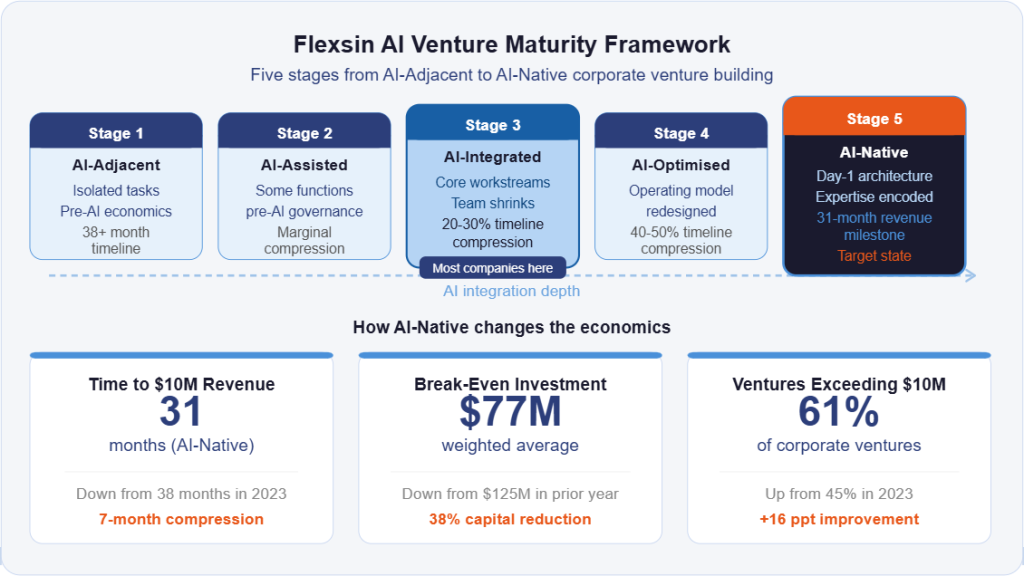
The Flexsin AI Venture Maturity Framework maps corporate ventures across five stages of AI integration – from AI-Adjacent, where AI is used in isolated tasks, to AI-Native, where AI is embedded in the operating model from the first day of venture design.
Most companies that consider themselves AI-forward are operating at Stage 2 or 3: they have deployed AI tools across some functions, but the venture team’s structure, performance targets, and governance cadence still reflect pre-AI assumptions. The gap between Stage 3 and Stage 5 of AI venture building service is not a technology gap – it’s an organizational design gap.
Stage 1 – AI-Adjacent
AI used in isolated tasks. Market research, slide generation, financial summary drafting. The venture team operates conventionally; AI is an assistant, not an architecture. Break-even timelines and capital requirements are largely unchanged from pre-AI norms.
Stage 3 – AI-Integrated
AI embedded in core work streams: product discovery, user research synthesis, competitive positioning. Team size begins to shrink because AI in venture building handles tasks that previously required dedicated roles. Timelines compress by 20 to 30 percent. Most forward-thinking corporate venture programs operate here.
Stage 5 – AI-Native
AI venture building is part of the venture’s operating architecture from day one. Human expertise is encoded into AI systems that multiply it across every team function – so that a 10-person team operates with the analytical and creative output of a team three times its size. Capital requirements drop sharply. Iteration cycles run in days, not months. This is where McKinsey’s data on compressed timelines and lower break-even investment originates.
Flexsin’s Take on the Use of AI in Venture Building
Flexsin’s enterprise AI strategy and custom software development teams have worked with corporate venture programs across financial services, advanced manufacturing, and B2B technology. What we consistently observe is that the companies making the fastest progress are not necessarily the ones with the largest AI budgets – they’re the ones that redesign their venture team’s operating model before they write a single line of code or submit a business case.
A regional financial services firm in Southeast Asia, with revenues under $500 million, cut their time from opportunity identification to working prototype by 11 weeks by embedding AI-assisted competitive analysis and automated customer interview synthesis into their venture sprint model – before hiring a single dedicated product manager for AI-first startup..
The risk we see most often is not AI underinvestment – it’s AI misdeployment. Ventures that add AI tools to an unchanged process get efficiency gains. Ventures that redesign the process around AI get compounding gains. That’s the distinction between a Stage 3 and a Stage 5 venture in the Flexsin AI Venture Maturity Framework, and in practice it’s often the difference between a venture that breaks even in 18 months and one that’s still seeking approval at month 24.
Strategic Outcomes and Proof Indicators
The McKinsey data gives us the headline: 61 percent of corporate ventures now generate more than $10 million in revenue, up from 45 percent in 2023. That’s a 16-percentage-point improvement in venture viability in two years. It correlates directly with the period of accelerated AI adoption in enterprise settings.
Leaders from companies that have built new ventures in the past five years are 13 times more likely than first-time builders to have increased their venture-building prioritization in the past year. That compounding commitment – where success breeds more structured, AI-enabled attempts – is the pattern that separates serial venture builders from organizations that treat each new AI venture building as an experiment, rather than a capability.
56 percent of business leaders expect their companies to build data- and AI-driven ventures in the next five years, making it the top expected venture category overall. Technology, media, and telecom sectors lead anticipated activity, followed by financial services and advanced industries. What this means in practice: the window for companies to build AI-native venture capability before their sector consolidates around it is narrowing.
What This Really Means
None of this means AI-native venture building is without friction. Three honest caveats deserve direct attention.
First, small-team AI leverage requires high-quality human expertise at the center. AI multiplies what’s already there – strategic judgment, domain knowledge, customer relationships. A team without those inputs won’t produce better outputs faster; it will produce faster noise. Second, AI-compressed timelines create a false sense of readiness. A venture that validates faster still needs to survive market contact. Faster validation is only an advantage if the underlying hypothesis is sound. Third, the organizational change required to move from Stage 2 to Stage 5 in the Flexsin framework is harder than deploying any individual AI tool.
Governance models, funding stages, performance benchmarks, and team incentives all need recalibration. Most companies underestimate how much structural work that represents.
People Also Ask:
How much faster do AI-era ventures reach revenue milestones?McKinsey data shows ventures in 2025 reached $10M revenue in 31 months on average, down from 38 months in 2023. That is a seven-month compression driven primarily by AI adoption.
What is the average break-even investment for a corporate venture today?The weighted average break-even investment for corporate ventures dropped from $125 million to $77 million in a single year. AI-enabled efficiency is the primary driver of that reduction.
What percentage of corporate ventures now exceed $10M in revenue?61 percent of corporate ventures generated more than $10M in revenue in 2025. That figure was 45 percent in 2023, representing a 16-percentage-point improvement over two years.
Is corporate venture building still a strategic priority in uncertain economic conditions?Yes. 43 percent of leaders increased their venture-building focus over the prior 12 months, per McKinsey’s 2025 survey. Experienced venture builders are especially committed: it is a top-five priority for 58 percent of them.
Ready to rewire your venture program around AI?Flexsin’s Enterprise AI Strategy and Custom Software Development teams help corporate venture programs move from AI-adjacent to AI-native – redesigning the operating model, not just the toolset. We have worked across financial services, advanced manufacturing, and B2B technology to deliver measurable compression in time to validation and time to revenue.
Contact Flexsin Technologies to begin with corporate AI venture innovation journey.

What Leaders Ask Us:
1. What is AI-native venture building?AI-native venture building means designing a new business from day one with AI embedded in its operating model. Teams are structured, processes are built, and performance expectations are set around AI-augmented output from the start.
2. How does AI reduce the capital required for corporate ventures to break even? AI reduces the labor and time cost of ideation, validation, and prototyping. Smaller teams can produce more output per sprint, which compresses the pre-revenue phase and reduces cumulative burn before the venture generates cash.
3. What are hybrid human-agent teams in venture building?Hybrid human-agent teams pair human experts with AI agents that handle data synthesis, research, and drafting tasks. The human provides judgment and domain expertise; the AI multiplies the volume and speed of work those humans can produce.
4. Which industries are most active in AI-driven venture building? Technology, media, and telecom sectors lead, followed by financial services and advanced industries. Healthcare and pharma are also seeing significant AI-venture activity, particularly in analytics and data platforms.
5. How long does it take for an AI-first corporate venture to break even?Among ventures that have broken even, 61 percent did so within two years. AI-first ventures operating at Stage 4 or 5 of the Flexsin AI Venture Maturity Framework typically reach break-even faster than that benchmark.
6. What is the biggest risk in AI-enabled venture building? AI misdeployment – adding tools to an unchanged process – is the most common failure mode. Ventures that do not redesign their operating model around AI get incremental gains, not the compounding efficiency gains that drive materially different economics.
7. How does AI change the team size needed for a corporate venture?AI allows smaller teams to operate with the output of much larger ones. McKinsey’s research points toward a future where billion-dollar ventures are built by teams of fewer than a dozen people, as AI handles tasks previously requiring dedicated specialist roles.
8. What is the Flexsin AI Venture Maturity Framework? It is a five-stage model mapping ventures from AI-Adjacent to AI-Native. Stage determines team design, performance expectations, and governance cadence. Most corporate ventures currently operate at Stage 2 or 3, with Stage 5 representing the benchmark for AI-first operating economics.
9. What percentage of business leaders plan to build AI-driven ventures?56 percent of business leaders expect their companies to build data- and AI-driven ventures in the next five years. This is the most commonly expected venture type across industries, according to McKinsey’s 2025 survey of 715 senior executives.
10. How can Flexsin help with AI-native corporate venture building? Flexsin’s enterprise AI strategy and software development teams work with corporate venture programs to redesign operating models, build AI backbones from day one, and encode human expertise into scalable AI systems. Contact us at flexsin.com/contact to start the conversation.
