

 +1.844.3539.746
 info@flexsin.com
The High-Impact Role of Business Intelligence Strategy in Market Success
 Chiranjit Paul
Let's talk
Table of Contents:
- Business Intelligence Strategy: Why Most Organizations Are Flying Blind
- Why Standard BI Deployments Fall Short for Market-Leading Ambitions
- Key Capabilities That Set Data-Driven Businesses Apart
- What We Have Seen Work in the Field
- What the Technology Can and Cannot Do
- Most Asked Questions
- Ready to Build Intelligence That Moves Markets?
- Top Questions Answered
Most companies that lose market position never see it coming – because they were watching the wrong signals.
They had BI dashboards for executives. They had reports. They had weekly all-hands meetings where someone showed a bar chart. What they did not have was intelligence – the kind that tells you what is about to happen before a competitor makes the first move. That gap, between data collected and intelligence acted upon, is exactly where data-driven businesses build their most durable competitive advantages.
The distinction matters enormously. Data is raw material. Business intelligence is the manufacturing process. And what rolls off the line – when the process works – is clarity: who your customers will be next quarter, which markets are softening before the revenue line confirms it, and where your operational costs are silently bleeding margin. According to McKinsey, organizations that use data-driven decision making are 23 times more likely to acquire customers and 19 times more likely to be profitable. Those are not marginal gains. That is a structural shift in who wins.
This post unpacks how a data-driven business actually operates at a strategic level – not in theory, but in practice. The architecture. The culture. The specific capabilities that separate market leaders from organizations still reacting to last month’s numbers.
Business Intelligence Strategy: Why Most Organizations Are Flying Blind
Here is what most technology audits quietly confirm: companies are not short on data. They are short on the infrastructure and culture required to turn that data into business intelligence that influences decisions before a problem fully materializes.
The typical mid-market enterprise operates across a fractured data landscape. CRM data lives in Salesforce. Financial performance sits in an ERP. Marketing attribution runs through a third platform. Operational metrics are scattered across spreadsheets that live on individual laptops. Each source tells a partial story. None of them speak to each other in real time. That is not a data problem – it is an architecture problem disguised as a reporting problem.
The consequence is predictable. Leadership teams make decisions based on lagging indicators. Competitive intelligence analysis is retrospective rather than anticipatory. Sales leaders discover churn risks after the renewal window has closed. Product teams learn about shifting customer preferences through lost deals rather than behavioral data signals.
According to research from Capgemini, data-powered enterprises realize 70% more revenue per employee and drive 22% more profit than their peers. Yet less than 40% of organizations are actually using data-driven insights to drive meaningful business value. The capability gap is enormous – and it is not technical. It is organizational.
Why Standard BI Deployments Fall Short for Market-Leading Ambitions
Off-the-shelf business intelligence deployments are built for reporting. They are not built for intelligence. That difference in design philosophy produces radically different outcomes in practice.
A standard BI implementation answers questions that have already been asked: how did we perform last quarter, which region missed target, what was our customer acquisition cost. These are useful. They are also insufficient for any organization that wants to lead rather than follow its market.
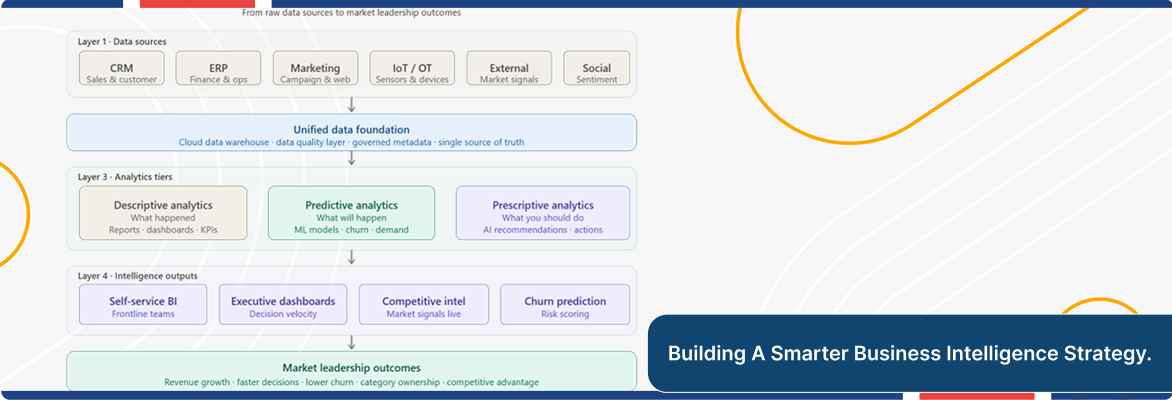
Market leadership requires anticipatory capability. You need to know not just what happened but what is about to happen – and why. That requires moving through three analytical tiers in sequence.
Tier 1 – Descriptive Analytics: What Happened
This is where most organizations stop. Dashboards, reports, and historical summaries. Valuable as a baseline, but fundamentally backward-looking. A business intelligence strategy anchored at this tier can measure performance but cannot influence it before the moment has passed.
Tier 2 – Predictive Analytics: What Will Happen
Predictive analytics for business applies machine learning models to historical data to forecast outcomes. Churn risk scoring, demand forecasting, price optimization, lead scoring – these are all predictive functions. Organizations operating at this tier stop reacting and start positioning.
Tier 3 – Prescriptive Analytics: What You Should Do
This is where data-driven decision making reaches its full strategic value. Prescriptive analytics goes beyond forecasting to recommend the specific actions most likely to produce the desired outcome. It is the difference between a weather forecast and a flight routing system that adjusts automatically to incoming turbulence. Most enterprises are targeting this tier. Very few have actually built the foundation required to reach it.
The gap between where most organizations are and where market leaders operate is not a tools problem. It is a data architecture, data quality, and organizational alignment problem – and solving it requires a fundamentally different approach than buying another dashboard license.
Key Capabilities That Set Data-Driven Businesses Apart
The architecture is the foundation. What market-leading companies build on top of it – the specific capabilities – is where the competitive separation happens.
Competitive Intelligence Analysis at Scale
Leading organizations do not rely on quarterly competitive reviews prepared by a business intelligence strategy consultant. They operationalize competitive intelligence analysis by continuously ingesting pricing signals, product change logs, hiring patterns, patent filings, and web behavioral data from competitor properties. The output is not a PowerPoint. It is a live feed of signals that product and go-to-market teams act on continuously.
Customer Behavior Modeling and Predictive Churn
The most expensive customer problem in B2B is the one you discover too late. Data-driven businesses build churn prediction models that score every account against behavioral, financial, and engagement variables. Accounts with rising risk scores trigger automated plays – executive outreach, accelerated QBR cycles, or contract restructuring conversations – before the renewal conversation becomes a retention crisis.
Decision-Velocity Intelligence
A BI dashboard for executives is not a collection of charts for advanced analytics consulting. It is a decision-velocity tool. The best implementations surface the three to five metrics that matter most to each role, flag anomalies automatically, and link every metric to the strategic initiative it is tracking. When a CEO opens their dashboard at 7am, they should know in 90 seconds whether the business is moving in the right direction – not spend 40 minutes reconciling conflicting data from three spreadsheets.
Dynamic Market Segmentation
Static customer segments are a legacy artifact. Data-driven businesses use clustering algorithms to segment markets dynamically – based on behavioral data, not just firmographic profiles. That changes how they prioritize product investment, allocate sales capacity, and devise data driven marketing strategy. A segment that was low-priority six months ago might now show the highest lifetime value indicators. Static models miss that entirely.
Demand Forecasting and Supply Chain Intelligence
Predictive analytics for business extends into operational planning. Leading manufacturers, distributors, and retailers use ML-driven demand forecasting to optimize inventory positioning, reduce carrying costs, and avoid both stockouts and overstock scenarios. The model improves continuously as it ingests more seasonal data, promotional lift signals, and external market indicators.
What We Have Seen Work in the Field
After working with enterprises across manufacturing, financial services, healthcare, and technology sectors, one pattern is consistent: the organizations that successfully use data-driven business intelligence to lead their markets did not start with technology. They started with a question.
Not “what data do we have” but “what decision would we make differently if we had better information” – and they worked backward from that to determine what data, what architecture, and what analytical capability would actually change the outcome.
That distinction sounds subtle for data-driven decision making. The implementation difference is enormous. Organizations that start with technology end up with dashboards that nobody looks at. Organizations that start with the decision end up with intelligence infrastructure that earns trust fast, because every output is tied to a real business outcome someone cares about.
The second thing we consistently observe in business intelligence strategy is that data culture is the limiting factor long before technology is. Technical implementation accounts for roughly 30% of a BI deployment’s success. The remaining 70% is organizational – leadership commitment to act on data even when it contradicts intuition, training programs that make data literacy a baseline expectation, and governance frameworks that make data quality everyone’s responsibility rather than the analytics team’s problem alone.
Flexsin’s Business Intelligence and Analytics practice is built around this reality. Our engagement model prioritizes use-case definition before AI-powered analytics platform selection, data quality architecture before visualization, and capability transfer to client teams rather than long-term dependency on our consultants. Market leaders do not outsource intelligence. They build it, and they own it.
What the Technology Can and Cannot Do
No BI strategy is without friction. Organizations planning to build or mature data-driven business intelligence capabilities should anticipate three constraints that every deployment encounters.
Data Quality Debt
Legacy systems accumulate data quality debt the way codebases accumulate technical debt – gradually, until it becomes a structural problem. Inconsistent field naming across CRMs, duplicate customer records, manually entered data with no validation – all of it flows downstream and undermines analytical models. Remediating this debt is the most time-intensive part of most enterprise BI programs. It is also non-negotiable. Predictive models trained on poor data do not produce useful predictions. They produce confident wrong answers.
Data Quality Debt
Data culture in organizations is the behavioral and structural commitment to making data-informed decisions and getting real-time business analytics at every level of the business. Building it requires more than a training program. It requires leadership that visibly acts on data, incentive structures that reward data-informed decisions, and enough psychological safety that teams surface bad data rather than hide it. That is a change management initiative, not a technology initiative.
Model Drift and Governance
Predictive models degrade over time as market conditions, customer behavior, and competitive dynamics change. An enterprise data analytics solution that deploys a model and forgets about it will eventually be acting on outdated intelligence. Model monitoring, periodic retraining, and clear ownership of model performance are governance requirements, not optional enhancements.
Most Asked Questions
What is data-driven business intelligence strategy? Data-driven business intelligence strategy is the practice of systematically converting raw organizational data into actionable insights that guide strategic and operational decisions. It combines data integration, analytics, and visualization tools to give leaders a clear, current picture of business performance.
How does data-driven decision making improve market competitiveness? It replaces reactive responses with anticipatory moves. Forrester research shows companies using data tools for decisions are 58% more likely to achieve revenue goals and 162% more likely to surpass them versus competitors.
What is the difference between descriptive and predictive analytics? Descriptive analytics tells you what happened in the past using historical data. Predictive analytics uses statistical models and machine learning to forecast what is likely to happen next, enabling proactive strategy rather than reactive adjustment.
How long does it take to build a mature BI capability? Most enterprises reach an operational baseline within six to twelve months and meaningful predictive capability within twelve to twenty-four months. Timeline depends on data quality, the use of BI tools for market leadership, organizational alignment, and architectural complexity.
What ROI can businesses expect from a business analytics strategy? Enterprise data analytics solutions that implement business intelligence strategy effectively achieve 3.8x higher business analytics ROI and make decisions five times faster than those relying on intuition and manual reporting. PwC data shows data-driven firms outperform peers by 6% in profitability and 5% in productivity.
How do executives use BI dashboards for real-time intelligence? Executive BI dashboards surface the most strategically relevant metrics, flag anomalies automatically, and link performance data to business objectives. The best implementations reduce insight-to-action time from weeks to hours.
Ready to Build Intelligence That Moves Markets?
Most organizations already have the data. What they need is the architecture, the analytical models, and the organizational alignment to turn that data into a genuine competitive advantage.
Flexsin’s Business Intelligence and Analytics practice works with enterprises to define the right BI strategy, build the data infrastructure that supports it, and deploy AI-powered analytics that convert operational data into market intelligence. Our work spans Power BI implementations, advanced predictive modeling, real-time data pipeline architecture, and enterprise-wide data modernization programs.
Connect with Flexsin’s analytics team – and build the intelligence infrastructure your market position demands.
Top Questions Answered
1. What makes a business truly data-driven vs. just data-aware? A data-aware organization collects and reports on data. A data-driven business intelligence strategy embeds data into every strategic and operational decision – with governance structures, trained teams, and real-time intelligence infrastructure that make data the default input rather than a periodic reference point. The difference shows up most clearly in how quickly an organization responds to a market shift: days versus weeks, or automated versus manual.
2. Is data-driven business intelligence strategy only viable for large enterprises?No. S&P Market Intelligence research commissioned by AWS found that 65% of highly data-driven small and medium-sized businesses outperform their competitors financially, compared to just 33% of their less data-driven counterparts. Cloud-based market intelligence platforms and prescriptive analytics enterprise architectures have made enterprise-grade capability accessible at significantly lower entry points than five years ago.
3. How do you measure the success of a BI and analytics implementation?Beyond platform adoption metrics, the most meaningful KPIs are decision velocity (how quickly leadership can act on a signal), forecast accuracy improvement over baseline, and measurable business outcomes tied to intelligence-driven decisions – such as churn rate reduction, pipeline conversion improvement, or inventory carrying cost reduction.
4. What is the biggest mistake companies make when building a data driven business intelligence strategy?Starting with the technology rather than the decision. Organizations that select a BI platform before defining which business decisions they need to make better consistently end up with systems that report comprehensively but influence nothing. The right starting point for self service business intelligence is always: what would we do differently with better information, and what data would we need to have confidence in that decision?
5. How does competitive intelligence analysis fit into a broader data strategy? Competitive intelligence analysis is the external-facing arm of a data driven business intelligence strategy. Where internal analytics tells you how your business is performing, competitive intelligence tells you how the market is moving relative to your position. Operationalizing it means treating competitor signals – pricing, hiring, product changes, customer reviews, technology adoption patterns – as structured data inputs rather than qualitative observations discussed in a quarterly strategy meeting.
6. What is the role of AI in modern business intelligence strategy? YAI serves three functions in enterprise BI: pattern recognition at scale (finding signals in datasets too large for human analysis), predictive modeling (forecasting outcomes and risks), and prescriptive intelligence (recommending specific actions). The global BI market is growing from $36.82 billion in 2025 at roughly 15% annually through 2033, driven primarily by AI and machine learning integration. For most enterprises, AI does not replace the analyst – it makes the analyst dramatically more effective.
