

 +1.844.3539.746
 info@flexsin.com
The Healthcare AI Gap: Why Some Hospitals Move Faster Than Others
 Sudhir K Srivastava
Let's talk
Table of Contents:
- Technology Is Not the Bottleneck Alignment Is
- AI Adoption in Healthcare Is Real, But It Is Concentrated
- Life Sciences Runs a Different Risk Profile
- Choosing the Right Microsoft Partner Solutions for Healthcare
- Build It Right the First Time
- People Also Ask
- Frequently Asked Questions
A hospital CIO in the Midwest recently discovered that three different vendors were managing three different pieces of her patient data pipeline – and none of them could explain why a single record took eleven minutes to sync between systems. That delay is not a glitch. It is the default state of healthcare IT, and it is exactly the problem Microsoft partner solutions for healthcare were built to solve.
Health systems do not lack technology. They lack technology that talks to itself. Electronic health records (EHR) integration, billing platforms, telehealth tools, and remote monitoring devices each run on separate logic, separate vendors, and separate update schedules. The result is a clinician who toggles between six screens to answer one question about a single patient. Microsoft’s answer is not another point solution. It is a partner ecosystem – Azure, Dynamics 365, Power Platform, and Microsoft Cloud for Healthcare – stitched together by systems integrators.
Technology Is Not the Bottleneck. Alignment Is.
Every health system has acquired AI tools, cloud storage, and analytics dashboards over the past few years. Few have acquired anyone capable of connecting those tools into a single coherent workflow. That gap – between owning technology and deploying it correctly – is where Microsoft’s certified partner network earns its relevance.
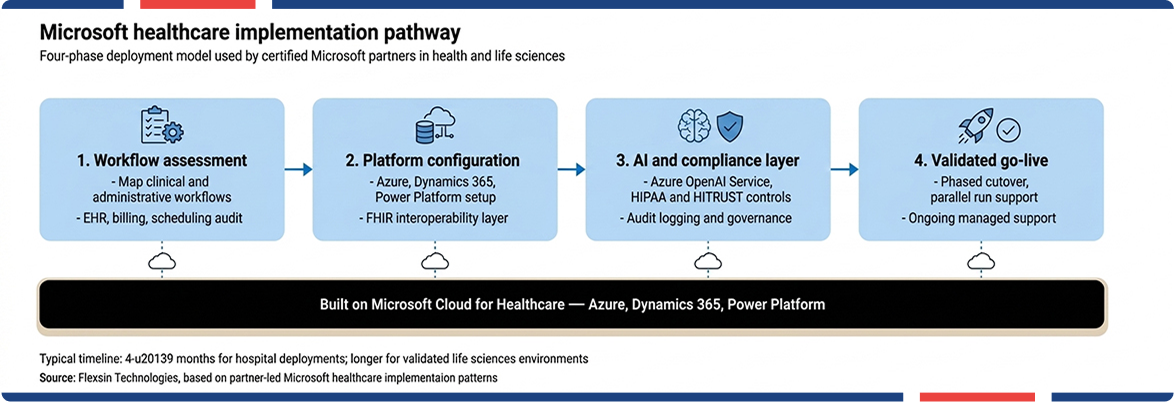
A partner with deep Azure for healthcare and life sciences experience does something a generic IT vendor cannot: they map clinical workflows first, then fit the technology to the workflow instead of forcing clinicians to adapt to software built for a different industry. Microsoft Cloud for Healthcare ships with FHIR-based interoperability, built-in HIPAA and HITRUST controls, and care coordination tools designed around actual clinical processes. None of that delivers value on its own. It delivers value when a partner configures it against the specific friction points inside a specific hospital, clinic, or life sciences lab.
AI Adoption in Healthcare Is Real, But It Is Concentrated
Enterprise AI adoption data tells an uncomfortable story for healthcare leaders watching other industries move faster. According to research cited by S&P Global Market Intelligence and McKinsey, only 18 percent of healthcare organizations have an AI healthcare agent running in production, compared to 47 percent in banking and insurance. Healthcare is not behind because the technology does not apply. It is behind because the regulatory bar for deploying AI against patient engagement workflows – correctly, much higher than it is for a chatbot answering account questions.
That is precisely why the partner layer matters more in healthcare than almost any other vertical of clinical burnout technology. Azure OpenAI Service, deployed inside a Microsoft-certified partner’s governance framework, gives health systems a path to clinical documentation assistance, prior authorization automation, and diagnostic support tools that meet compliance requirements instead of skirting them. A hospital experimenting with AI for healthcare on its own risks a HIPAA violation. A hospital working through an experienced Microsoft healthcare and life sciences solutions partner gets the same capability with an audit trail built in from day one.

Life Sciences Runs a Different Risk Profile
Pharmaceutical and life sciences organizations face a parallel but distinct challenge. Drug development pipelines generate enormous volumes of research data, much of it siloed across lab systems, clinical trial platforms, and manufacturing software that predates cloud computing entirely. Microsoft’s life sciences-focused partners bring Azure’s high-performance life sciences cloud computing capacity to bear on genomic analysis and molecular modeling – workloads that used to require dedicated on-premises supercomputing clusters.
Speed matters more here than in almost any other sector, because every month shaved off a clinical trial timeline has measurable financial and human value. A partner who understands GxP compliance, 21 CFR Part 11 requirements, and validated cloud environments can deploy infrastructure that would take an internal IT team months to configure correctly on its own. This is not a luxury. It is the difference between a trial that hits its enrollment window and one that does not.
Choosing the Right Microsoft Partner Solutions for Healthcare
Not every Microsoft healthcare cloud partner with a healthcare logo on their website has shipped a real hospital deployment. The distinguishing factor is rarely the certification badge. It is whether the partner has handled the unglamorous parts: data migration from legacy EHR systems, interoperability testing against real payer networks, and post-launch support when something breaks at 2 a.m. on a Saturday.
Ask for a partner’s specific HIPAA and HITRUST compliance track record, not a general statement about taking security seriously. Ask how many Azure for healthcare and life sciences deployments they have completed in the past two years, not over their entire history. The technology landscape moves quickly enough that experience older than 24 months tells you less than it used to.
Build It Right the First Time
Flexsin’s Microsoft Solutions practice has built and supported Azure, Dynamics 365 healthcare implementation and Power Automate healthcare workflow deployments for health systems and life sciences organizations that needed compliance and clinical workflow handled correctly the first time. Our certified engineers manage the data migration, interoperability testing, and governance work that determines whether a Microsoft healthcare deployment succeeds or stalls.
Explore Flexsin’s Microsoft Solutions practice to see how a properly architected partner relationship changes the outcome. Flexsin builds the Microsoft healthcare infrastructure your clinical teams can actually rely on.
People Also Ask:
What are Microsoft partner solutions for healthcare?They are certified implementation services built on Azure, Dynamics 365, and Microsoft Cloud for Healthcare. Partners configure these platforms to meet HIPAA, HITRUST, and clinical workflow requirements.
How do you implement Microsoft Dynamics 365 healthcare solutions?Implementation starts with mapping existing clinical and administrative workflows before any configuration begins. A certified partner then migrates data, integrates EHR systems, and tests interoperability before go-live.
Is Azure or AWS better for healthcare and life sciences workloads? Azure leads in healthcare-specific compliance tooling, including built-in HIPAA and HITRUST compliance controls. AWS offers comparable raw infrastructure but requires more custom configuration for healthcare-grade governance.
How much does a Microsoft healthcare cloud and life sciences solutions partner cost? Costs vary by scope, ranging from focused EHR integration projects to full platform transformations. Most engagements use fixed-cost, time-and-material, or dedicated-team pricing models.
How long does a healthcare cloud migration with a Microsoft partner take? A mid-sized health system migration typically runs four to nine months depending on legacy system complexity. Life sciences deployments involving validated environments often take longer due to compliance testing.
Does Microsoft Cloud for Healthcare support FHIR-based interoperability?Yes, Microsoft Cloud for Healthcare ships with native FHIR-based interoperability for clinical data exchange. This allows EHR systems, payer platforms, and care coordination tools to share data more reliably.
Frequently Asked Questions:
1. What makes Microsoft Cloud for Healthcare different from a standard cloud migration? Standard cloud migrations move infrastructure without addressing clinical workflow or compliance design. Microsoft Cloud for Healthcare ships with HIPAA and HITRUST controls, FHIR-based interoperability, and care coordination tools built specifically for clinical environments. A partner still has to configure it correctly, but the foundation is purpose-built rather than retrofitted.
2. Can a Microsoft healthcare cloud and life sciences solutions partner work with our existing EHR vendor?Yes. Most partner-led deployments integrate with established EHR systems like Epic or Cerner rather than replacing them outright. The partner’s role is building the interoperability layer that lets your existing systems exchange data reliably.
3. How does Azure OpenAI Service handle patient data compliance? Azure OpenAI Service operates inside Microsoft’s broader compliance framework, including HIPAA-eligible configurations when deployed correctly. A certified partner sets up the governance, audit logging, and data handling controls required before any AI model touches patient information.
4. Will switching to a Microsoft partner ecosystem disrupt current operations?A well-run implementation phases the rollout to avoid disrupting active patient care or administrative workflows. Most health systems run parallel systems briefly during cutover, then retire legacy tools once the new environment is validated.
5. Do life sciences companies need a different Microsoft healthcare cloud partner than hospitals? Life sciences organizations benefit from partners with specific GxP compliance cloud and validated cloud environment experience. Hospital-focused partners may understand HIPAA well but lack the regulatory depth required for drug development and clinical trial infrastructure.
