

 +1.844.3539.746
 info@flexsin.com
The ERP Mistake Many Growing Companies Make – And How Odoo Changes the Equation
 Munesh Singh
Let's talk
Table of Contents:
- Why Odoo for Small Business Works Differently Than You Think
- Evaluating Odoo ERP Pricing Through a Business Growth Lens
- Building Only What You Need, When You Need It
- Choosing the Right ERP: A Practical Framework for Evaluating Odoo
- People Also Ask
- Ready to Implement Odoo for Your Small Business?
- Frequently Asked Questions
Most small business owners dismiss ERP as a large-enterprise problem – and that assumption is costing them more than they realize. Managing sales in a spreadsheet, tracking inventory in a different system, and closing the books in yet another tool creates a data ecosystem held together by hope and manual labor. Odoo ERP for small businesses exists precisely to break that pattern without replacing it with something expensive and rigid.
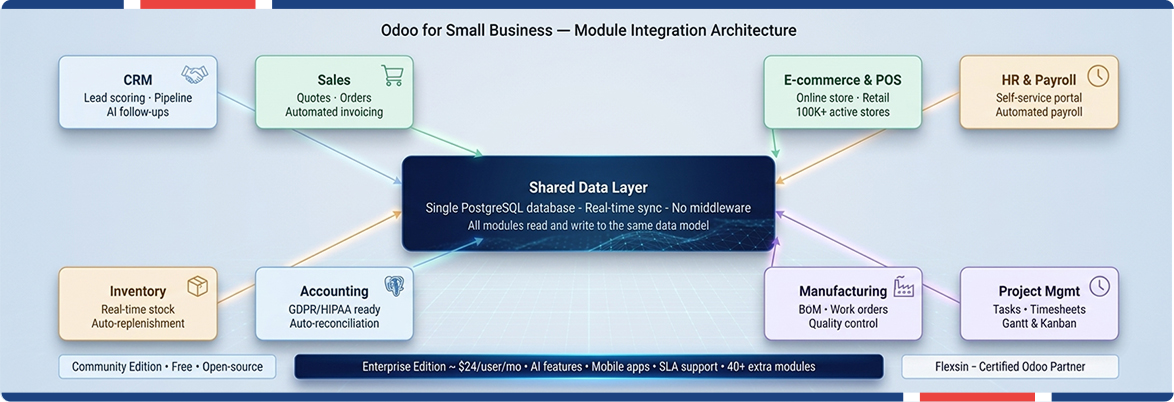
Odoo is an open-source, modular ERP platform with over 13 million users across 175 countries, according to Odoo’s official user data. It covers CRM, accounting, inventory, HR, e-commerce, project management, and more – all native to one platform, all sharing one database. The Community edition is free.
You don’t install the whole suite on day one. You install what you need, prove value fast, and expand as your operational complexity grows. That is not how most enterprise software works – and it is exactly why Odoo ERP for small businesses has become the dominant choice in the SMB ERP market, holding approximately 15% of the global SMB ERP segment with projections to reach 25% by 2027, per NextSprints market data.
Why Odoo for Small Business Works Differently Than You Think
The standard ERP story goes like this: choose a system, budget 12-18 months for implementation, train a reluctant team, and go live hoping the thing works. Odoo does not tell that story. SME deployments on Odoo typically go live in 8-12 weeks with packaged implementation offers, compared to multi-year rollouts that have plagued SAP and Oracle deployments at mid-market companies.
That speed is structural, not accidental. Because Odoo modules for small businesses share a single underlying data model, connecting your sales pipeline to your inventory to your accounting requires no custom middleware. The data flows natively. That is why businesses moving from a fragmented software stack to Odoo regularly report dramatic reductions in manual data entry – the system simply stops requiring it.
Here is what that looks like in practice: a team spending 50 hours a week on manual order processing can typically cut that to 10 hours using Odoo Sales, Inventory, and Accounting together. The arithmetic is unambiguous – and it compounds.
Evaluating Odoo ERP Pricing Through a Business Growth Lens
Odoo ERP pricing follows a pay-as-you-grow model that most ERP vendors still won’t offer. The Community edition – a fully functional, open-source platform – costs nothing in licensing fees. It includes CRM, Sales, basic Accounting, Inventory, Manufacturing, Project Management, HR, Website, and e-commerce. For a business with revenue under $2 million running a single-entity, single-currency operation, Community handles core needs competently.
The Enterprise edition adds over 40 additional modules – including Odoo Studio, AI-driven workflows, advanced marketing automation, helpdesk with SLAs, and official mobile apps. At approximately $24 per user per month (with a 20-25% discount on annual billing), Enterprise delivers capabilities that traditionally required multiple six-figure vendor contracts.
| ERP System | Entry Pricing (Per User/Month) | Best For |
|---|---|---|
| Odoo Community | Free (self-hosted) | Startups, early-stage SMBs |
| Odoo Enterprise | ~$24 | Growing businesses, multi-entity ops |
| SAP Business One | $270-$625 | Mid-to-large enterprises |
| Microsoft Dynamics 365 | $65-$210+ | Medium enterprises |
| NetSuite | $99-$399+ | Large enterprises |
Building Only What You Need, When You Need It
One of the most common small business ERP system failure patterns is buying too much software too early. A 12-person company does not need a full supply chain suite and advanced financial consolidation on day one. But traditional ERP vendors rarely let you start small without a complicated contract renegotiation later.
Odoo ERP for small business modules work differently. The platform has more than 80 applications. You install CRM and Sales first, prove adoption, add Inventory when you need real-time stock visibility, layer in Accounting to close data silos between your finance and operations teams. The architecture is designed for organic growth.
In contrast, open-source ERP for small businesses alternatives often require significant developer resources to maintain forks, apply security patches, or build missing functionality. Odoo’s partner ecosystem – Odoo certified implementation specialists operating globally – absorbs that complexity so business owners don’t have to.
Choosing the Right ERP: A Practical Framework for Evaluating Odoo
Choosing the best ERP for small businesses is not a software decision in isolation. It is an operations decision with long consequences. The right question is not which ERP has the most features – it is which ERP your team will actually use, at a cost your P&L can sustain, with a migration path your business can absorb.
Three criteria consistently separate successful cloud ERP implementations for SMBs from failed ones: implementation speed, total cost of ownership, and post-go-live support quality. On all three, Odoo ERP for small businesses holds a structural advantage over both enterprise legacy platforms and lightweight point solutions that can’t scale.
| Evaluation Criterion | Odoo | SAP Business One | NetSuite |
|---|---|---|---|
| Avg. SMB Go-Live Time | 8-12 weeks | 6-18 months | 6-12 months |
| User/Month Cost (Enterprise) | ~$24 | $270-$625 | $99-$399+ |
| Open Source Option | Yes (Community) | No | No |
| Native E-commerce + POS | Yes | No | No |
| AI Features Included | Yes (Enterprise) | Limited | Limited |
People Also Ask:
What is Odoo ERP and is it suitable for small businesses?Odoo is an open-source, modular ERP platform covering CRM, accounting, inventory, HR, and e-commerce in one system. It is specifically designed to scale from early-stage startups to complex multi-entity operations, making it an affordable ERP software for small business options available.
How much does Odoo cost for a small business? The Community edition is free and covers core modules. Enterprise pricing starts at approximately $24 per user per month, with a 20-25% discount available on annual billing.
How long does an Odoo implementation for small business take? SME deployments typically go live in 8-12 weeks using packaged implementation offers. Phased rollouts – starting with CRM and Sales before adding Inventory and Accounting – are the most common path to reducing risk.
Can Odoo replace multiple software tools for a small business? Yes. Odoo ERP features natively cover CRM, accounting, inventory, HR, project management, and e-commerce in one platform. Replacing multiple standalone subscriptions with Odoo consistently reduces software costs and eliminates data-entry duplication.
How does Odoo vs SAP and Odoo vs NetSuite compare for a small business?SAP and NetSuite are architected for large enterprise scale, with per-user costs ranging from $99 to over $600 per month. Odoo ERP for small businesses delivers comparable functionality at a fraction of the price, with a free open-source tier that SAP and NetSuite do not offer.
Is Odoo Community Edition enough for a small business?Community handles CRM, Sales, basic Accounting, Inventory, and Project Management at zero license cost. For businesses requiring advanced Odoo automation features, accounting workflows, AI features, mobile apps, or SLA-backed support, Enterprise is the appropriate upgrade.
Ready to Implement Odoo for Your Small Business?
Flexsin Technologies is a certified Odoo implementation partner with a 15+ year track record across healthcare, e-commerce, retail, manufacturing, and professional services. We have deployed and integrated Odoo ERP frameworks for businesses including Daikin, AIDA Software, PapiPay, and Jamis Bikes – reducing ERP total cost of ownership by up to 37% while improving cross-departmental visibility.
If you are evaluating ERP software for small business or planning an Odoo implementation, Flexsin delivers the technical depth and vertical expertise to get your system live in weeks, not years. Reach out to the Flexsin Odoo team to start your ERP transformation.
Frequently Asked Questions:
1. What modules should a small business start with in Odoo? Start with CRM, Sales, and Inventory to get the core operational loop running. Add Accounting next to close the data gap between finance and operations. HR and Project modules can be layered in once the core system is stable.
2. Can I migrate from QuickBooks or another accounting tool to Odoo?Yes, Odoo ERP for small businesses supports data migration from QuickBooks, Xero, SAP, and other platforms. A certified implementation partner will map your existing chart of accounts, open transactions, and historical data to minimize disruption during cutover.
3. Does Odoo work for e-commerce businesses? Odoo includes a native e-commerce module, a POS system, and a payments infrastructure that all connect to the same inventory and accounting data. More than 100,000 active online stores run on Odoo as of Q2 2025, according to Store Leads data.
4. Is Odoo secure enough for financial data? Odoo Enterprise includes end-to-end encryption, role-based access control, GDPR compliance features, and regular security patches. The platform supports HIPAA-compliant configurations for healthcare-adjacent businesses.
5. What is the difference between Odoo Community and Enterprise for a small business?Community is free, open-source, and self-hosted. Enterprise adds 40+ additional modules, managed cloud hosting, SLA-backed support, AI features, mobile apps, and automatic version upgrades at approximately $24 per user per month.
6. How difficult is it for non-technical staff to learn Odoo?Odoo’s interface follows modern UX conventions and requires no technical background for day-to-day use. Most teams reach functional proficiency within two to three weeks of go-live with proper training.
7. Can Odoo scale as my business grows?Odoo runs deployments at 300,000+ simultaneous users, including enterprise clients like Toyota and Sodexo. Small businesses can start with two or three modules and expand to a full enterprise suite without ever changing platforms.
8. How do I find a reliable Odoo implementation partner? Look for certified Odoo partners with verifiable industry experience, client references in your vertical, and transparent project methodology. Flexsin’s Odoo consulting practice serves SMBs and enterprises across multiple sectors with end-to-end implementation, Odoo ERP customization, and ongoing support.
