

 +1.844.3539.746
 info@flexsin.com
The Enterprise GenAI Reality Check: Why Scale Remains Elusive
 Munesh Singh
Let's talk
Table of Contents:
- The Enterprise Pilot Cycle That Never Ends
- Redefine the Job Before You Redefine the Tool
- Establishing Enterprise AI Governance That Encourages Adoption
- Treat Skill-Building as Culture Work, Not Course Work
- Think AI Operating Model, Not Just Tooling
- Why People, Not Technology, Determine GenAI Success
- Frequently Asked Questions
- People Also Ask
Ninety-five percent of generative AI pilots never produce a dollar of measurable return. Not a low return – zero. MIT’s Project NANDA tracked over 300 enterprise deployments and found the pattern repeating across industries, budgets, and vendor stacks. The model worked. The rollout did not.
That gap in enterprise GenAI adoption is the real story behind enterprise generative AI adoption today. Executives keep asking which model to buy, which platform to standardize on, which vendor has the lowest token cost. Those are real decisions. They are not the decisions that determine whether GenAI sticks.
McKinsey pegs the long-term productivity upside of generative AI at $4.4 trillion across corporate generative AI use cases, and IDC expects global AI spending to top $632 billion by 2028. The money is moving regardless. What separates the five percent of companies capturing real value from the rest is not budget size – it is whether they treated this as a people transition or a procurement exercise.
The Enterprise Pilot Cycle That Never Ends
Most organizations treat enterprise generative AI adoption like any other software purchase: select a platform, run a pilot, scale what works. That playbook fits tools people already know how to use. It breaks down with generative AI, because employees do not know what to trust, how to phrase a prompt, or what the tool means for their job security. When that uncertainty goes unaddressed, adoption quietly dies. Some employees ignore the tool. Others actively work around it.
Moving from experimentation to dependable production also requires AI Development Services that connect generative AI capabilities with enterprise workflows, governance, and measurable business outcomes.
This matters for scaling generative AI solutions because the resistance is rarely loud. A 2026 WRITER survey of more than 1,200 employees found that 29 percent admitted to sabotaging their company’s AI strategy, with the figure climbing to 44 percent among Gen Z staff. That is not a training gap. That is a trust gap, and no model upgrade closes it.
Redefine the Job Before You Redefine the Tool
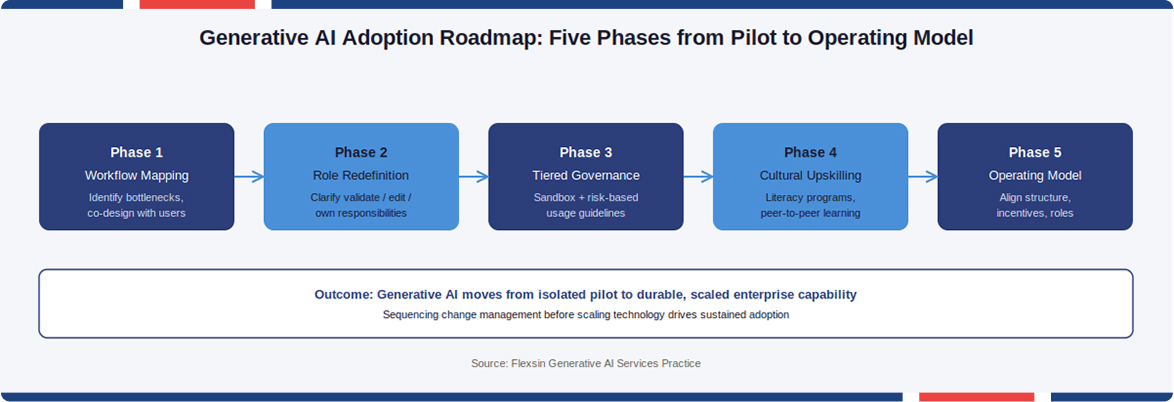
Enterprise generative AI adoption does not just speed up tasks. It changes who decides what, and that shift creates quiet anxiety long before it creates measurable productivity. A claims processor who once typed reports now reviews AI-drafted ones. A marketer who once wrote copy now edits AI-generated drafts and approves tone. The job did not disappear – it moved from doing to directing, and most companies never say that out loud.
Leaving the question unanswered is costly. Deloitte’s 2026 State of AI in the Enterprise survey found that 42 percent of leaders believe their strategy is highly prepared for AI, yet far fewer feel equally confident about AI workforce readiness, talent, or risk controls. Strategy slides do not retrain a workforce. Clear role definitions do.
The fix is direct for enterprise AI adoption challenges: rewrite job expectations so employees know exactly what to validate, what to edit, and what they now own outright. Pair that clarity with practical training in prompt design and critical evaluation of AI output, not generic AI literacy decks. People do not need to become data scientists. They need to understand precisely where their judgment fits into a hybrid human-AI workflow.

Establishing Enterprise AI Governance That Encourages Adoption
Concerns about hallucination, data leakage, and compliance are legitimate, and they multiply fast once generative AI touches customer-facing systems. Sixty-seven percent of executives in the 2026 WRITER survey believe their organization has already suffered a data breach linked to unapproved AI tools – a number serious enough to justify caution, but not paralysis.
Caution without structure produces shadow enterprise GenAI adoption, shadow AI risk, and may result in generative AI pilot failure, where employees route around blocked tools and use personal accounts instead, which is worse for security than the access they were denied. The better path is tiered AI governance framework: looser rules for internal, low-risk experimentation, tighter controls for anything customer-facing.
Treat Skill-Building as Culture Work, Not Course Work
The operational truth is that most enterprises are managing cyber, AI, and operational risk through disconnected programs. Security teams run threat detection. Compliance teams manage regulatory reporting. AI governance – where it exists – is often siloed inside product or engineering functions. The integrated risk operations model challenges this architecture directly.
Rather than treating each risk domain as a separate P&L, integrated risk operations builds a unified intelligence and governance layer that connects cybersecurity operations, identity and access management across human and non-human identity governance, AI governance enterprise and security posture, continuous threat exposure management (CTEM), operational technology (OT) security, and third-party supply chain cyber risk.
The Growing Impact of Supply Chain Vulnerabilities on Enterprise Resilience
The biggest misconception about AI upskilling enterprise is that everyone needs to become a prompt engineer. They do not. What scales generative AI is a cultural shift toward curiosity and cross-functional experimentation, not a mandatory certification track that nobody finishes.
Companies seeing real traction in enterprise GenAI adoption are running AI literacy programs across every level, from the C-suite to frontline teams, and framing the work as capability-building rather than threat response. They celebrate small wins publicly. A support rep who cuts ticket resolution time with a well-built prompt becomes the next training session, not a footnote.
Think AI Operating Model, Not Just Tooling
Embedding generative AI changes how a business runs, not just which software it licenses. For enterprises, this makes GenAI adoption part of broader Digital Transformation Services, requiring alignment across digital workflows, data, technology, and workforce strategy. That requires aligning AI initiatives with the broader digital, data, and workforce strategy already in motion – not bolting a chatbot onto an org chart that was never built to support it.
Ask harder structural questions before the next rollout for enterprise agentic AI adoption. Does your organization have a defined owner for AI-as-a-service across business units? Do roles like AI product manager or content curator exist, or are they being absorbed informally into someone’s already full job? Are incentives actually rewarding safe, creative use of these tools, or quietly punishing the people who experiment? Even the most capable model underperforms without a structure built to support it. This operating model allows organizations to turn individual AI initiatives into scalable Enterprise Solutions that can be governed and adopted across business units.
Why People, Not Technology, Determine GenAI Success
Technology is not the hard part of enterprise generative AI adoption. Change is. The organizations separating themselves from the 95 percent generating zero measurable return are not the ones with the best model access – they are the ones treating AI change management as core infrastructure, not an afterthought bolted onto a technical rollout.
An AI Development Company can support this transition by combining AI implementation, workflow integration, governance, and deployment planning rather than treating the model as a standalone technology.
None of this requires abandoning ambition. It requires sequencing ambition correctly: workflow before model, role clarity before tooling, tiered governance before lockdown, outcome metrics before another demo. Skip a step and the pilot looks fine in the steering committee and dies quietly six weeks later, exactly the pattern MIT, BCG, and Deloitte all documented independently across thousands of enterprises this year.
As an IT Consulting Company, Flexsin has guided enterprise teams through exactly this transition, pairing generative AI implementation with the change management work that determines whether it sticks. Our Generative AI Services team builds AI implementation roadmaps, role redefinition plans, and governance frameworks alongside the technical deployment, not after it.
Explore Flexsin’s generative AI consulting services and build a generative AI rollout your workforce actually adopts.
Frequently Asked Questions:
What is the biggest reason generative AI pilots fail to scale?Poor change management, not weak technology, is the leading cause of stalled generative AI pilots.
How long does enterprise generative AI adoption typically take? Most enterprises need 6 to 12 months to move a single use case from pilot to dependable production use.
What does AI change management actually involve?It involves redefining roles, training employees on AI judgment, and building governance that supports rather than blocks experimentation.
How much does a generative AI implementation roadmap cost?Costs vary widely by scope, but enterprise roadmap engagements commonly range from the low tens of thousands to several hundred thousand dollars.
Can small or mid-size companies scale generative AI without a large AI team?Yes, by partnering with an experienced generative AI consulting team instead of building an internal data science function from scratch.
People Also Ask:
1. What is generative AI adoption strategy?It is a structured plan covering workflow design, role changes, and governance that determines how generative AI gets adopted across an organization.
2. How do you measure generative AI ROI?Generative AI ROI is measured against specific business outcomes like cycle time, cost per transaction, or customer satisfaction, not usage volume alone.
3. What is the difference between generative AI and agentic AI?Generative AI creates content or responses on demand, while agentic AI autonomously executes multi-step tasks with limited human input.
4. Why do employees resist generative AI tools at work?Employees resist generative AI tools mainly due to unclear expectations about job impact and a lack of involvement in how the tools were designed.
5. What industries benefit most from generative AI adoption?Manufacturing, financial services, and healthcare currently show the strongest measurable benefits from generative AI adoption.
