

 +1.844.3539.746
 info@flexsin.com
The Enterprise Gaps That Delay Agentic AI Adoption at Scale
 Munesh Singh
Let's talk
Table of Contents:
- Before You Move Forward with Agentic AI Adoption
- The Disconnect in Enterprise Agentic AI Adoption Strategies
- Where Enterprise Agentic AI Programs Break
- Flexsin’s Agentic AI Maturity Framework
- Flexsin’s Perspective on Enterprise Agentic AI Adoption
- What Robust Agentic AI Deployment Looks Like
- The Operational Challenges That Follow
- People Also Ask
- What Leaders Ask Us
Seventy-nine percent of enterprises have deployed AI agents in some form. Only 11% run them in production. That gap is the largest deployment backlog in enterprise technology history, according to recent research. The organizations that close it fastest don’t have better models. They have better strategy.
Agentic AI arrived with a specific promise: autonomous systems that plan, act, and adapt across enterprise workflows with minimal human intervention. The promise is real. The path from pilot to production turns out to be the hard part – and most enterprises are learning that lesson expensively.
The reality is that most agentic AI programs are not failing because the technology isn’t ready. They’re failing because the enterprise isn’t ready for the technology. That distinction drives everything that follows.
Before You Move Forward with Agentic AI Adoption
- Only 11% of enterprises run AI agents in production despite 79% claiming adoption – the gap is a governance and architecture problem, not a model quality problem
- Gartner projects that over 40% of agentic AI projects will be cancelled by 2027 if governance and ROI clarity are not established before scaling
- The organizations seeing real returns – averaging 171% ROI on structured AI agent deployments – share a common pattern: they designed the workflow before they designed the agent
- Enterprise agentic AI adoption success requires data infrastructure, process intelligence, and orchestration architecture in place before agents are deployed at scale.
- Governance is not a constraint on agentic AI adoption – it’s the enabler that turns pilots into production-grade systems.
The Disconnect in Agentic AI Adoption Strategies
Here’s the counterintuitive reality: the organizations that adopted agentic AI fastest are not the ones winning. The ones winning designed for scale before they deployed at all.
Recent enterprise survey data shows 97% of executives report deploying AI agents in the past year. What it actually describes is a proliferation of disconnected pilots – without unified governance, AI agent orchestration infrastructure, or the data alignment that meaningful autonomy requires. Gartner calls it agent sprawl, and it’s the primary reason more than 40% of active agentic projects are at risk of cancellation by 2027.
The Pilot Trap
A pilot environment is almost never representative of production conditions. Security controls tighten. Data access becomes more restricted. Edge cases appear that the controlled test never surfaced. Stakeholders who were enthusiastic observers in the demo become skeptical gatekeepers when the agent starts touching real systems. Enterprise AI consulting that moves through this transition successfully plan for Agentic AI integration before writing the first line of agent logic.
Where Enterprise Agentic AI Programs Break
Forrester’s root-cause analysis of agentic AI adoption failures identifies three patterns – none of them model-quality problems. Forty-one percent trace to unclear success criteria. Thirty-three percent to insufficient data access. Twenty-six percent to evaluation drift over time.
The Data Infrastructure Gap
Agents operate on data. If that data is incomplete, inconsistently structured, or locked in formats the agent can’t parse, outputs degrade in direct proportion. Intelligent document processing is not a nice-to-have – it’s the precondition for agentic AI that behaves reliably at scale.
A mid-market logistics company in the American Midwest deployed an agentic procurement system without addressing its unstructured supplier document backlog. Decision accuracy on purchase order exceptions ran at 61%. After six weeks of intelligent document processing work, accuracy exceeded 88%. The agent didn’t change. The data did.
Flexsin’s Agentic AI Maturity Framework
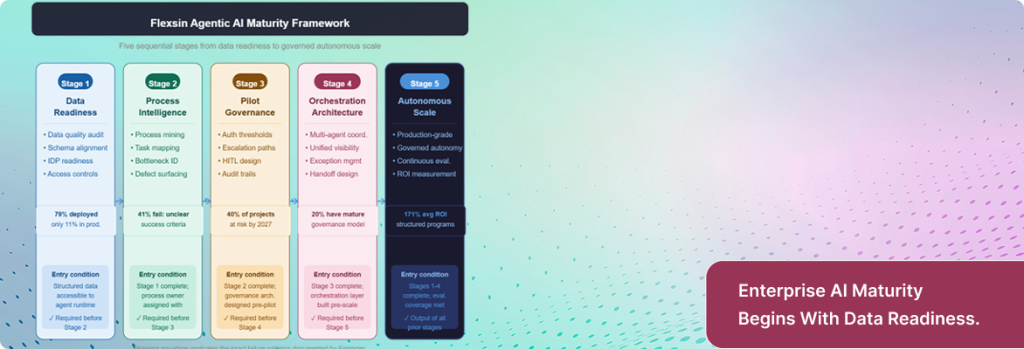
Flexsin’s Agentic AI Maturity Framework maps enterprise agentic readiness across five stages: Data Readiness, Process Intelligence, Pilot Governance, Orchestration Architecture, and Autonomous Scale. Each stage has defined entry conditions. Skipping a stage creates the exact failure patterns Forrester documents.
Stage 1 – Data Readiness
Get this layer right and every subsequent stage costs less. Organizations that assess data quality and accessibility honestly before deployment reduce their failure rate substantially.
Stage 2 – Process Intelligence
Process mining and task mining tools surface bottlenecks, rework loops, and agentic AI governance and compliance risks for enterprise agentic AI adoption. Agents deployed into a poorly understood process execute its defects faster.
Stage 3 – Pilot Governance
Governance architecture in enterprise agentic AI adoption must be designed before the pilot launches: action-level authorization, escalation thresholds, human-in-the-loop requirements, and behavioral monitoring. Build it after the fact and you’re retrofitting guardrails onto a moving vehicle.
Stages 4 and 5 – Orchestration and Scale
Multi-agent system orchestration turns individual agents into coordinated systems. Autonomous scale is the output of the preceding four stages – not a destination reachable directly.
Flexsin’s Perspective on Enterprise Agentic AI Adoption
Flexsin’s agentic AI development and enterprise GenAI consulting practices engage organizations at the moment most programs hit the governance gap. What we encounter consistently: the pilot worked. The expansion plan doesn’t account for what actually happens when agents touch production systems.
A software and technology firm with 400 engineers deployed a two-agent architecture across service desk, incident management, and knowledge management. Ticket deflection exceeded 40%. Critical incident acknowledgement time dropped from 22 minutes to under four. Those are production baselines, not pilot projections.
What Robust Agentic AI Deployment Looks Like
The agentic AI company delivering measurable agentic AI adoption ROI share four habits: they tie deployment to a defined metric, assign a business owner with budget authority, treat evaluation coverage as the production-readiness gate, and design the orchestration layer before building the agents.
McKinsey and BCG document median time-to-value at 5.1 months. Customer-facing agents pay back in 3 to 4 months; finance and operations agents take 8 to 9. The variance is the clarity of success criteria and data infrastructure quality – not the model.
The Operational Challenges That Follow
Agentic AI deployed into structurally defective processes executes those defects at scale. The Flexsin framework accelerates readiness; it doesn’t substitute for re-engineering a broken workflow.
Healthcare and financial services organizations face governance overhead that extends timelines at every stage. Build hybrid human-agent workflows as the medium-term target, not full autonomy
The talent gap for agentic AI adoption is real. Only 20% of organizations have a mature enterprise AI governance model for autonomous AI agents, according to Deloitte. External capability – through consulting or structured staff augmentation – is the practical bridge between enterprise GenAI strategy and production in agentic AI.
Flexsin’s agentic AI development and enterprise GenAI consulting services help technology leaders move from stalled pilots to governed, production-grade agentic systems.
If your program has hit the governance gap or the orchestration ceiling, that’s exactly where Flexsin engages. Start with a structured readiness assessment.
Contact Flexsin Technologies to accelerate your enterprise agentic AI adoption and deployment with scalable, secure, and intelligent AI solutions tailored to your business goals.
People Also Ask:
What is agentic AI adoption? Agentic AI adoption is the deployment of autonomous AI systems that plan and act across enterprise workflows. Most organizations are in early pilot stages, with fewer than 12% running agents in production
Why do agentic AI projects fail? Most failures trace to unclear success criteria, insufficient data access, or missing governance architecture. Model quality is rarely the root cause in documented failure analyses.
What ROI can enterprises expect from AI agents?Well-structured deployments average 171% ROI, with median payback at 5.1 months. Top-performing programs exceed that substantially; poorly governed deployments commonly return negative ROI at 12 months.
What is agent sprawl in enterprise AI? Agent sprawl is the proliferation of disconnected agentic AI implementation across an organization without unified AI governance framework, orchestration, or visibility. Gartner identifies it as a primary risk factor for program failure by 2027.
What Leaders Ask Us
1. What does agentic AI mean for enterprise operations? Agentic AI enables autonomous systems to manage multi-step workflows without continuous human instruction. It shifts enterprise operations from task automation to goal-directed execution.
2. How is agentic AI different from RPA? RPA follows predefined rules in structured environments. Agentic AI adapts to dynamic conditions, reasons across systems, and takes action toward defined goals without scripted logic.
3. What is the agentic AI adoption rate currently? Approximately 79% of enterprises report some form of AI agent adoption. Only 11% operate agents in production at scale, per current industry benchmarks
4. How long does enterprise AI agent deployment take? Median time-to-value is 5.1 months across functions. Customer service deployments pay back fastest at 3 to 4 months; finance and operations take 8 to 9 months.
5. What is intelligent document processing in agentic AI? Intelligent document processing extracts and structures data from unstructured sources so agents can operate on reliable inputs. It’s a prerequisite for AI readiness assessment and accurate agentic AI decision-making.
6. How do you govern AI agents in an enterprise? Governance requires action-level authorization, defined escalation thresholds, behavioral monitoring, and audit trails for every agent action across all connected systems.
7. What is agentic AI orchestration? Agentic orchestration coordinates multiple AI agents across workflows, providing unified visibility, exception management, and governance at the enterprise level.
8. What is the cost of agentic AI implementation? Implementation costs vary significantly by scope and complexity. Enterprise deployments with full governance architecture require meaningful investment; the average payback period is under six months for well-scoped programs.
9. Which industries are leading agentic AI adoption? Telecommunications leads at 48% deployment rate, followed by retail and CPG at 47%. Financial services and healthcare are scaling cautiously under regulatory requirements, per recent industry research.
10. How does Flexsin approach agentic AI strategy? Flexsin applies the Agentic AI Maturity Framework across five stages: data readiness, process intelligence, governance, orchestration, and scale. Each stage runs in sequence – no shortcuts.
