

 +1.844.3539.746
 info@flexsin.com
The Budget Problem Isn’t Migration – It’s Cloud Adoption Strategy
 Sudhir K Srivastava
Let's talk
Table of Contents:
- Why a Cloud Adoption Strategy Matters More Than the Migration Itself
- Step One: Assess Where You Stand in Your Cloud Adoption Strategy
- Step Two: Align Strategic Objectives Before Setting Targets
- Step Three: Build a Cross-Functional Team with Decision Rights
- Step Four: Prepare People, Processes, and Governance First
- Step Five: Let Strategic Priorities Shape Every Later Decision
- The Strategy Is the Product
- People Also Ask
- Frequently Asked Questions
Most cloud migrations don’t fail because of bad technology. They fail because nobody owned the why. That’s the uncomfortable truth behind a number that should worry every CIO: nearly three-quarters of organizations exceeded their cloud budgets last fiscal year, according to research cited by IT Pro.
Teams move fast, provision faster, and somewhere between the first workload and the fiftieth, the original plan disappears. What’s left is a sprawling bill and a leadership team asking where the savings went.
A cloud adoption strategy is the decision framework that determines what gets built, why it gets built, and how success gets measured – before a single resource group exists. Get this step wrong, and every later phase inherits the confusion.
Why a Cloud Adoption Strategy Matters More Than the Migration Itself
Here’s what that looks like in practice. McKinsey’s research on Forbes Global 2000 companies puts the EBITDA value at stake from cloud adoption at over $3 trillion by 2030 (mckinsey.com). That figure isn’t about lifting servers into Azure.
It’s about rebuilding how a business operates, prices, and competes. Companies that treat cloud as an infrastructure project capture a fraction of that value. Companies that treat it as a business transformation, with infrastructure as the enabler, capture the rest.
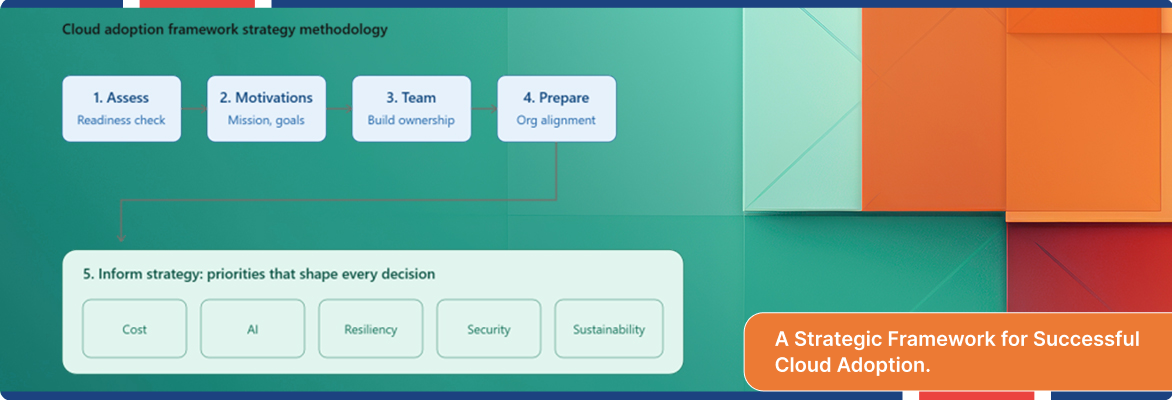
This matters because the gap between those two outcomes is almost entirely strategic, not technical. Microsoft’s Cloud Adoption Framework frames this as a five-step methodology – assess readiness, define motivations and objectives, build the right team, prepare the organization, and let strategic priorities inform every downstream decision.

Step One: Assess Where You Stand in Your Cloud Adoption Strategy
Most assessments start with infrastructure inventories. Start somewhere else: with the operating model.
Ask whether your organization runs on a project model or a product model. A project model treats migration as a one-time initiative with a start date and an end date. A product model treats cloud platforms as living systems that teams own and improve indefinitely.
Microsoft’s framework flags this shift – from project to product thinking – as a prerequisite for organizational cloud readiness assessment, not an optional upgrade.
In contrast, organizations that skip this assessment for cloud cost management tend to migrate workloads successfully and then watch costs creep upward for years, because nobody owns ongoing cloud cost optimization.
Step Two: Align Strategic Objectives Before Setting Targets
Real motivations connect to specific business outcomes: entering a new market within a fixed timeline, retiring a data center lease before renewal, or supporting a product launch that requires elastic scale.
The reason this distinction in cloud migration services matters is measurement. A vague motivation produces a vague success metric, and a vague metric means nobody can prove the strategy worked – which means nobody can defend the next budget request either.
Classify motivations honestly. Some are growth-driven: new revenue streams, faster product cycles, expansion into regions where on-premises infrastructure isn’t viable.
Step Three: Build a Cross-Functional Team with Decision Rights
A strategy team made up entirely of infrastructure engineers will produce an infrastructure plan – competent, technically sound, and disconnected from the business case meant to justify it.
The teams that get this right pull in finance early, not after the first invoice arrives. They include application owners who understand which workloads are revenue-critical and which are legacy debt nobody’s touched in years.
As a result, the strategy reflects tradeoffs the business actually cares about: speed versus cost, modernization versus stability, centralized governance versus team autonomy.
Step Four: Prepare People, Processes, and Governance First
Leadership buy-in sounds like a formality. It isn’t. Which means the organizations that skip executive alignment discover, six months in, that a business unit leader never agreed to the migration timeline – and now every dependent project is blocked.
Preparing the organization means aligning strategies across departments that rarely talk to each other: cloud security strategy, finance, HR, and the business units whose applications are actually moving.
Step Five: Let Strategic Priorities Shape Every Later Decision
Five areas should inform every architecture decision for cloud first strategy from this point forward: financial efficiency, AI integration, resiliency, security, and sustainability. Financial efficiency isn’t a finance-team concern bolted on later. Cost modeling needs to happen at the architecture stage – not after the first quarterly bill lands.
Resiliency planning matters just as much. McKinsey projects that by 2030, companies will lose roughly $650 billion to downtime and security breaches, and that resilient cloud architecture can cut that downtime by more than half.
The Strategy Is the Product
Here’s the non-obvious part: a cloud adoption strategy isn’t a document you finish. It’s a decision-making system you maintain.
Microsoft’s cloud adoption framework Azure explicitly frames this as iterative – revisit it regularly, reassess as the business changes, treat maturity as an ongoing target rather than a destination.
Organizations that build their strategy as a living framework adapt when priorities shift. Organizations that treat it as a one-time deliverable end up re-litigating the same decisions every eighteen months, usually under worse conditions than the first time.
People Also Ask:
What is a cloud adoption strategy? It’s the decision framework that defines why an organization moves to the cloud. It sets priorities before any technical migration begins.
How do you build an enterprise cloud strategy?Start by assessing your operating model, not your infrastructure. Then define motivations, build a cross-functional team, and align leadership.
Cloud adoption framework vs. cloud migration strategy: what’s the difference? A cloud adoption framework sets overall direction and governance. A cloud migration strategy executes specific workload moves.
How much does poor cloud adoption strategy cost businesses? Industry research shows up to 30% of cloud budgets go to waste from misaligned planning. That waste compounds annually without a cloud governance strategy.
How long does it take to develop a cloud adoption strategy? Most enterprises need 6 to 12 weeks for assessment, motivation mapping, and team formation for multi-cloud strategy. Complex organizations may need longer.
Does a cloud adoption strategy need to include AI planning?Yes. AI cloud strategy decisions made today directly shape which workloads can scale tomorrow. Skipping this step creates architecture constraints later.
What role does Azure cloud consulting play in adoption strategy? External consultants bring outside perspective to internal tradeoffs. They help validate assumptions and prepare cloud transformation roadmap before costly migration decisions are locked in.
Flexsin works with enterprise teams to build cloud adoption strategies that hold up past the first quarterly budget review – grounded in the Microsoft Cloud Adoption Framework and tailored to how your business actually operates. Explore Flexsin’s Azure consulting services to start the assessment. Flexsin builds the strategy your migration deserves.

Frequently Asked Questions:
1. Why do cloud migrations go over budget so often? Most overruns trace back to a missing strategy phase. Without defined motivations and ownership, teams provision resources reactively.
2. Should startups follow the same cloud adoption framework as enterprises? The five-step methodology applies to both, but the depth changes. Startups can move through assessment and motivation-setting faster.
3. How does Flexsin support cloud adoption strategy development?Flexsin works alongside internal teams during the assessment and planning phases, bringing Microsoft Azure expertise to validate technical assumptions against business priorities before migration begins.
4. What’s the biggest mistake companies make in cloud adoption strategy? Treating it as a one-time document rather than a living framework. Strategies that aren’t revisited regularly become outdated within a year, especially as AI workload demands shift.
