

 +1.844.3539.746
 info@flexsin.com
Stop Picking Software. Start Designing Your Business Architecture.
 Munesh Singh
Let's talk
Table of Contents:
- Salesforce vs SAP: The Comparison Is More Complex Than It Appears
- Where Odoo for Growing Businesses Earns Its Place
- The Microsoft 365 as ERP Misconception – and What It Actually Solves
- The Decision Framework: Four Questions Before You Touch a Vendor
- Beyond Licensing: The Real Math Behind Software ROI
- Which management software for business is right for you?
- People Also Ask
Somewhere in your last planning cycle, someone asked which management software for business your company should run – and the conversation immediately turned into a feature-by-feature cage match between Salesforce, SAP, Odoo, and Microsoft 365. That is the wrong fight, and losing it either way costs you more than you think.
The ERP vs CRM difference is not a technical footnote. It is the first strategic decision your organization has to get right. According to Panorama Consulting Group’s 2025 ERP Report, 55% to 75% of ERP projects fail to meet their objectives – and the number one driver is not a bad vendor; it is a misaligned business case going in. SAP holds roughly 22% of the global ERP market.
Salesforce dominates CRM. Odoo is the fastest-growing modular ERP for mid-market businesses. Microsoft 365 anchors the productivity stack of most of the enterprise world. None of them is the right choice in the abstract.
Salesforce vs SAP: The Comparison Is More Complex Than It Appears
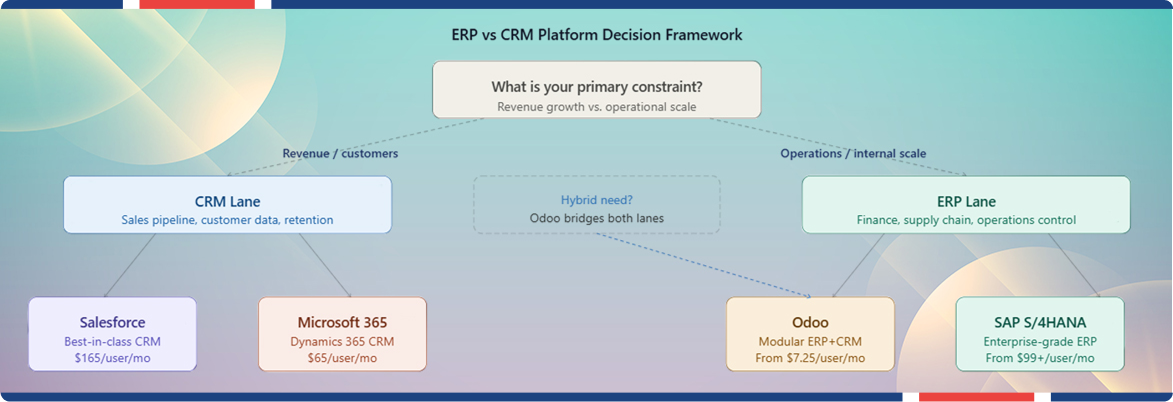
Executives reach for this comparison when they are dealing with two fundamentally different symptoms. Salesforce solves a revenue problem: pipeline visibility, sales cycle compression, customer retention. The best CRM for enterprise is the one that tightens the link between your go-to-market motion and your customer data – and Salesforce is built from the ground up to do exactly that.
SAP solves an operations problem. Its S/4HANA platform holds roughly 22% of the enterprise ERP market, according to Apps Run the World data cited in a 2026 global ERP analysis. SAP is for companies where the bottleneck is not in the funnel but in fulfillment, compliance, multi-entity accounting, or global supply chain governance.
The Salesforce vs SAP comparison only makes sense if both tools are legitimately in scope. For most organizations, they serve different layers of the stack – and the real architecture question is how they should coexist, not which one wins.

Where Odoo for Growing Businesses Earns Its Place
Odoo sits in a category of its own. It is modular, open-source, and designed to let a company start lean and expand deliberately. The ERP software for SMB market is competitive, but Odoo ERP’s pricing model – currently starting at $7.25 per user per month for its Standard plan, billed annually – removes the barrier that historically kept mid-market companies on spreadsheets longer than they should have been.
The strategic value of Odoo is its architecture, not its price point. Odoo development consulting can help growing businesses determine which modules to implement, how they should interact, and where customization is actually justified before the system becomes difficult to govern. Because Odoo CRM and Odoo ERP share one unified database, the CRM ERP integration strategy that costs other organizations months of middleware work simply does not exist as a separate problem. Sales, inventory, accounting, and procurement talk to each other natively. That is a structural advantage, not a feature.
The risk with Odoo is not capability - Odoo 18 added Progressive Web App support, simplified navigation, and mobile-first access improvements. The risk is scope creep. Companies that activate modules without a governing architecture end up with a fragmented system that is neither ERP nor CRM but an expensive hybrid of both. Well-structured Odoo development services can keep those customizations aligned with the core business architecture while preserving the flexibility that makes the platform attractive to growing organizations.
The Microsoft 365 as ERP Misconception – and What It Actually Solves
Microsoft 365 is the most widely deployed productivity platform in enterprise. The instinct to expand it into operational management is understandable – the interface is familiar, licensing already exists, and the integration with Power BI, Azure, and Teams is deep. Microsoft Dynamics vs Salesforce is a genuine comparison when the company already runs the Microsoft stack.
Using Microsoft 365 as ERP, however – meaning using SharePoint lists, Excel, and Teams tabs to manage business operations – is a pattern that works until it does not. The moment multi-currency, revenue recognition, or warehouse logic enters the picture, the seams show. The platform is a collaboration layer. It is not an operations layer.
Dynamics 365 CRM development consulting can help Microsoft-centric organizations extend their existing ecosystem into customer management without confusing productivity tools with a full ERP architecture.

The Decision Framework: Four Questions Before You Touch a Vendor
Every enterprise software selection criteria conversation should start from business architecture, not product marketing. Here is the framework I have used across dozens of technology assessments:
1. Where is your primary constraint?If customers are not buying or renewing, you have a CRM problem. If operations cannot scale without chaos, you have an ERP problem. These are not synonymous.
2. What is your complexity ceiling in 36 months?A company that will stay under 200 employees and one geography has different needs than one planning multi-entity expansion. Overbuilding for complexity is as damaging as underbuilding for it.
3. What does your existing tech stack assume?Microsoft-centric organizations get compounding returns from Dynamics. Salesforce-native organizations get compounding returns from extending the platform. Greenfield companies get the most flexibility – and the highest risk of choosing on trend rather than fit.
4. Who is responsible for post-go-live governance?The best ERP or CRM implementation with no internal owner reverts to chaos within 18 months. ERP implementation failure rate in manufacturing alone hit 73% in recent discrete manufacturing studies.
Beyond Licensing: The Real Math Behind Software ROI
Enterprise software ROI is not about licensing cost. Among organizations that conducted an ROI analysis before implementation and had been live for more than a year, 83% reported meeting their ROI expectations – but that number drops sharply when the implementation was driven by vendor relationships or industry trend rather than internal diagnosis, per Panorama Consulting’s 2025 ERP Report.
The median time to ROI for well-run ERP systems is 2.5 years, according to Nucleus Research, with properly governed platforms cutting operational costs by 23%. Those numbers are not built into the software. They are earned through architectural alignment and disciplined implementation.
Which management software for business is right for you?
Salesforce, SAP, Odoo, and Microsoft 365 each solve a real problem – but none of them solves all problems equally. Salesforce wins when growth depends on customer acquisition, pipeline precision, and cross-sell intelligence. SAP wins when operations at scale require financial governance and supply chain traceability that smaller platforms cannot support.
Odoo wins when a company needs a full-stack business management platform with fast deployment, low total cost, and modular flexibility. Microsoft 365 and Dynamics win when the organization already runs deep in the Microsoft ecosystem and wants unified identity, security, and collaboration across every workflow.
People Also Ask:
1. What is the difference between ERP and CRM software?ERP manages internal operations – finance, inventory, supply chain, and HR. CRM manages external relationships – sales pipelines, customer data, and marketing campaigns.
2. Is Microsoft 365 a management software for business?Microsoft 365 is a productivity and collaboration platform, not an ERP or CRM. For business operations management, Microsoft Dynamics 365 is the correct platform within the Microsoft ecosystem.
3. How does Salesforce CRM pricing compare to Odoo for growing businesses?Salesforce Sales Cloud Enterprise starts at $165 per user per month. Odoo Standard starts at $7.25 per user per month – making Odoo the lower-cost entry for SMBs, though Salesforce offers deeper CRM specialization at scale.
4. What is the typical SAP implementation cost for a mid-sized company?Mid-market SAP implementations average $7.1 million and 17.4 months, per Panorama Consulting’s 2025 ERP Report. Cost varies significantly based on modules selected, customization depth, and implementation partner expertise.
5. What is the ERP implementation failure rate and how can it be avoided?Between 55% and 75% of ERP projects fail to meet objectives, according to Panorama Consulting and Nucleus Research. Organizations that engage certified implementation partners report an 85% success rate.
Work with a team that has implemented Salesforce, SAP, Odoo, and Microsoft Dynamics – not just evaluated them.
Flexsin’s CRM and ERP consulting practice combines platform certification with real deployment experience across manufacturing, distribution, professional services, and technology. Whether you need to build an ERP architecture from scratch, migrate off a legacy system, or integrate Salesforce and Odoo into a unified data layer - Flexsin has shipped it.
Explore Flexsin’s ERP and CRM consulting services:
Tell us what you’re running today – and where it’s breaking. Flexsin maps the architecture first, then recommends the platform that earns its place in your stack.
