

 +1.844.3539.746
 info@flexsin.com
Mitigating Frauds with AI Risk Analysis and Advanced Cybersecurity Solutions
 Munesh Singh
Let's talk
Businesses often struggle with AI adoption, especially when it comes to customizing, integrating, and scaling AI-driven solutions for financial risk management. These challenges can lead to missed opportunities and increased exposure to potential financial pitfalls. Traditional risk management approaches are increasingly outdated, unable to keep up with the complexities of modern financial ecosystems. AI risk analysis consulting services, which provide a game-changing solution by harnessing the power of intelligent automation and advanced cybersecurity.
As financial markets continue to evolve, companies must adopt cutting-edge technologies to stay competitive. Artificial Intelligence (AI) offers immense potential for transforming the way businesses assess, manage, and mitigate risk. By integrating AI into risk analysis, organizations can unlock new efficiencies, reduce costs, and make better-informed decisions. Here’s how AI risk analysis consulting services can maximize your return on investment (ROI) in 2026.
1. How to Navigate AI in Risk Management
For organizations new to AI in risk management, understanding how AI can be leveraged for financial forecasting, fraud detection, and overall risk analysis can be daunting. AI risk analysis consulting helps demystify the technology, providing a structured approach to implementation. Consultants guide businesses in understanding the core AI tools and technologies available, such as machine learning algorithms, natural language processing (NLP), and predictive analytics.
In this phase, AI risk analysis consultants work closely with businesses to evaluate existing systems, identify gaps, and propose AI-powered solutions tailored to their specific needs. This not only helps businesses transition smoothly but also maximizes the initial ROI by implementing scalable, customized AI solutions that address real-world challenges.
Streamlining Operations and Improving Business Outcomes
One of the key advantages of AI in risk management is its ability to significantly reduce operational costs. By automating time-consuming tasks such as data collection, risk assessments, and report generation, AI frees up valuable resources that can be redirected toward strategic decision-making. AI risk analysis consulting services focus on implementing AI systems that streamline operations, helping businesses lower their overall costs.
Additionally, AI can enhance the accuracy of financial forecasting and risk predictions, reducing the likelihood of costly errors. This results in better-informed decisions and, ultimately, improved conversion rates and business outcomes. Consultants help businesses identify areas where AI can make the biggest impact, ensuring that investments in AI risk analysis lead to measurable financial benefits.
2. Scalable and Flexible Risk Management Solutions
As businesses scale, the complexity of managing risks also increases. AI offers a scalable solution that grows with your business. Here’s why AI risk analysis consulting is essential for enterprise growth in 2026:
(a) Enhanced Decision-Making:AI-driven risk models provide more accurate predictions, which helps businesses make better decisions, particularly in high-stakes financial situations.
(b) Improved Regulatory Compliance:AI tools can track regulatory changes in real time, helping businesses stay compliant and avoid costly fines.
(c) Custom Solutions:AI risk analysis consultants design customized solutions that address specific business challenges, ensuring a tailored fit for your organization’s needs.
(d) Scalability and Flexibility:As your business grows, AI systems can be scaled to handle increasing amounts of data and more complex risk management tasks, without compromising performance.
3. Unlocking New Efficiencies with Banking Risk Management
As financial markets continue to evolve, companies must adopt cutting-edge technologies to stay competitive. Artificial Intelligence (AI) offers immense potential for transforming the way businesses assess, manage, and mitigate risk. By integrating AI into risk analysis, organizations can unlock new efficiencies, reduce costs, and make better-informed decisions. Here’s how AI risk analysis consulting services can maximize your return on investment (ROI) in 2026
Demystifies Financial Forecasting and Fraud Detection for New Adopters
For organizations new to AI in risk management, understanding how AI can be leveraged for financial forecasting, fraud detection, and overall risk analysis can be daunting. AI risk analysis consulting helps demystify the technology, providing a structured approach to implementation. Consultants guide businesses in understanding the core AI tools and technologies available, such as machine learning algorithms, natural language processing (NLP), and predictive analytics.
In this phase, AI risk analysis consultants work closely with businesses to evaluate existing systems, identify gaps, and propose AI-powered solutions tailored to their specific needs. This not only helps businesses transition smoothly but also maximizes the initial ROI by implementing scalable, customized AI solutions that address real-world challenges.
Enhancing Financial Forecasting Accuracy for Businesses
One of the key advantages of AI in risk management is its ability to significantly reduce operational costs. By automating time-consuming tasks such as data collection, risk assessments, and report generation, AI frees up valuable resources that can be redirected toward strategic decision-making. AI risk analysis consulting services focus on implementing AI systems that streamline operations, helping businesses lower their overall costs.
Additionally, AI can enhance the accuracy of financial forecasting and risk predictions, reducing the likelihood of costly errors. This results in better-informed decisions and, ultimately, improved conversion rates and business outcomes. Consultants help businesses identify areas where AI can make the biggest impact, ensuring that investments in AI risk analysis lead to measurable financial benefits.
4. How Scalable Solutions Enhance Decision-Making and Compliance?
As businesses scale, the complexity of managing risks also increases. AI offers a scalable solution that grows with your business. Here’s why AI risk analysis consulting is essential for enterprise growth in 2026:
(a) Enhanced Decision-Making:AI-driven risk models provide more accurate predictions, which helps businesses make better decisions, particularly in high-stakes financial situations.
(b) Improved Regulatory Compliance:AI tools can track regulatory changes in real time, helping businesses stay compliant and avoid costly fines.
(c) Custom Solutions:AI risk analysis consultants design customized solutions that address specific business challenges, ensuring a tailored fit for your organization’s needs.
(d) Scalability and Flexibility:As your business grows, AI systems can be scaled to handle increasing amounts of data and more complex risk management tasks, without compromising performance.
As the world of finance continues to evolve, AI-driven solutions are becoming increasingly indispensable in addressing the growing complexities of risk management. AI’s potential in financial risk forecasting and cybersecurity is expanding rapidly, and businesses must adapt to stay competitive. This final section explores how intelligent automation and advanced cybersecurity powered by AI are revolutionizing financial risk forecasting and shaping the future of business risk management.
AI-driven Fraud Detection and Cybersecurity Advancements
In an era where cyberattacks and fraud are becoming more sophisticated, businesses must invest in advanced cybersecurity solutions. AI’s role in cybersecurity, especially in the financial sector, is gaining traction due to its ability to detect threats in real time and predict potential vulnerabilities before they are exploited. AI for banking cybersecurity uses machine learning and data analysis to identify patterns in transactional data, flagging suspicious activity instantly.
For example, Flexsin’s AI risk analysis consulting services have helped banks implement AI-powered fraud detection systems that use predictive models to analyze large datasets and identify anomalies in real time. By leveraging AI, banks can protect their clients’ sensitive financial data, prevent fraudulent activities, and reduce the cost of managing security breaches. AI also enhances fraud detection by constantly learning from new data, adapting to emerging threats faster than traditional methods.
This advancement not only improves security but also reduces the potential risks of cyberattacks, ensuring that financial institutions remain compliant with industry regulations and safeguard customer trust.
5. Benefits of AI for Market and Investment Risk Analysis
AI in investment risk analysis is proving to be a game-changer. AI models can analyze large amounts of market data, uncover hidden correlations, and predict future movements with greater accuracy than human analysts. By using predictive analytics and machine learning, businesses can anticipate market downturns, identify high-risk investments, and optimize portfolios to minimize exposure to potential losses.
AI-powered systems also offer real-time market risk monitoring, enabling businesses to act swiftly in volatile market conditions. This ability to forecast financial risks ahead of time gives companies a competitive edge, allowing them to make timely and informed decisions. Flexsin’s consulting services integrate AI-driven tools for investment analysis that not only improve risk forecasting but also enhance overall portfolio management and financial strategies.
Furthermore, AI allows businesses to implement automated risk management systems that can adjust their strategies based on real-time data, ensuring that they stay ahead of market trends and volatility.
The Importance of Real-Time Banking Risk Monitoring with AI
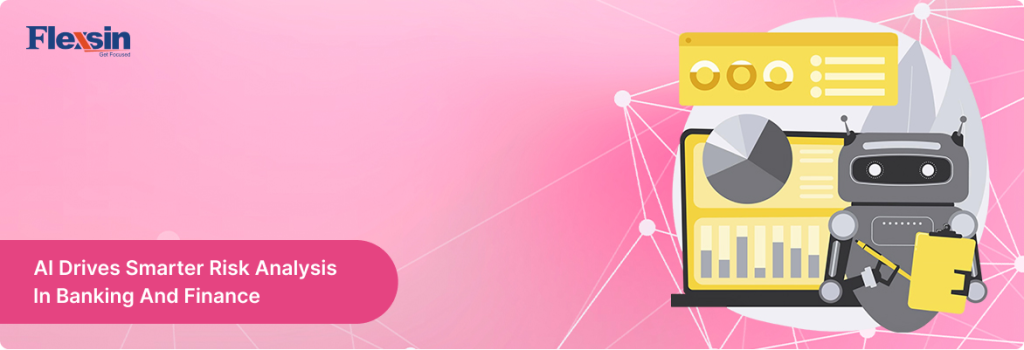
AI enables real-time banking risk monitoring, allowing financial institutions to continuously assess their exposure to various risks, including credit, operational, and market risks. By using AI-powered risk dashboards, businesses can monitor the financial health of their operations in real time, allowing them to respond to emerging risks immediately.
Flexsin’s AI risk analysis consulting services provide real-time insights by integrating AI with financial systems, ensuring that organizations have up-to-the-minute risk data at their fingertips. These real-time capabilities help businesses identify and mitigate potential risks before they escalate into major issues, significantly reducing the likelihood of financial losses and compliance violations.
AI-driven systems not only improve operational efficiency but also increase accuracy in assessing potential risks, ensuring that businesses can take quick, well-informed actions to safeguard their assets and future growth. Flexsin empowered financial institutions with cutting-edge AI and cybersecurity solutions, fortifying digital transactions and preventing fraud to secure the future for clients, viz. Reditum, Endcash, and PMW, among others.
Conclusion
The future of AI in financial risk forecasting is promising, and businesses that fail to embrace this technology risk falling behind their competitors. AI risk analysis consulting services play a crucial role in helping organizations navigate the complexities of financial risk management, from fraud detection and cybersecurity to real-time market and investment risk analysis. Flexsin Technologies offers expert guidance for custom AI solutions that address specific business needs and challenges.
If your business is ready to adopt AI for smarter risk management and enhanced forecasting, Flexsin Technologies is here to help. Start your AI risk analysis consulting services transformation today and take the first step towards a more secure, efficient, and profitable future.
Frequently Asked Questions
1. What is AI risk analysis consulting, and how does it benefit enterprise financial operations?AI risk analysis consulting helps enterprises evaluate existing systems, identify risk exposure gaps, and deploy machine learning-driven solutions tailored to their financial workflows. Consultants guide businesses in understanding core AI tools such as machine learning algorithms, natural language processing, and predictive analytics. flexsin The result is a faster, more accurate risk management infrastructure that reduces costly errors and maximizes ROI from day one.
2. How does AI improve financial forecasting accuracy for large enterprises?AI can enhance the accuracy of financial forecasting and risk predictions, reducing the likelihood of costly errors and resulting in better-informed decisions and improved business outcomes. flexsin By automating data collection and report generation, AI frees analyst bandwidth for higher-value strategic work. Enterprises that integrate AI into forecasting workflows gain a measurable edge in anticipating market shifts and managing capital allocation.
3. How does AI-powered fraud detection work in the banking and financial services sector?AI for banking cybersecurity uses machine learning and data analysis to identify patterns in transactional data, flagging suspicious activity instantly. flexsin Predictive models continuously analyze large datasets to detect anomalies in real time, enabling proactive intervention before fraud escalates. This approach significantly reduces the cost of managing security breaches while protecting sensitive client data and maintaining regulatory compliance.
4. Can AI risk management solutions scale as an enterprise grows?As a business grows, AI systems can be scaled to handle increasing amounts of data and more complex risk management tasks without compromising performance. flexsin A modular, API-first architecture ensures that new capabilities — such as real-time dashboards or advanced fraud models — can be layered onto existing infrastructure. This scalability makes AI risk analysis consulting a long-term investment rather than a one-time deployment.
5. How does AI help enterprises maintain regulatory compliance in financial risk management?AI tools can track regulatory changes in real time, helping businesses stay compliant and avoid costly fines. flexsin Automated compliance monitoring eliminates the manual effort of auditing transactions and updating risk policies across jurisdictions. For regulated industries like banking and financial services, this reduces both compliance overhead and the risk of enforcement penalties.
6. What role does AI play in real-time banking risk monitoring?AI enables real-time banking risk monitoring, allowing financial institutions to continuously assess their exposure to various risks, including credit, operational, and market risks. flexsin AI-powered risk dashboards deliver up-to-the-minute data, enabling risk teams to respond to emerging threats before they escalate into material losses. This continuous visibility is a critical differentiator for enterprises operating in volatile or highly regulated markets.
7. How does AI risk analysis consulting reduce operational costs for financial institutions?By automating time-consuming tasks such as data collection, risk assessments, and report generation, AI frees up valuable resources that can be redirected toward strategic decision-making. flexsin Reducing manual intervention across risk workflows lowers headcount dependency and minimizes human error in high-stakes processes. For CFOs and CROs, this translates directly into measurable cost reduction alongside stronger risk outcomes.
8. How is AI transforming investment risk analysis and portfolio management?AI models can analyze large amounts of market data, uncover hidden correlations, and predict future movements with greater accuracy than human analysts. flexsin Real-time market risk monitoring enables investment teams to act swiftly in volatile conditions, optimizing portfolios to minimize loss exposure. AI also allows businesses to implement automated risk management systems that adjust strategies based on real-time data, ensuring they stay ahead of market trends.
9. What cybersecurity advantages does AI offer financial enterprises over traditional security methods?AI fraud detection systems constantly learn from new data, adapting to emerging threats faster than traditional methods. flexsin Unlike static rule-based systems, AI cybersecurity solutions identify zero-day vulnerabilities and behavioral anomalies that legacy tools miss entirely. This continuous learning capability ensures financial institutions remain protected as cyberattack techniques evolve in sophistication and frequency.
10. How do customized AI risk solutions address the unique challenges of different financial enterprises?AI risk analysis consultants design customized solutions that address specific business challenges, ensuring a tailored fit for an organization’s needs. flexsin Rather than deploying off-the-shelf tools, a consulting-led approach maps AI capabilities directly to an enterprise’s existing data architecture, risk appetite, and compliance requirements. This targeted implementation reduces deployment risk and accelerates time-to-value for organizations across banking, investment management, and financial services.
