

 +1.844.3539.746
 info@flexsin.com
 Sudhir K Srivastava
Microsoft has already done what most enterprises are still debating. Across a supply chain spanning 70+ Azure regions and 400 data centers, they deployed more than 25 AI agents that act, not just report. Simulations replace guesswork. Autonomous agents replace manual escalation. The question isn’t whether this architecture works. It’s whether you’re building it.
Most supply chain leaders have already spent two or three years improving visibility. They can see where inventory sits, where freight is delayed, and where demand is spiking. That’s not nothing, but it’s also not the same as doing something about it. The honest gap in most enterprise supply chains right now isn’t data. It’s decision authority.
What Microsoft documented in its own operations is the clearest enterprise proof point available today. In 2018, they consolidated more than 30 systems into a single supply chain data lake on Azure. From that foundation, they built progressively – a Demand Planning Agent that runs AI-based demand simulations, a CargoPilot Agent that continuously balances cost, carbon impact, and cycle times, and a Multi-Agent DC Spare-Part Space Solver that forecasts storage needs before stockouts occur.
Microsoft’s target is over 100 deployed agents by end of 2026. Their supply chain teams are already saving hundreds of hours each month. That’s not a pilot. That’s a production system with compounding returns.
The enterprises that are moving fastest aren’t necessarily the ones with the most sophisticated models. They’re the ones that resolved a simpler question first: where can AI make a decision without a human in the loop, and where can it absolutely not. That line is harder to draw than it sounds, which is why most AI supply chain programs produce great dashboards and modest outcomes.
Before You Read On:
- Microsoft’s internal supply chain transformation – 30+ consolidated systems, 25+ deployed agents, 100+ targeted by end of 2026, is the most credible enterprise proof point for agentic AI at scale available today.
- The three architecture layers that define Supply Chain 2.0 are AI-powered simulation, multi-agent orchestration, and physical AI — and Microsoft’s own deployment followed exactly that sequence, not a simultaneous rollout.
- Data unification is a prerequisite, not a phase. Microsoft spent years consolidating before building a single agent. Organizations that skip this step find their agents making decisions on fragmented information, which compounds quietly and is harder to detect than an outright failure.
- By 2030, Gartner projects 50% of cross-functional supply chain management solutions will use intelligent agents to autonomously execute decisions. The competitive gap between movers and waiters is widening every quarter, and Microsoft’s lead makes that gap structural, not just temporal.
- Physical AI robots, trained in simulation before touching a live warehouse floor, is no longer a research conversation. Microsoft’s partner ecosystem including Figure AI, Hexagon Robotics, and KUKA has physical AI in production today, all running on Azure infrastructure.
The Counterintuitive Problem With ‘Smart’ Supply Chains
The obvious assumption is that more data leads to resilient supply chain performance. Most enterprise programs of the last decade were built on exactly that logic. In practice, the opposite problem has emerged: operations now have too much signal and too little authority to act on it.
Think of it like a control room with a hundred monitors and a single phone. Every screen shows a problem. The phone is always busy. That’s the operational reality for most enterprise supply chain teams right now – overwhelming visibility, constrained response. Microsoft’s own pre-transformation environment looked exactly like this: Excel-based reporting, siloed data, limited visibility, and manual reconciliation cycles that consumed planning capacity daily.
What nobody says out loud is that most ‘AI-powered’ supply chain tools are really just faster reporting. They surface the anomaly. Then a human decides. Then another human approves. By the time the action reaches the floor, the disruption has already cost the business. Agentic AI is architecturally different because it short-circuits that loop – the agent detects, decides, and executes within the same system, under defined governance rails. Microsoft’s CargoPilot Agent doesn’t file a recommendation. It makes the call.
The Decision Latency Problem
Decision latency – the time between a supply chain signal and a corrective action, is where most enterprise AI investments quietly fail. A demand spike flagged at 9 AM that gets reviewed by a planner at 2 PM, escalated by 4 PM, and approved the following morning is not an intelligent supply chain. It’s a digital paper trail. Agentic supply chains collapse that window from hours to seconds.
IBM research shows organizations with higher AI investment in supply chain operations report revenue growth 61% greater than their peers. That gap isn’t coming from better forecasts. It’s coming from faster action on the forecasts they already have, which is precisely what Microsoft’s agent architecture was designed to deliver.
Why Most Enterprise AI Deployments Stall at the Same Gate
Here’s what the analysts don’t say plainly enough: up to 95% of generative AI initiatives in supply chain have struggled to deliver sustained ROI, and the reason is almost never the model. It’s the data estate underneath it.
Microsoft’s internal transformation makes this unavoidable. The agents that now run autonomously across their supply chain couldn’t have been built on fragmented systems. The 2018 consolidation of 30+ systems into a single Azure data lake wasn’t a technology project, it was a strategic prerequisite. Most enterprises want to skip that step because it’s slow, expensive, and unglamorous. The ones that skip it spend 18 months building agents and another 18 months debugging why those agents keep making quietly wrong calls on bad data.
There’s a secondary stall point that gets less attention: the governance gap. Gartner flagged that over 40% of current agentic AI projects face cancellation by 2027, not because the technology fails but because organizations can’t answer basic questions about who is accountable when an agent makes a wrong call. That’s a leadership problem, not a technical one. Microsoft resolved it by building governance architecture before scaling. Most enterprises do it the other way around, and the repair costs more than the original build.
The Data Unification Non-Negotiable
Celonis and Microsoft have jointly documented the pattern in their shared architecture: supply chain data at the source-of-record layer typically doesn’t speak the same language across systems. ERP, warehouse management, and transport management data sit in separate schemas, updated on different cycles, with different field definitions for what looks like the same entity. Agents built on top of that fragmentation don’t fail dramatically – they make quiet, consistent errors that are harder to detect and far more expensive to unwind than an outright system failure.
The Strategic Framework for Agentic AI Supply Chain
Microsoft’s deployment path – whether intentional or emergent, maps precisely onto the Flexsin Supply Chain AI Maturity Model. Three sequenced architecture layers. Each one is a prerequisite for the next. Organizations that try to jump directly to multi-agent systems without simulation foundations, or to physical AI without governed agent orchestration, consistently find themselves rebuilding from scratch 18 months later. Microsoft didn’t get to 25+ agents by moving fast. They got there by moving in sequence.
Layer 1 – Predictive Simulation
Before agents make live decisions, the supply chain needs a simulation environment where those decisions can be stress-tested. Microsoft’s Demand Planning Agent runs AI-based demand simulations for non-IT rack components, not to replace the planner but to give the planner a risk-free environment in which every scenario has already been tested before it becomes real.
Partners like Cosmo Tech offer AI simulation platforms on Azure that use dynamic digital twins to model how disruptions cascade system-wide. SoftServe demonstrated this at Krones – integrating NVIDIA Omniverse-based digital twins cut simulation cycle times from several hours to under five minutes. At Toyota Material Handling Europe, the same approach cut training times for autonomous forklift systems by more than 30%. Simulation isn’t a phase you eventually graduate from. It’s the environment in which every subsequent agent learns before it touches production.
Layer 2 – Multi-Agent Orchestration
Microsoft’s multi-agent architecture across its own supply chain is the clearest available model of what orchestration looks like at scale. The CargoPilot Agent doesn’t just optimize routes, it continuously weighs transport modes, cost structures, carbon impact, and cycle times simultaneously. The Spare-Part Space Solver uses computer-vision-driven monitoring and multi-agent reasoning to forecast storage needs before a stockout risk becomes visible to any human planner.
In Microsoft’s partner ecosystem, CSX Transportation runs a multi-agent system that validates customer eligibility, routes complex requests, and coordinates multi-step rail operations. Dow Chemical deploys invoice analysis agents that review thousands of freight invoices daily, automatically detecting discrepancies across its global shipping network. C.H. Robinson’s fast-quoting agents cut freight quote generation time across its carrier network. These aren’t pilots. They’re production systems with measurable, compounding returns.
What ties multi-agent systems together is the orchestration layer. Microsoft’s Work IQ, Foundry IQ, and Fabric IQ provide the intelligence context that gives agents full enterprise awareness, so they reason against real KPIs like inventory turnover and on-time delivery, not isolated data signals. Without that context layer, agents optimize locally and create system-wide imbalances that take months to diagnose.
Layer 3 – Physical AI
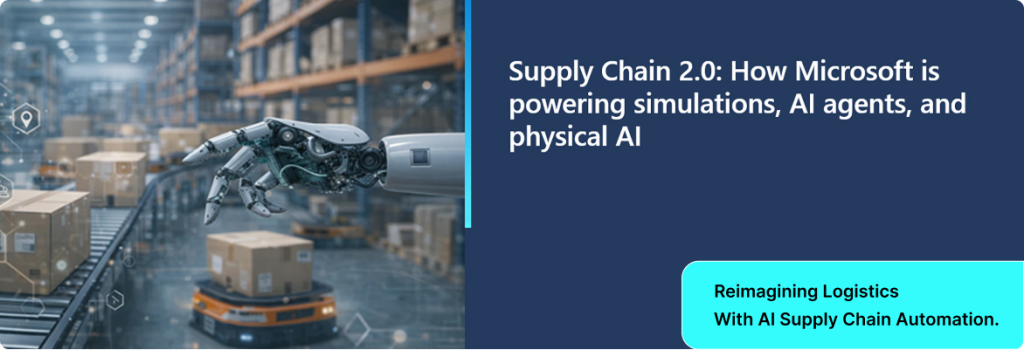
Physical AI is where the intelligence moves off the screen and into the machine. Microsoft’s Rho-alpha robotics model – combining natural language, visual perception, and tactile feedback, is already in early-access research deployments. Figure AI, partly funded by Microsoft, has its humanoid Figure 03 robot sorting packages at conveyor belt speeds in real logistics environments. KUKA and Microsoft jointly built iiQWorks Copilot, reducing robot programming time for simple tasks by up to 80% using Azure AI services.
The critical architectural insight – one most organizations miss entirely, is that physical AI doesn’t replace simulation. It depends on it. Robots trained purely on live operations require expensive, disruptive trial-and-error on production floors. Robots trained in simulation first, then deployed with reinforcement learning frameworks like NVIDIA Isaac Lab, fail faster and recover faster without touching production. That’s not a theoretical advantage. SoftServe’s Toyota deployment proved it quantitatively: 30%+ reduction in autonomous system training time, entirely from simulation-first architecture.
Flexsin’s Take on Agentic AI Supply Chain
Most supply chain AI programs we encounter share the same structural flaw: strong analytics capability, weak action infrastructure. The data is clean enough to surface good signals. The governance isn’t mature enough to let those signals trigger automated responses.
The result is a reporting layer that everyone trusts and an action layer that nobody has built. What Microsoft demonstrated, and what most enterprises haven’t internalized yet, is that the gap between insight and execution is not a technology gap. It’s an architecture decision. And every quarter you delay making it, the companies that already made it compound their advantage further.
A mid-sized North American industrial distributor – 800 employees, four regional distribution centers, $340M in annual revenue, came to Flexsin Technologies after 18 months of dashboard investment that had produced exactly zero autonomous decisions. We built their simulation environment on Azure first, stress-tested their top 12 disruption scenarios before a single agent went live, then deployed a three-agent orchestration layer covering demand planning, freight routing, and supplier risk monitoring.
Six months in, manual replanning cycles dropped from daily to exception-only – meaning planners touched less than 12% of decisions. Inventory carrying costs fell 18% on the covered product families. The other 88% ran autonomously within governance bands that the operations team themselves defined. That last part matters: they owned the rules. The agents enforced them.
Agentic AI Supply Chain: Named Outcomes and Proof Points
Start with Microsoft’s own numbers, because they’re the hardest to dismiss. Their supply chain teams are saving hundreds of hours each month from AI in logistics alone, not from a single flagship deployment but from 25+ agents running across interconnected workflows. That’s what compounding looks like when agents are designed to work together rather than in isolation.
The broader data confirms the pattern is repeatable. IBM research shows AI-powered innovations in supply chains can reduce logistics costs by 15%, optimize inventory levels by 35%, and improve service levels by 65%. Those figures sound abstract until you apply them to a $500M distribution operation, at which point they represent tens of millions of recoverable cost annually.
According to BCG, agentic systems already accounted for 17% of total AI value in 2025 and are projected to reach 29% by 2028. The share is growing because the results are compounding, not because the technology is getting cheaper.
The most telling data point is from organizations that actually deployed. In 2025, nearly 67% of companies that deployed agentic AI in supply chain and inventory management reported a significant revenue increase, but that figure concentrates almost entirely in organizations that had completed data unification before building agents. The ones that hadn’t reported inconsistent, hard-to-explain results. That’s not a coincidence. It’s the exact pattern Microsoft’s own 2018 consolidation was designed to prevent, and it’s the same pattern we see consistently across every enterprise engagement we run.
Trade-offs for Agentic AI Supply Chain
Agentic supply chain systems are not a fit for every organization at every stage. The prerequisites are real and they’re expensive: a unified data estate, clearly documented decision logic, governance frameworks that define agent authority and escalation paths, and the operational discipline to maintain those boundaries as agent behavior evolves in ways you didn’t fully anticipate during design.
Physical AI carries compounding complexity. Humanoid robots and advanced automation systems require integration with legacy OT environments – SCADA systems, MES platforms, and warehouse management systems that predate modern API architecture by a decade or more. Getting those integrations right typically takes 12 to 18 months. Organizations that underestimate that timeline don’t just delay their robot deployment, they strand it in proof-of-concept status permanently, because the business case erodes faster than the integration timeline moves.
The governance gap is the most expensive lesson we’ve seen enterprises learn the hard way. When an agent makes a suboptimal procurement decision at 2 AM on a Friday, and it will, eventually – accountability has to land somewhere before that moment arrives, not after. The organizations that resolve that question in a governance workshop before go-live spend an afternoon on it. The ones that resolve it after the first significant agent error spend six months on it, in a room that also includes legal, finance, and at least one person whose entire job is now explaining what happened.
People Also Ask:
What is an agentic AI supply chain?An agentic supply chain uses AI agents that sense disruptions, make decisions, and execute corrective actions autonomously within defined governance parameters. It acts – not just reports.
How is Microsoft using agentic AI in supply chain?Microsoft has deployed 25+ AI agents across its own global supply chain, covering demand planning, freight optimization, and spare-part management. Their target is 100+ agents by end of 2026.
What is a digital twin in supply chain?A supply chain digital twin is a virtual model of physical operations that simulates disruptions and decisions before they happen. It reduces risk and accelerates replanning cycles significantly.
How long does agentic AI supply chain deployment take?Single-purpose agent deployments can go live in 60 to 90 days. Multi-agent orchestration systems typically require 6 to 12 months, depending on data readiness and governance maturity.
Microsoft proved the architecture works. Flexsin builds it for you.
Our generative AI and agentic AI services help manufacturing, logistics, and industrial enterprises design, deploy, and govern multi-agent supply chain systems, from demand simulation through to physical AI. We work directly with your operations leaders, not just your IT department, because the architecture has to reflect how your supply chain actually runs, not how it looks in a diagram. Contact Flexsin to schedule a focused discovery session.
What Leaders Ask Us:
1. What’s the difference between Microsoft’s agentic AI supply chain and traditional automation? Microsoft’s agents reason across systems and act on multi-step decisions autonomously. Traditional automation executes predefined rules without adaptive reasoning or cross-system context.
2. Do we need to replace our ERP before deploying AI agents? No. Most agentic architectures, including Microsoft’s, integrate with existing ERP systems via APIs. Data unification is the priority – not system replacement.
3. What does Microsoft’s agentic AI supply chain cost to replicate? Full enterprise multi-agent programs range from $500K to $2M+ over 18 months including integration and governance design. The data unification phase is often the largest cost variable.
4. What governance structure is required for agentic AI supply chain? At minimum: defined authority thresholds per agent type, clear escalation paths to human review, audit logging for every autonomous decision, and a designated business owner accountable for agent performance.
5. Can AI agents handle agentic AI supply chain disruptions in real time? Yes, within their trained decision logic. Microsoft’s agents reroute freight, adjust inventory allocation, and trigger supplier escalations in seconds. Novel disruption types still require human judgment.
6. What is the ROI timeline for Microsoft-style agentic AI supply chain? Organizations with solid data foundations typically see measurable ROI within 12 to 18 months. Fragmented data estates extend timelines to 24 months or longer, often indefinitely.
7. Is physical AI – humanoid robots, ready for production warehouse deployment? For specific, repeatable tasks such as sorting and pallet handling, yes. Microsoft partners Figure AI, Hexagon Robotics, and KUKA have production deployments running on Azure infrastructure today.
8. What role does simulation play before deploying warehouse robots? Simulation is the training ground. Microsoft’s partner ecosystem trains robots in virtual environments before live deployment. SoftServe’s Toyota project cut autonomous system training time by 30%+ using this approach.
9. How does Microsoft Fabric fit into agentic AI supply chain architecture? Microsoft Fabric unifies disparate data sources into a single analytics foundation. It’s the data layer that feeds agent reasoning – without it, agents lack the context to make reliable decisions.
10. What supply chain decisions can Microsoft-powered agents make autonomously? Demand planning adjustments, freight route optimization, supplier escalation triggers, inventory reallocation, and invoice discrepancy detection are all in active production across Microsoft’s own and partner deployments.