

 +1.844.3539.746
 info@flexsin.com
 Sudhir K Srivastava
Microsoft Agent 365 introduces a centralized governance and management layer for AI agents, designed to help enterprises maintain visibility, security, and operational control as autonomous AI agents become deeply embedded across business workflows. As organizations move beyond experimentation, AI agents are no longer isolated assistants. They actively participate in decision-making, execute tasks across systems, and operate with increasing autonomy.
This evolution fundamentally changes how enterprises must think about AI oversight. Traditional IT controls were built for applications and users, not for intelligent agents that can reason, adapt, and act independently. Without a dedicated governance layer, enterprises face growing risks related to security, compliance, operational inconsistency, and loss of control.
Microsoft Agent 365 addresses this challenge by acting as a unifying control layer for AI agents across the enterprise. It brings governance, security, and operational oversight into a single framework, enabling organizations to scale AI adoption responsibly while maintaining enterprise-grade trust and accountability.
Understanding Microsoft Agent 365 Landscape
Microsoft Agent 365 is designed to operate above individual AI agents and agent frameworks. Rather than focusing on how agents are built or trained, it focuses on how they are managed once deployed into production environments.
Its role is to provide centralized visibility, governance, and lifecycle oversight across all AI agents operating within the enterprise. This includes agents developed internally, agents created through low-code platforms, and agents sourced from third parties. By abstracting governance away from individual implementations, Microsoft Agent 365 enables consistent oversight across a highly diverse AI ecosystem.
Microsoft Agent 365 as a Control Plane for Agents
Microsoft Agent 365 functions as a control plane for agents by centralizing how AI agents are registered, monitored, and governed across environments. Instead of managing agents in silos, enterprises gain a single layer of control that spans platforms, teams, and business units.
Centralized agent management gives organizations a unified view of all AI agents operating across the enterprise. This includes first-party agents, third-party agents, and internally developed agents. By maintaining a comprehensive agent registry, enterprises reduce the risk of shadow AI, improve accountability, and gain clarity into where and how AI agents are being used.
Unified Agent Control Across Platforms
Unified agent control allows enterprises to apply consistent governance policies regardless of where agents run. Whether agents operate within productivity tools, cloud services, or line-of-business systems, the same control framework applies.
This consistency is essential in complex environments where fragmented controls can create security gaps and operational confusion.
Agent Governance and Enterprise AI Governance
Agent governance is a foundational capability of Microsoft Agent 365. It supports broader enterprise AI governance by defining how agents are approved, monitored, and constrained throughout their lifecycle. Rather than treating governance as a post-deployment concern, Microsoft Agent 365 embeds governance directly into the operational fabric of AI agents.
Policy-Driven Agent Governance
Enterprises can define governance policies that control agent behavior, access permissions, and operational boundaries. These policies determine what agents are allowed to do, which systems they can access, and under what conditions actions are permitted.
Policy-driven governance ensures AI agents operate within approved risk, compliance, and ethical frameworks.
Aligning AI Agents with Enterprise Governance Models
Microsoft Agent 365 integration into existing enterprise governance models ensures that AI agents are subject to the same security, compliance, and audit expectations as other enterprise assets. By extending governance models to AI agents, organizations avoid creating parallel control structures that increase complexity.
Agent Onboarding and Lifecycle Management
Managing AI agents does not end at deployment. Agent onboarding and agent lifecycle management are critical to maintaining long-term control, security, and reliability. Microsoft Agent 365 provides structured processes for managing agents from introduction to retirement.
Structured Agent Onboarding
Structured agent onboarding ensures that new agents are registered, reviewed, and approved before they are allowed to operate. This process validates agent purpose, permissions, and compliance requirements upfront. By enforcing onboarding controls, enterprises reduce the risk of unmanaged or insecure agents entering production environments.
AI Agent Security and Identity-Driven Access
AI agent security becomes increasingly critical as agents gain autonomy and access to sensitive systems. Microsoft Agent 365 works alongside identity and security services to enforce secure, identity-driven access controls. This approach treats AI agents as first-class security principals rather than anonymous processes.
Identity-Based Controls for AI Agents
Each AI agent can be assigned a distinct identity. This allows enterprises to apply authentication, authorization, and conditional access policies similar to those used for human users. Identity-based controls enable precise access management and reduce the blast radius of potential security incidents.
Security Monitoring and Risk Reduction
By integrating with security tooling, Microsoft Agent 365 helps organizations detect misconfigurations, monitor agent behavior, and reduce attack surfaces. Continuous monitoring strengthens security posture and enables faster response to emerging risks.
Architecture, Components, and Capabilities
Microsoft Agent 365 is built around modular components that support governance, security, and observability across the enterprise AI ecosystem.
Core Architectural Components
Core components include an agent registry, telemetry and monitoring services, access control mechanisms, and policy enforcement layers. Together, these components provide centralized oversight and control across distributed agent environments.
Tools and Features Supporting Enterprise Agent Management
Key features include agent inventory tracking, policy enforcement, lifecycle oversight, and deep integration with identity and security platforms. These capabilities support enterprise agent management at scale without limiting innovation.
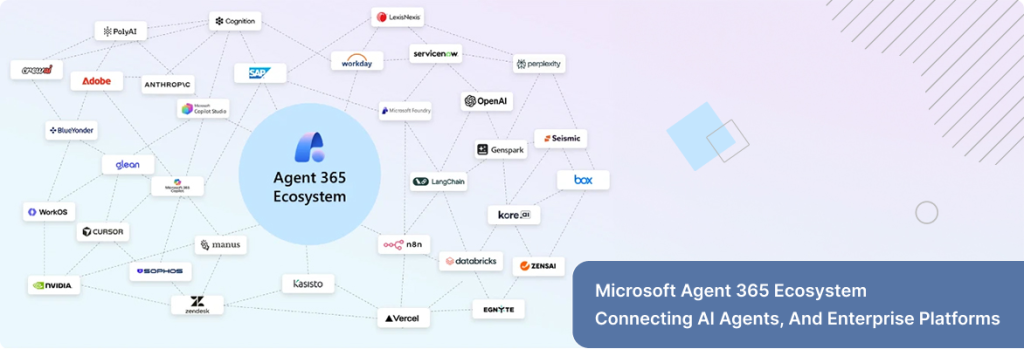 Source: Microsoft
Use Cases for Microsoft Agent 365
At a primary level, organizations use Microsoft Agent 365 to establish visibility into AI agents operating across the enterprise while enforcing baseline governance and security controls. This foundational use case focuses on understanding where AI agents exist, what they do, and how they interact with systems and data, creating a trusted starting point for scaling AI adoption.
At a secondary level, Microsoft Agent 365 supports more advanced operational needs such as managing AI agent deployments across multiple teams, standardizing agent onboarding processes, and maintaining consistent compliance across business units.
In niche scenarios, Microsoft solutions provider can be particularly valuable in highly regulated environments where AI agents must adhere to strict audit, compliance, and reporting requirements. Centralized governance and lifecycle oversight enable organizations to meet regulatory expectations without slowing innovation or increasing operational complexity.
Industry-specific use cases further highlight the value of centralized agent management. Sectors such as finance, healthcare, and manufacturing rely on Microsoft Agent 365 to balance rapid AI-driven innovation with regulatory, security, and operational obligations, ensuring AI agents operate safely and predictably within industry constraints.
Why Agent Governance Is Becoming a Strategic Priority
From Flexsin Technologies’ perspective, agent governance is no longer optional. As enterprises deploy autonomous AI agents, governance evolves from a technical concern into a strategic capability.
Microsoft Agent 365 reflects a broader shift toward proactive, platform-level control of AI agents. This approach enables enterprises to innovate confidently while aligning AI adoption with risk management, compliance, and long-term business objectives.
Microsoft Agent 365 Compared to Traditional AI Management Approaches
| Aspect | Traditional AI Management | Microsoft Agent 365 |
|---|---|---|
| Scope | Model focused | Agent focused |
| Governance | Fragmented | Centralized |
| Security | Reactive | Identity driven /td> |
| Visibility | Limited | Unified |
| Scalability | Constrained | Enterprise ready |
Best Practices for Governing AI Agents with Microsoft Agent 365
- Establish clear and formal governance policies that define how AI agents are approved, deployed, and constrained across environments
- Specify acceptable agent behaviors, access boundaries, and escalation paths for exceptions or high-risk scenarios
- Treat AI agents as identities by assigning each agent a distinct identity for consistent authentication and authorization
- Apply conditional access controls to AI agents with the same rigor used for human users and system accounts
- Continuously monitor AI agent behavior as agents evolve over time
- Track how agents interact with systems, data, and users to detect anomalies, drift, or unintended actions
- Regularly review telemetry and agent activity to maintain governance effectiveness
- Conduct periodic governance reviews to ensure policies align with business objectives and regulatory requirements
- Integrate agent governance into existing enterprise security, risk, and compliance frameworks
- Align AI agent governance with established enterprise processes to avoid fragmented controls and siloed oversight
Limitations and ConsiderationsWhile Microsoft Agent 365 provides robust governance and control capabilities, it does not eliminate the need for organizational discipline and strategic alignment. Enterprises must clearly define ownership models that specify who is responsible for agent creation, approval, monitoring, and retirement.
Organizational readiness is another important consideration. Governing AI agents requires new skills, updated processes, and cross-functional collaboration between IT, security, compliance, and business teams. Enterprises may need to invest in training and change management to ensure teams understand how to work within governed AI environments.
Additionally, Microsoft Agent 365 should be viewed as part of a broader digital transformation strategy rather than a standalone solution. Agent governance must align with enterprise architecture, data governance, and long-term AI roadmaps.
Real World Micro Case ExamplesIn one global enterprise, multiple AI agents were deployed across departments to support customer operations, analytics, and internal productivity. As adoption accelerated, leadership faced challenges around visibility and inconsistent access controls. By implementing Microsoft Agent 365, the organization centralized its view of all AI agents.
In another scenario, an organization with a long history of AI experimentation discovered that several outdated agents were still operating with elevated permissions. Using agent lifecycle management capabilities, the enterprise identified these agents, reviewed their relevance, and safely retired those that no longer served a business purpose.

Frequently Asked Questions
1. What is Microsoft Agent 365 used for?
Microsoft Agent 365 is used to centrally govern, manage, and secure AI agents operating across enterprise environments, providing visibility and control as AI adoption scales.
2. How does Microsoft Agent 365 support AI agent security?
It supports AI agent security by integrating identity-based access controls, continuous monitoring, and security tooling that help reduce risks associated with autonomous agent behavior.
3. Can Microsoft Agent 365 manage third-party AI agents?
Yes, it is designed to provide governance and visibility across both first-party and third-party AI agents deployed within the enterprise.
4. How does agent onboarding work in Microsoft Agent 365?
Agent onboarding ensures that new agents are registered, reviewed, and approved before they are allowed to operate, reducing the risk of unmanaged or insecure agents entering production environments.
5. What role does identity play in agent governance?
Identity allows each AI agent to be treated as a governed entity, enabling consistent access control, authentication, and policy enforcement similar to human users.
6. How does Microsoft Agent 365 support enterprise AI governance?
It aligns AI agent management with enterprise governance, security, and compliance frameworks, ensuring AI adoption follows established risk and oversight models.
7. Is Microsoft Agent 365 suitable for regulated industries?
Yes, it supports governance and oversight requirements common in regulated sectors such as finance, healthcare, and manufacturing.
8. What is the difference between agent lifecycle management and model management?
Agent lifecycle management focuses on how agents operate, evolve, and are retired in production, while model management focuses on training and maintaining the underlying AI models.
9. How does Microsoft Agent 365 improve visibility into AI agents?
It provides a centralized registry and monitoring capabilities that give enterprises a unified view of all AI agents across platforms and environments.
10. Why is centralized agent management important?
Centralized agent management reduces risk, improves compliance, and enables enterprises to scale AI adoption with greater confidence and control.