

 +1.844.3539.746
 info@flexsin.com
If Your Hybrid Cloud Feels Slow, Look at the Edge First
 Munesh Singh
Let's talk
Table of Contents:
- Edge Orchestration for Hybrid Cloud Has Become a Boardroom Priority
- What Edge Orchestration Solves – and What It Won’t
- How Multi-Cloud Edge Computing Works in Practice
- Edge Orchestration Adoption Framework: From Pilot to Scale
- What Comes Next for Edge Orchestration for Hybrid Cloud
- People Also Ask
- Ready to Build Your Edge First Hybrid Cloud Strategy?
- Frequently Asked Questions
Most enterprises have spent the last five years getting cloud right – and just as they stabilized the core, the operating model shifted beneath them. The explosion of distributed workloads, AI inference at the edge, and data sovereignty mandates has created a new problem: the cloud alone can no longer run everything that needs to run.
Edge orchestration for hybrid cloud is not a feature addition. It is the architectural response to a structural reality that most cloud strategies were not built to handle.
Gartner projects that by 2025, 75% of enterprise-generated data will be processed outside the traditional data center or cloud – up from less than 10% in 2019. That is not a gradual trend. That is a reorientation of where compute lives.
Edge Orchestration for Hybrid Cloud Has Become a Boardroom Priority
The traditional view was that the cloud was the destination and the edge was a temporary stopgap – a staging area while connectivity improved. That framing has not aged well. The drivers pushing compute to the edge are structural, not transitional.
Latency-sensitive applications like autonomous production lines, surgical robotics, and real-time customer personalization cannot tolerate the round-trip time to a centralized cloud.
Regulations across healthcare, financial services, and public-sector markets mandate that certain data never leave its origin jurisdiction. And disconnected or constrained environments – offshore platforms, remote logistics sites, manufacturing floors – simply cannot rely on consistent cloud connectivity to maintain operational continuity.
What Edge Orchestration Solves – and What It Won’t
There is considerable confusion about what edge orchestration for hybrid cloud means in practice. It is not simply remote server management or branch-office networking. It is an intelligent control plane that automates workload placement, enforces policy, manages lifecycle, and optimizes resource allocation across every node in a distributed environment.
Edge orchestration handles three things that hybrid cloud alone cannot: the dynamic decision of where a workload should run based on current latency, compliance, and cost conditions; the automated enforcement of security and governance policies across heterogeneous environments; and the real-time rebalancing of compute across nodes as conditions change.
Kubernetes-based operational models, containerized edge applications, and software-defined networking provide the technical substrate. The orchestration layer for hybrid cloud orchestration platform is the intelligence that runs on top.
The result is a connected layer of IT solutions that can manage workloads consistently across edge nodes, private infrastructure, and public cloud environments.
How Multi-Cloud Edge Computing Works in Practice
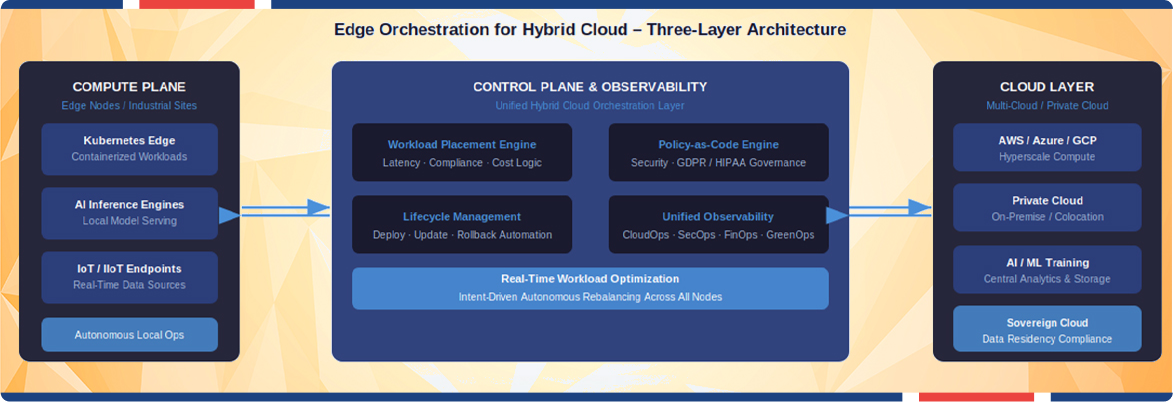
Effective edge orchestration for hybrid cloud operates across three layers, and understanding the separation matters for enterprise architects. Cloud engineering services help enterprises design the distributed architecture needed to connect edge workloads with hybrid and multi-cloud environments while maintaining portability, scalability, and operational control.
The Compute Plane: Placing Workloads Where They Belong
Edge AI deployment at the enterprise level requires the ability to push inference workloads close to data sources without building a separate operational model for each location. Container orchestration – primarily Kubernetes edge deployment, provides workload portability. The orchestration platform adds intelligent placement logic: it evaluates edge computing latency reduction requirements, data residency rules, and infrastructure availability.
The Control Plane: Policy, Compliance, and Governance at Scale
Hybrid cloud security and compliance cannot function as a bolt-on. In distributed environments for edge computing workload management, it must be embedded in the architecture. Policy as code, enforced through the distributed control plane, ensures that every workload at every node operates within defined parameters.
The Observability Plane: Visibility Across Every Node
Cloud workload automation without observability is guesswork. Unified monitoring across edge and cloud environments – combining CloudOps, SecOps, and FinOps disciplines – gives operations teams a single picture of the full distributed estate. Anomalies surface at the node level before they cascade. Cost attribution becomes possible at the edge, not just in the cloud.
Edge Orchestration Adoption Framework: From Pilot to Scale
Most organizations that have deployed edge orchestration successfully followed a sequenced adoption model. Those that failed typically tried to solve governance, resilience, and AI deployment simultaneously without establishing the control plane first.
The right sequence starts with identifying the highest-latency or highest-compliance-risk workloads and deploying orchestration specifically for those. The wins in operational continuity and regulatory assurance make the business case for broader rollout. From there, expanding the distributed control plane Kubernetes to cover additional sites and use cases builds on proven infrastructure rather than on aspirational architecture.
Containerized edge applications, deployed via Kubernetes and managed through the orchestration platform, allow operations teams to manage thousands of edge nodes and real-time workload optimization. This is the operational multiplier that makes scale viable without proportional headcount growth.
Cloud consulting services can help organizations identify suitable edge workloads, establish governance requirements, select the right orchestration architecture, and create a phased path from pilot to enterprise scale.
What Comes Next for Edge Orchestration for Hybrid Cloud
The current generation of edge orchestration platforms is primarily reactive – workloads are placed and policies enforced based on current conditions. The next generation is intent-driven edge orchestration. Administrators define outcomes – latency thresholds, hybrid cloud security and compliance requirements, cost ceilings, and carbon targets.
As 5G edge computing orchestration and eventually 6G networks mature, the latency gap between edge and cloud narrows further, enabling more sophisticated workloads to run at distributed locations without trade-offs in performance. Sovereign AI requirements – the demand that AI models and training data remain within national or organizational boundaries – will make edge orchestration central to AI strategy, not just infrastructure strategy.
People Also Ask:
What is edge orchestration for hybrid cloud?Edge orchestration for hybrid cloud is an intelligent control plane that automates workload placement, policy as code cloud governance enforcement, and edge node lifecycle management across distributed edge nodes and cloud environments.
How does edge orchestration differ from standard cloud management?Standard cloud management operates within centralized data centers with reliable connectivity. Edge orchestration for hybrid cloud extends that governance to distributed cloud infrastructure management, often intermittently connected nodes.
Which industries benefit most from hybrid cloud orchestration platforms? Manufacturing, healthcare, retail, telecom, and logistics see the highest impact from hybrid cloud orchestration platforms because their operations involve latency-sensitive workloads.
What does Kubernetes edge deployment involve in enterprise environments?Kubernetes edge deployment extends container orchestration to distributed edge nodes, enabling enterprises to manage, update, and scale containerized edge applications.
How long does it take to implement a hybrid cloud edge orchestration strategy?Initial edge orchestration deployments for specific high-priority workloads typically take 60 to 120 days. Scaling to full enterprise coverage across multiple edge sites can take 12 to 24 months.
Ready to Build Your Edge First Hybrid Cloud Strategy?
As a cloud engineering company, Flexsin brings deep expertise in cloud workload automation, multi-cloud edge computing, and distributed infrastructure design to enterprise transformation programs. Our Cloud & DevOps practice builds edge orchestration architectures that are production-ready, governance-compliant, and built to scale – not proof-of-concept environments that stall before they deliver value.
Explore Flexsin’s Cloud & DevOps services, and take the first step toward an orchestration-led hybrid cloud architecture that performs under real-world conditions.
Frequently Asked Questions:
1. What components make up an edge orchestration platform for hybrid cloud?An edge orchestration platform for hybrid cloud typically includes a distributed control plane for policy enforcement, a compute layer based on containerized edge applications and Kubernetes edge deployment, an observability layer for unified monitoring.
2. Can edge orchestration for hybrid cloud support AI workloads at the edge?Yes. Edge AI deployment for enterprises is one of the primary use cases driving enterprise adoption of edge orchestration. The platform manages the deployment, versioning, and continuous monitoring of AI inference models at distributed nodes.
3. How does edge cloud integration strategy address data sovereignty requirements?a properly designed edge cloud integration strategy localizes data processing at the node level for workloads subject to sovereign cloud edge computing or residency regulations. Policy as code enforces these rules automatically, ensuring that regulated data never transits to cloud regions outside permitted boundaries.
4. What is the role of GreenOps in edge orchestration?GreenOps cloud sustainability practices are applied in edge orchestration to optimize workload placement for energy efficiency, not just performance and cost. The orchestration platform tracks per-node energy consumption, and attributes carbon output to specific workloads.
5. How does edge orchestration improve operational resilience compared to cloud-only architectures? Edge orchestration for hybrid cloud enables edge nodes to operate autonomously during cloud connectivity loss, executing locally cached policies and maintaining critical workloads without central coordination. Decentralized control planes replace single-points-of-failure with distributed decision-making.
