

 +1.844.3539.746
 info@flexsin.com
How to Choose the Best BI Development Company for Smarter Business Intelligence and Reporting
 Sudhir K Srivastava
Table of Contents:
- What a BI Development Company Should Deliver
- BI Strategy, KPIs and BI Development Consulting
- Data Warehouses, Lakehouses and Data Pipelines
- Data Quality, Master Data and a Single Source of Truth
- Choosing BI Tools and Power BI Development Services
- Self-Service Analytics and Governed Reporting
- Security, Performance and Ongoing Operations
- Partner Selection and Support
- Frequently Asked Questions
- Turn Data Into Decisions With the Right BI Team
- People Also Search For
Let's talk
Most organizations have more data than ever and still struggle to get a straight answer to a simple question. Figures differ between reports, analysts spend days preparing spreadsheets, and leaders fall back on instinct because the numbers arrive too late or don’t match. A BI development company is there to fix what sits behind that: where data comes from, how it’s cleaned and modeled, and how it reaches the people who need it.
This guide explains what a capable partner should handle, the technical choices that shape a business intelligence platform and what to check before you hire one.
What a BI Development Company Should Deliver
BI development services cover the whole path from raw data to decisions. That includes understanding what the business needs to know, connecting source systems, building pipelines and a central data store, modeling the data, creating reports and dashboards, securing access and keeping everything running reliably.
The reports are the part people see, but they rest on a lot of less visible work. If the pipelines are fragile or the data model is inconsistent, even well-designed dashboards will show wrong numbers. When you compare proposals, look at how much attention the partner gives to data preparation and testing, not only to report design.
BI Strategy, KPIs and BI Development Consulting
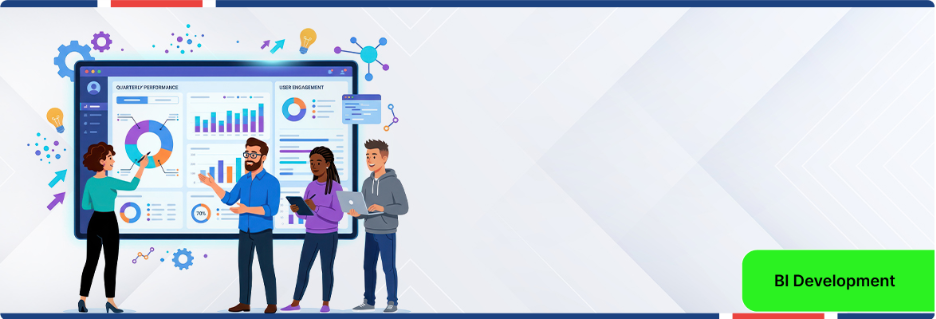
A BI program works best when it starts with decisions rather than data. BI development consulting usually opens with interviews across finance, sales, operations and leadership to find out which questions matter most, how often the answers are needed and what actions follow from them.
This is also when definitions get settled. Teams often calculate revenue, margin or active customers differently, and a report can only use one version. Agreeing on each KPI in writing, with a named owner, prevents conflicting figures later. The outcome should be a prioritized roadmap that delivers a few high-value reports early, instead of trying to build everything at once.
Data Warehouses, Lakehouses and Data Pipelines
Reporting straight from operational systems puts extra load on them and makes combining sources difficult, so most BI platforms bring data into a central store. A data warehouse holds structured, modeled data ready for reporting. A lakehouse, built on platforms such as Microsoft Fabric or Databricks, can hold raw and modeled data side by side in open formats, which suits organizations with large or varied data.
Pipelines get the data in, using tools such as Azure Data Factory, Fabric Data Factory or dbt. Many teams organize data in layers, often called bronze, silver and gold, moving from raw copies to cleaned data to business-ready tables. In the reporting layer, a dimensional design with fact and dimension tables keeps queries fast and calculations consistent.
Data Quality, Master Data and a Single Source of Truth
BI is only as useful as the data behind it. Duplicate customers, inconsistent product codes and missing values all produce reports people stop trusting. A good partner builds data quality checks into the pipelines themselves, flagging records that fail rules for completeness, format or duplication before they ever reach a report.
Master data needs the same care. Customers, products, suppliers and locations should be defined once and used consistently everywhere. Tools such as Microsoft Purview can catalog data sources and show lineage, so people can see where a figure came from and how it was transformed. That visibility is what turns a reporting platform into a single source of truth.
Choosing BI Tools and Power BI Development Services
Power BI, Tableau, Looker and Qlik are among the most widely used BI tools, and each has its strengths. The right choice depends on your existing technology, licensing, skills and how reports will be shared. For organizations already on Microsoft 365, Azure or Dynamics 365, Power BI is often the natural fit because of how closely it works with those products.
If you go with Power BI, look for real depth in it. Power BI development services should cover semantic model design, DAX measures, row-level security, refresh planning and licensing, while Power BI development consulting helps you decide how to organize workspaces and when Fabric capacity makes sense. A Power BI development company with experience at your scale will know where performance problems tend to appear and how to avoid them.
Self-Service Analytics and Governed Reporting
Most organizations want both governed reporting and self-service analysis. Governed reports, such as financial results or executive dashboards, are built and tested centrally so everyone sees the same figures. Self-service lets analysts explore data and build their own reports without waiting on IT.
The two work well together when self-service is built on shared, certified data models. Analysts get room to create new views, while calculations and definitions stay consistent because they come from the same source. Separate workspaces for personal exploration, team sharing and official reports keep the environment manageable as usage grows.
Security, Performance and Ongoing Operations
Access should follow each person’s role. Row-level security limits users to the regions, departments or accounts relevant to them, and sensitivity labels can protect confidential data even after it’s exported. Set this up early, since retrofitting security across many reports is slow and error-prone.
Performance needs attention as data grows. Incremental refresh, aggregation tables and partitioning keep large models fast, and monitoring shows when pipelines or refreshes fail. Someone should own those alerts and act quickly, because a report showing yesterday’s numbers when it should show today’s loses people’s trust fast.
Partner Selection and Support
When comparing BI partners, look for experience in both data engineering and reporting, not just one of them. Relevant certifications, references from organizations of similar size and industry, and platforms still in use a year after delivery are all good signs.
A strong proposal includes a phased roadmap, named team members, a licensing estimate and clear assumptions about data sources. Support terms should cover pipeline and refresh failures, response times by severity, regular usage and performance reviews, and confirmation that all data models, pipelines and reports belong to you.
Frequently Asked Questions:
What does a BI development company do?It defines reporting needs, connects source systems, builds pipelines and data models, creates reports and dashboards, secures access and keeps the platform running.
What’s the difference between a data warehouse and a lakehouse? A warehouse stores structured, modeled data for reporting. A lakehouse can hold both raw and modeled data in open formats, suiting larger or more varied data.
Which BI tool should we choose? It depends on your existing systems, skills and licensing. Power BI is often the best fit for organizations already using Microsoft products.
How do you keep BI data accurate? By building quality checks into pipelines, managing master data centrally and tracking lineage so every figure can be traced to its source.
Turn Data Into Decisions With the Right BI Team
If you’re looking for a BI development company in the USA, UAE or India, Flexsin’s teams in Dallas, Dubai and India provide BI development services and consulting alongside Power BI development services and consulting, so your data, models and reports rest on one consistent foundation. Book a consultation to map out the decisions your data needs to support.
People Also Search For:
1. How long does a BI implementation take? A focused first phase often takes two to four months, with further reports and data sources added in later phases.
2. What is self-service BI? An approach that lets business users build their own reports and analysis on shared, governed data models.
3. What is the medallion architecture? A layered data design, usually bronze, silver and gold, that moves data from raw copies to cleaned and business-ready tables.
4. How much do BI development services cost? Costs depend on the number of data sources, data volume, licensing and how many reports and models are needed.
