

 +1.844.3539.746
 info@flexsin.com
 Sudhir K Srivastava
Enterprises looking to deploy intelligent, adaptive software must first modernize the systems beneath them. Legacy application modernization provides the technical and operational foundation for AI-readiness by restructuring applications, data, and infrastructure so intelligent capabilities can be embedded, governed, and scaled with confidence.
Most core systems were built for stability rather than AI-driven decisioning or continuous learning. As AI adoption accelerates, this gap becomes a business constraint. Legacy application modernization reframes existing systems as evolving assets, selectively re-architecting applications, data flows, and integrations so intelligent behavior, analytics, and automation can operate reliably across digital products, processes, and platforms.
Why Legacy Systems Block AI-Ready Intelligent Apps?
Older applications are structurally rigid, tightly coupling business logic, data storage, and user interfaces, which restricts AI integration. This design prevents models from accessing clean data or influencing workflows in real time. App modernization decouples these layers, while cloud application modernization consolidates fragmented data into governed pipelines, enabling AI-readiness through consistent access for training, inference, and monitoring at scale.
Operational Risk Slows AI Experimentation and Scale
Monolithic systems increase release risk and limit experimentation, making it difficult to deploy AI-driven capabilities that require frequent updates and controlled testing. Application modernization services introduce modular architectures that reduce operational risk and support rapid iteration without destabilizing core business operations.
Defining Legacy Application Modernization for AI-Readiness
Legacy application modernization is the disciplined transformation of existing applications so they can support modern workloads, cloud-native services, and intelligent capabilities. It spans code, data, infrastructure, and operating models.
Unlike simple rehosting, legacy modernization services align technology choices with AI-readiness outcomes. This includes scalable compute, event-driven data flows, observability, and security controls that allow AI systems to function responsibly in enterprise settings.
Application modernization services focus on preserving business value while removing technical constraints. The goal is not novelty. The goal of app modenization is operational intelligence embedded into everyday workflows.
Core Components of an AI-Ready Modernization Architecture
An AI-ready modernization architecture brings together application design, data platforms, and cloud capabilities to support intelligent workloads at scale. These components ensure that legacy application modernization not only improves system flexibility but also enables AI-readiness through reliable data access and controlled change. Each layer of the architecture plays a specific role in reducing complexity while accelerating intelligent application delivery.
Modular Design and Cloud-Native Data Foundations
Modular application design allows AI features and legacy modernization services to be added incrementally by breaking applications into well-defined components. Application modernization tools help identify refactoring boundaries, while cloud legacy system migration enables cloud-native data platforms that provide elastic, governed access to data for analytics and machine learning.
API-Driven Integration and Secure Runtime Environments
Cloud application modernization introduces API-driven integration layers and event streams that support continuous data exchange across systems. Application modernization solutions also establish secure, observable runtime environments with logging and telemetry, enabling effective monitoring of AI performance, bias, and drift.
The Role of Cloud Migration in AI Enablement
Cloud migration services are a prerequisite, not the destination. AI-readiness depends on how workloads are migrated and modernized, not just where they run.
Cloud migration consulting service alignment
Strategic cloud migration consulting service engagement ensures infrastructure choices support AI compute, storage, and networking needs from day one.
Azure cloud migration for intelligent workloads
Azure cloud migration provides managed services for data, analytics, and AI that integrate directly with modernized applications. This reduces operational complexity while accelerating intelligent feature delivery.
Cloud service migration beyond lift and shift
True cloud service migration includes replatforming and refactoring where necessary. This enables auto-scaling, resilience, and cost control for AI-driven workloads.
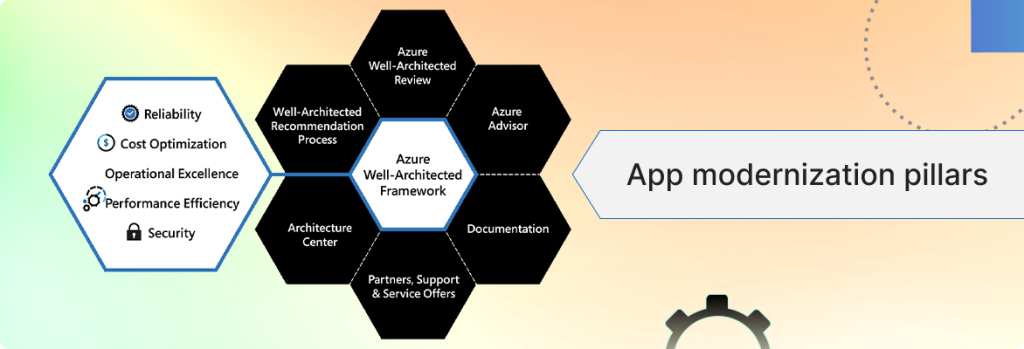 Source: Microsoft
Legacy Application Modernization Models That Support AI
Different application modernization services require different modernization paths. Selecting the right model determines AI success. Application modernization supports different levels of change based on business need.
Intelligence-intensive systems such as customer platforms, pricing engines, and fraud systems often require re-architecting to embed AI decisioning, while data-heavy reporting and analytics applications can be re-platformed to leverage cloud-native data services without full code rewrites. Stable, low-change systems can be re-hosted with guardrails, exposing data through modern interfaces so AI capabilities can consume insights without disrupting core functionality.
Use Cases for AI-Ready Legacy Applications Modernization
Primary use cases of legacy application modernization focus on embedding predictive analytics, intelligent recommendations, and automated decisioning directly into core business workflows, enabling faster, data-driven actions at scale. As maturity increases, secondary use cases emerge around operational optimization, anomaly detection, and intelligent monitoring across both IT environments and business processes, improving efficiency and resilience.
Niche use cases of app modenization extend these capabilities into context-aware automation, conversational interfaces, and adaptive user experiences that respond dynamically to user behavior and real-time signals. At the industry level, modernization supports advanced scenarios such as risk scoring in financial services, clinical decision support in healthcare, predictive maintenance in manufacturing, and demand forecasting in retail.
Legacy application modernization enables this progression by ensuring consistent data quality, rapid integration, and operational resilience at every stage.
Legacy Application Modernization for Intelligent Apps
At Flexsin, we treat application modernization as an intelligence multiplier, not a technology refresh. Our legacy modernization services focus on creating platforms where AI can deliver measurable outcomes without increasing operational risk.
We prioritize application modernization strategies that unlock data, reduce coupling, and introduce observability early. This approach allows enterprises to deploy AI incrementally, validate impact, and scale responsibly.
Comparison – Traditional Systems vs AI-Ready Modernized Platforms
| Dimension | Traditional Legacy Systems | AI-Ready Modernized Platforms |
|---|---|---|
| Architecture | Monolithic | Modular and service-oriented |
| Data Access | Fragmented | Native and scalable |
| AI Integration | Limited and brittle | Native and scalable |
Best Practices for AI-Focused Legacy Application Modernization
- Start with business outcomes tied to intelligence, not tools.
- Modernize data pipelines before model deployment.
- Embed security and governance into modernization plans.
- Use application modernization tools to assess dependencies early.
- Adopt phased delivery with measurable milestones.
Limitations for Implementing Legacy Applications Modernization– Modernization introduces short-term complexity.
– AI-readiness increases infrastructure and governance demands.
– Not all legacy logic should be preserved.
– Talent and operating model changes are required.
Recognizing these constraints early improves long-term success.
Legacy application modernization is the practical pathway to AI-ready intelligent apps. By aligning architecture, data, and operations with intelligent workloads, enterprises move beyond experimentation toward sustainable AI-driven value creation.
To accelerate this journey, Flexsin helps organizations modernize securely and intelligently. Contact Flexsin Technologies to explore how our cyber threat intelligence solutions and legacy modernization services can support resilient, AI-ready digital platforms.
Frequently Asked Questions
1. What makes legacy application modernization critical for AI-readiness?AI systems depend on continuous access to high-quality data, flexible integration points, and strong operational controls. Most legacy architectures were built for transactional stability, not for real-time analytics, model inference, or rapid change. Legacy application modernization removes these structural constraints, making it possible to deploy, monitor, and scale AI capabilities reliably across the enterprise.
2. Is legacy application modernization the same as cloud migration?Application modernization and cloud migration are related but not the same. Cloud migration services primarily move existing workloads to cloud infrastructure, often with minimal change. Application modernization restructures applications, data flows, and architectures so they can fully leverage cloud-native services.
3. How long does AI-focused legacy application modernization take?Timelines vary based on application complexity, data readiness, and organizational maturity. Most enterprises begin to see meaningful AI enablement within 6 to 12 months by using phased modernization approaches that prioritize high-impact systems while continuing to operate legacy environments in parallel.
4. Do all applications need to be modernized for AI?Not every application needs deep modernization. Organizations should prioritize systems where intelligent capabilities can deliver measurable business value, such as customer-facing platforms, decision engines, and data-intensive workflows. Some stable legacy systems can remain unchanged while still supporting AI through integration layers.
5. What role does data play in AI-ready legacy application modernization?Data is the foundation of AI-readiness and legacy modernization solutions. High-quality, accessible, and well-governed data enables model training, inference, and ongoing improvement. Without consistent data pipelines and governance frameworks, AI initiatives struggle to move beyond experimentation and fail to deliver sustainable results.
6. Can legacy systems still run alongside modernized apps?Yes. Hybrid environments are common during modernization journeys. Many enterprises operate legacy systems alongside modernized applications, gradually shifting functionality and data access as confidence and capability increase. This approach by legacy modernization services reduce disruption while maintaining business continuity.
7. How do legacy application modernization tools help?Application modernization tools help teams analyze existing systems, map dependencies, and identify the best candidates for refactoring or re-architecting. By providing visibility into technical complexity and risk, these tools enable more informed decisions and reduce the likelihood of costly modernization missteps.
8. What security considerations arise with AI-enabled apps?AI-enabled applications introduce new security requirements beyond traditional controls. Model integrity, data privacy, access management, and monitoring for misuse or drift must be built into the architecture. Application modernization strategy creates the opportunity to embed these controls systematically rather than layering them on later.
9. Does AI-readiness increase cloud costs?AI-readiness can change cost structures, but it does not necessarily increase long-term spend. While compute and data services may add short-term costs, intelligent optimization, automation, and improved operational efficiency often lead to lower total cost of ownership over time.
10. When should enterprises involve external partners?Enterprises should involve external partners when internal teams lack deep modernization experience, when transformation risk is high, or when large-scale change must be delivered quickly. Experienced application modernization solutions partners bring proven frameworks, tools, and execution discipline that accelerate outcomes and reduce uncertainty.