

 +1.844.3539.746
 info@flexsin.com
ERP Vulnerabilities Grow Fast – Odoo Data Security Helps Keep Systems Protected
 Tarun Malhotra
Let's talk
Table of Contents:
- The Security Gap No One Talks About in ERP Procurement
- Why Generic ERP Security Claims Are Not Enough
- The Technical Architecture Behind Odoo’s ISO 27001: 2022 Certification
- What ISO 27001:2022 Actually Unlocks in Odoo
- Flexsin’s Perspective on Odoo Security Implementation
- Challenges and Technical Boundaries of Odoo Security Integration
- People Also Ask:
- Frequently Asked Questions
The breach that ends your vendor contract will not come through your firewall; it will come through the secure ERP implementation system that your entire operation runs on. That is the risk calculus most procurement teams still get wrong: they vet perimeter security while the core business platform sits under a patchwork of informal access policies and no independent audit trail.
Odoo’s achievement of ISO/IEC 27001:2022 certification changes that equation, and for organizations running or evaluating Odoo, the certification is not a footnote – it is a competitive signal with direct operational consequences.
The Security Gap No One Talks About in ERP Procurement
An ERP is not just software. It is the single system that holds your financials, customer records, HR data, inventory, and often your supplier relationships – all in one place. That makes it precisely the target attackers prioritize. The global average cost of a data breach reached $4.88 million in 2024 before easing to $4.44 million in 2025, according to IBM’s Cost of a Data Breach Report. The U.S. figure told a different story: a 9% surge to $10.22 million, an all-time regional high driven by rising regulatory fines and escalating detection costs.
Most ERP evaluations still treat security as a checkbox after functionality is approved. That sequencing is backwards. When a breach materializes, the question the board asks is not whether the CRM worked well – it is why the platform holding the data was never independently audited. ISO 27001 is the audit. It is the third-party verification that a vendor’s information security management system (ISMS) has been examined, tested, and found compliant with the highest global standards for data governance.
Procurement teams at large enterprises and government agencies have started treating ISO 27001 as a baseline requirement – not a differentiator. A 2025 survey cited by Secithub found that companies holding ISO 27001 certification experience 40% faster vendor onboarding and 30% higher renewal rates on average compared to uncertified peers. The math is simple: certified vendors move faster through procurement, generate less friction in legal review, and carry lower risk profiles in vendor assessments.
Why Generic ERP Security Claims Are Not Enough
Every secure ERP implementation vendor makes security claims. Most of those claims live in marketing decks, not audit reports. The distinction matters because a claim is one person’s assertion – a certification is an independent body’s verified finding.
ISO 27001:2022 – the most recent revision of the standard – requires organizations to implement 93 Annex A controls spanning information security policies, physical and environmental security, cryptography, access control, supplier relationships, and business continuity. It mandates a formal risk assessment methodology, a documented risk treatment plan, and continuous improvement cycles.
Critically, it is not self-certified. An accredited external body conducts the audit. If Odoo GDPR compliance passes, it is because an independent Odoo compliance certification assessor reviewed the evidence and signed off – not because Odoo’s internal team declared compliance.
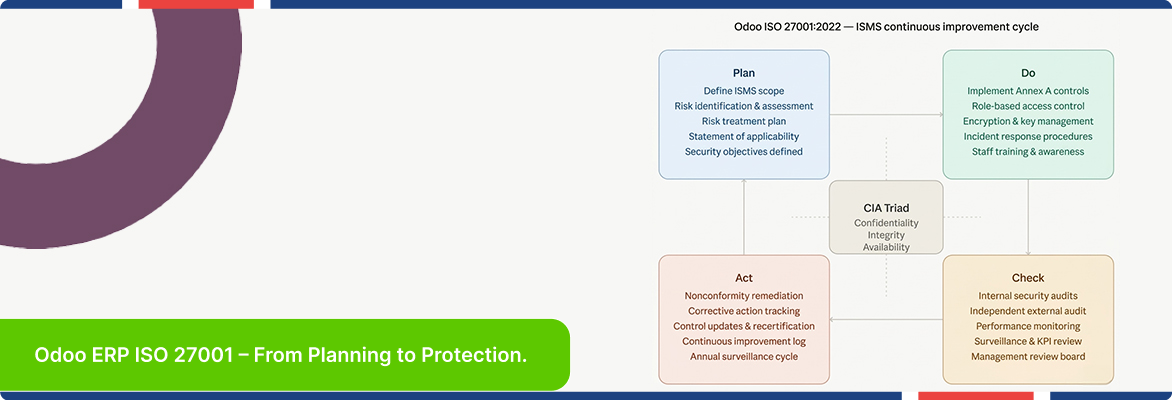
The CIA triad – Confidentiality, Integrity, and Availability – forms the operational core of the standard. For Odoo security features, this means only authorized users can access sensitive data, data remains accurate and tamper-resistant, and the platform stays accessible when operations demand it. Those three guarantees, independently verified, are what distinguishes ISO 27001 from a vendor’s internal security policy document.
82% of businesses consider ISO certifications like ISO 27001 critical for securing client trust and reinforcing commitment to compliance, according to Cisco research cited in recent cybersecurity benchmark reports. That figure reflects a market that has moved: trust is now earned through audit outcomes, not vendor assurances.
The Technical Architecture Behind Odoo’s ISO 27001: 2022 Certification
Odoo’s data security certification covers the platform and its cloud infrastructure – specifically Odoo.sh and Odoo Online, the managed hosting environments. The scope is deliberate. Odoo chose to certify the system that most of its customers actually run on, meaning the security guarantees are embedded in the environment, not layered on top of it.
At the infrastructure level, Odoo.sh provides SSL/TLS encryption for all data in transit, salted hashing using the PBKDF2 algorithm for password storage, automated daily backups with geo-redundant storage, and deployment isolation per user environment. These are not features a customer configures – they are standard architecture the certification auditors evaluated.
The ISMS itself is structured around continuous improvement. Odoo ISMS identifies risks through formal assessment cycles, implements controls mapped to those risks, and submits independent audits on a scheduled basis. That cycle – assess, control, audit, improve, is what prevents ISO 27001 certification from becoming a one-time trophy. The standard requires organizations to demonstrate that the ISMS is actively maintained, not just initially implemented.
One aspect of enterprise data security services that often surprises Enterprise Solutions buyers: certification covers the organizational processes that surround the platform, not just the technology. That means Odoo’s internal access management practices, incident response procedures, personnel security policies, and supplier chain security have all been audited. The scope of ISO 27001 Odoo security features is broader than most people assume when they hear “security certification.”
What ISO 27001:2022 Actually Unlocks in Odoo
Role-Based Access Control and Least Privilege
Odoo ERP data security enforces role-based access control (RBAC) at the module, record, and field level. Administrators can restrict access by group, role, or individual field to prevent unauthorized data exposure. This granularity is a direct implementation of the least-privilege principle required under ISO 27001’s access control domain, and it is auditable. Every access policy change creates a log entry.
Audit Trail and Accountability
Every action taken within Odoo – a record update, a permission change, a financial posting – is timestamped, attributed to a specific user, and stored in an immutable log. That audit trail is not optional. It is structural. For regulated industries, this means the compliance team has a forensic record without building a custom logging layer. For legal review of Odoo GDPR compliance, it means the chain of custody for any data action is recoverable.
Encrypted Data in Transit and at Rest
SSL/TLS encryption is enforced for all client-server communication by default across Odoo Online and Odoo.sh. Sensitive fields – passwords, API keys, payment credentials, are encrypted or hashed before storage. The ISO 27001 audit verified that these cryptographic controls meet the standard’s requirements for confidentiality protection.
GDPR Module and NIS2 Alignment
Odoo data security ERP certification’s built-in GDPR module manages user consent records, data access requests, and the right to erasure. As NIS2 extends mandatory cybersecurity requirements across more sectors in the EU, having an ISO 27001-certified ERP simplifies compliance readiness significantly. The ISMS documentation Odoo maintains – risk registers, control statements, incident procedures, maps directly to NIS2’s technical and organizational measure requirements.
Peppol Integration and Trusted Network Access
Odoo’s data security certification ISO 27001:2022 also supports its Peppol e-invoicing integration, which requires participants to demonstrate a baseline of information security governance before joining the network. ISO 27001 provides that baseline. For procurement, finance, and supply chain teams operating cross-border, this creates a seamless compliance pathway without a separate certification process.
Flexsin’s Perspective on Odoo Security Implementation
After delivering Odoo data security implementations across healthcare, banking, e-commerce, manufacturing, and education – with clients including PapiPay, My Compliance, AIDA Software, and Sales Scripter – the Flexsin team has developed a specific view on what ISO 27001 certification actually changes in the implementation context.
The most underestimated benefit is not the certification itself – it is what the certification process forces a vendor to build. ISO 27001 requires formalized incident response procedures, documented access policies, and supplier security assessments. For Flexsin’s implementation teams, that means we inherit a platform whose security architecture has been systematically thought through and externally validated. We are not starting from scratch on security design; we are extending a certified foundation.
In practice, this changes the client conversation. Regulated-industry clients – particularly in financial services and healthcare, previously required extensive security questionnaire responses before approving Odoo as their ERP backbone. With ISO 27001:2022 certification in place, those questionnaires move significantly faster. The independent audit report answers questions that previously required custom documentation from Flexsin’s side.
There is a subtler point worth stating plainly: Flexsin’s Odoo Development Services includes security hardening as standard delivery – not as an add-on. That means configuring least-privilege access roles at deployment, setting up audit trail monitoring, establishing backup and recovery procedures, and aligning system configurations with the CIA triad principles the certification validates. The certification sets the standard; we build implementations that live up to it.
Clients who want to pursue their own ISO 27001 certification often use Odoo implementation as a lever. The platform’s built-in ISMS-aligned controls and ERP data breach protection give organizations a significant head start on their own certification journey. That is a non-obvious benefit the reference article does not address, and one that has practical budget and timeline implications for enterprises planning compliance programs.
Challenges and Technical Boundaries of Odoo Security Integration
ISO 27001 is the platform’s certification – not yours. That distinction is essential to understand. Odoo certifies the software and Cloud Engineering Services it operates. If your organization deploys Odoo on a self-managed server, the certification does not automatically extend to that environment. You inherit the platform’s architecture, but the security of your hosting layer, your network configuration, and your access management practices falls under your own ISMS.
The shared responsibility model applies here. Think of ISO 27001 as a high-security safe that Odoo ISMS hands you. If unauthorized people are given credentials, if MFA is disabled for convenience, or if custom integrations bypass access controls, the safe is open regardless of the certification on the door. Odoo’s certification covers the infrastructure it manages. The implementation, configuration, enterprise ERP security, and operational practices on the client side require their own security discipline.
A second constraint: ISO 27001 certification does not equal HIPAA compliance, SOC 2 Type II, or PCI-DSS. In healthcare or payment processing contexts, additional controls and certifications will be required. ISO 27001 provides a strong foundational framework that maps to many of those requirements, but it is not a substitute for domain-specific compliance programs.
Finally, the 2022 revision of the standard introduced 11 new controls not present in the 2013 version – including controls for threat intelligence, cloud security, ICT supply chain security, and secure coding. All ISO 27001:2013 certifications were required to transition to the 2022 standard by October 2025. Odoo’s compliance certification covers ISO/IEC 27001:2022, meaning it reflects the current version of the standard.
People Also Ask:
What does Odoo’s ISO 27001 certification cover? It covers Odoo’s cloud platform and its information security management system, including infrastructure, processes, access controls, and incident response. It does not automatically extend to self-hosted deployments.
How does ISO 27001 certification affect Odoo vendor procurement decisions? Large enterprises and government agencies increasingly require ISO 27001 as a minimum bar for vendor onboarding. Certified vendors move 40% faster through procurement on average, reducing time-to-contract.
Is Odoo’s ISO 27001:2022 certification current? Yes. Odoo achieved ISO/IEC 27001:2022 certification, the version currently required since the 2013 standard expired in October 2025.
What is the CIA triad and how does Odoo implement it? The CIA triad stands for Confidentiality, Integrity, and Availability. Odoo enforces it through role-based access control, encrypted storage, immutable audit logs, and redundant hosted infrastructure.
Can Odoo ISO 27001 certification help my organization pursue its own certification? Yes. Odoo’s data security ERP’s built-in access controls, audit trails, and ISMS-aligned architecture give organizations a documented foundation that significantly reduces the effort required for their own ISO 27001 certification scope.
Does ISO 27001 mean Odoo is HIPAA or SOC 2 compliant? No. ISO 27001 is an information security management standard. HIPAA and SOC 2 are domain-specific frameworks requiring additional controls beyond what ISO 27001 mandates.
Running Odoo on a certified platform is half the equation. The other half is an implementation partner who builds to that standard.
Flexsin’s Odoo implementation practice engineers security into every deployment – from least-privilege access configuration and audit trail setup to compliance-aligned module rollout and ongoing security patch management. With 15+ years of enterprise delivery experience and Odoo projects spanning healthcare, financial services, manufacturing, and e-commerce, Flexsin’s team has the practice depth to deploy on a certified foundation and keep it that way.
Contact Flexsin’s Odoo security specialists at https://www.flexsin.com/it-security/it-security-services/ to schedule a security architecture review for your Odoo environment.
Your ERP is your most critical data asset. Build it on a foundation that has been independently verified – and implement it with a team that treats that standard as a starting point, not a ceiling.
Frequently Asked Questions
1. What is ISO/IEC 27001:2022 and why does it matter for ERP systems?ISO/IEC 27001:2022 is the international standard for information security management systems. For ERP platforms, it provides independently audited assurance that data governance, access controls, cryptographic protections, and incident response procedures meet globally recognized requirements. The 2022 revision of Odoo data security ERP added 11 new controls addressing modern threats including cloud security, threat intelligence, and secure coding practices.
2: What is an ISMS and what does it require from an ERP vendor?An information security management system (ISMS) is the combination of policies, procedures, processes, and controls an organization uses to manage information security risks. For an ERP vendor to achieve ISO 27001 certification, its ISMS must cover risk identification, control implementation, supplier security assessments, personnel security, business continuity, and continuous improvement cycles – all verified by an independent accredited auditor.
3. How does Odoo’s ISO 27001 certification interact with GDPR compliance? ISO 27001’s access control, cryptography, and incident notification requirements overlap significantly with GDPR’s technical and organizational measure obligations. Odoo’s built-in GDPR module – which manages consent records, data access rights, and erasure requests, is supported by the governance framework for the Odoo data security ISO 27001: 2022 certification validates. They are complementary, not duplicative.
4. What security features does Odoo provide at the platform level? Odoo provides SSL/TLS encryption for all data in transit, PBKDF2 salted hashing for passwords, role-based access control at module and field level, an immutable audit trail for all system actions, automated geo-redundant backups, deployment isolation on Odoo.sh, and a built-in GDPR compliance module. These features form the technical layer underlying its ISO 27001 certification.
5. Does running Odoo on-premise maintain the ISO 27001 certification benefits? Partially. The Odoo software architecture and its inherent security controls remain intact in on-premise deployments. However, ISO 27001 data security certification specifically covers Odoo’s cloud infrastructure (Odoo Online and Odoo.sh). On-premise deployments require the customer organization to independently ensure that hosting, network, and operational security controls meet equivalent standards.
6. How often does Odoo need to renew its ISO 27001 certification? ISO 27001: 2022 Odoo ERP data security certification is not a one-time event. It requires annual surveillance audits and a full recertification every three years. This continuous audit cycle is why the certification carries weight: the security posture must be actively maintained and re-verified, not just achieved once.
