

 +1.844.3539.746
 info@flexsin.com
Closing the Supply Chain Operational Gaps with SCM Software for SMEs in Singapore
 Tarun Malhotra
Let's talk
Table of Contents:
- Operational Challenges SMEs Face with Standard ERP Configurations
- Five SCM Software for SMEs in Singapore, Ranked by Operational Fit
- The Flexsin Perspective: What We See in the Field
- Common Limitations of SCM Software for SMEs in Singapore
- People Also Ask
- The Right SCM Platform Decision Starts with the Right Integration Architecture
- Frequently Asked Questions
Most Singapore SMEs are not losing to bad strategy -they are losing to bad software fit.
The supply chain and logistics sector here represents an S$6.8 billion market projected to grow at a 12.5% CAGR through 2033, according to LinkedIn’s Singapore Supply Chain Management Market Forecast (https://www.linkedin.com/pulse/singapore-supply-chain-management-market-forecast-xmpvc/). That number is the opportunity. What it does not show is how many SMEs are attempting to capture it using SCM software built for a multinational’s procurement team, licensed at a monthly per-user rate that quietly doubles when integration and customization fees arrive.
The capability gap is structural. Enterprise SCM platforms lead with global multi-entity orchestration and SAP-level analytics. SMEs in Singapore need something narrower: real-time inventory tracking across two or three warehouse locations, procurement workflows that do not require a dedicated ERP team to operate, and a system that plays nicely with the local compliance and ESG reporting Singapore is now moving toward mandating.
The IMDA’s Singapore Digital Economy Report 2024 (https://www.imda.gov.sg/-/media/imda/files/infocomm-media-landscape/research-and-statistics/sgde-report/singapore-digital-economy-report-2024.pdf) measured digital solution adoption at 93% in wholesale trade and 91% in transportation and storage. Those numbers sound like saturation. They are not. Adoption does not equal integration -and integrated supply chain management software for SMEs in Singapore is still the exception, not the rule.
The same report found AI adoption delivering productivity gains of 93.5% among SMEs. That figure is striking -and almost certainly reflects organizations that got the integration layer right first. AI sitting on top of a fragmented SCM stack delivers noise, not insight.
Three operational realities define what Singapore SMEs need from SCM software for SMEs in Singapore -and most vendors address only one:
-
- Tight labor margins amplified by foreign-worker constraints, pushing demand for warehouse automation and system-guided picking.
-
- High real estate and logistics costs creating a zero-tolerance environment for dead stock and over-purchasing.
- Regulatory acceleration -Singapore’s Manufacturing 2030 vision targets a 50% increase in manufacturing sector value-add (U.S. International Trade Administration), backed by compliance expectations that now reach into ESG supply chain reporting
Operational Challenges SMEs Face with Standard ERP Configurations
Enterprise ERP vendors design their supply chain modules for scale -then discount the license to reach the SME market. The architecture does not change. The assumption that you have a dedicated IT administrator, a structured implementation team, and twelve months for onboarding does not change either.
This is where the real cost of the wrong platform for supply chain management software Singpoare hides. Enterprise Singapore’s Productivity Solutions Grant (PSG) covers up to 50% of qualifying SCM and ERP costs for eligible SMEs. What it does not cover is the six-figure gap between the grant ceiling and what complex enterprise deployments actually cost once customization, integration, and change management are included.
According to Mordor Intelligence, the global SCM software market was estimated at USD 36.39 billion in 2026, growing toward USD 56 billion by 2031. The SME segment is the fastest-growing cohort -not because SMEs are suddenly buying enterprise tools, but because Cloud Engineering Services have made modular SCM accessible without a full ERP commitment.
Standard configurations also fail at the integration layer. Singapore SMEs frequently operate across three-party logistics networks, e-commerce marketplaces, and local procurement systems simultaneously. A disconnected ERP for small businesses
Singapore, warehouse management system SME, and finance module creates exactly the kind of data silo that the IMDA has been working to eliminate at the national level. PwC Singapore’s Digital Transformation for SMEs practice identifies this silo problem as the lead barrier to supply chain digitalization in local markets (https://www.pwc.com/sg/en/services/reimagine-digital/digital-transformation-for-small-and-medium-businesses.html).
The non-obvious truth here: many Singapore SMEs are not underdigitized -they are over-configured. They have purchased software with fifteen modules they cannot use, locked into annual contracts that predate the cloud-first SCM platforms that now serve the same needs at a fraction of the total cost.
Five SCM Software for SMEs in Singapore, Ranked by Operational Fit
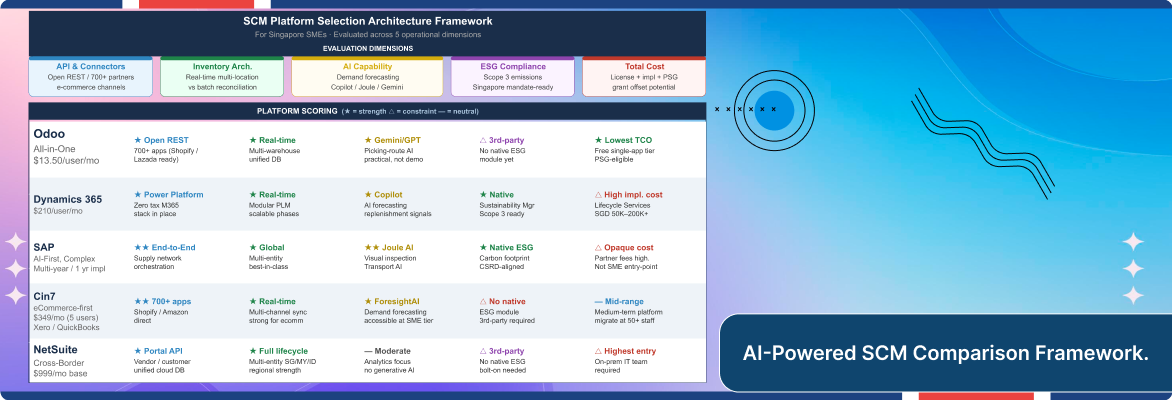
These five procurement software Singapore SME represent the realistic shortlist for SCM software for SMEs in Singapore. Ranking is based on total cost of ownership, integration depth, implementation complexity, and strategic fit for a business with 20 to 200 employees operating under Singapore’s regulatory and cost environment.
1. Odoo -Best All-in-One for Lean SCM Teams
Odoo’s supply chain module runs on a single database that also holds your CRM, accounting, and HR records. That unified data model is its primary competitive advantage, and its primary constraint. The free single-app tier makes it genuinely accessible for early-stage SMEs testing real-time inventory tracking software without capital commitment. The Standard plan starts at USD 13.50 per user per month, making it the most cost-accessible full-featured option on this list.
2. Microsoft Dynamics 365 Supply Chain Management -Best for Microsoft-First Environments
At USD 210 per user per month for the core SKU, Dynamics 365 Supply Chain Management is not an SME entry point by default. It earns this ranking for Singapore SMEs that are already running Microsoft 365, Azure, or Power BI -because the integration tax is zero. Copilot-driven forecasting, real-time replenishment signals, and the Sustainability Manager module all operate on the same identity and data governance layer as the rest of the Microsoft stack.
Implementation is not plug-and-play for the best inventory management system Singapore . Microsoft Lifecycle Services is a prerequisite for enterprise-grade deployments, and the onboarding timeline reflects that. For SMEs with an IT function and an existing Microsoft agreement, this is the lowest total-cost path to enterprise-grade supply chain management software in Singapore -for everyone else, the complexity cost is real.
3. SAP -Best AI Capability, Highest Complexity
SAP’s Joule generative AI agent delivers the most mature AI supply chain capability on this list -visual product inspection, transport planning optimization, and algorithm-driven forecast refinement are not marketing claims; they are production features used by firms like Siemens Energy at scale. The ESG reporting framework, including carbon footprint tracking across the supply chain, is the most comprehensive available without third-party integration.
The pricing model is opaque. SAP Supply Chain Base and Premium are licensed on multi-year terms starting from one user, but the total cost of implementation -including SAP-certified partner fees and customization -routinely exceeds what any SME PSG grant will offset. SAP is the right answer for a Singapore SME that is six to eighteen months away from no longer being an SME.
4. Cin7 -Best for E-Commerce and Multi-Channel Distribution
Cin7’s strength is connector breadth. With over 700 integration partners -QuickBooks, Xero, Amazon, Shopify, and regional courier networks -it is purpose-built for Singapore SMEs operating across omnichannel distribution. The ForesightAI demand forecasting module is one of the more accessible AI-driven planning tools available at the SME price point, starting at USD 349 per month for five users.
The structural limitation is equally clear: Cin7 has no native finance module, no HR capability, and no project management layer. SMEs that outgrow its supply chain and inventory scope will need to layer additional platforms on top -recreating the integration complexity they were trying to escape. Cin7 is a strong starting point for e-commerce-first SMEs; it is a medium-term platform, not a long-term architecture.
5. NetSuite -Best for Cross-Border and Multi-Entity Operations
NetSuite’s customer portal and full-product-lifecycle architecture make it the strongest option for Singapore SMEs with regional operations -managing entities in Malaysia, Indonesia, or Vietnam alongside the Singapore entity. Real-time, cross-party collaboration on a unified cloud database is a genuine capability, not a feature-sheet claim.
The on-premises requirement is the disqualifying factor for many Singapore SMEs. Maintaining NetSuite on-premises demands a software engineering function that most SMEs do not have and should not need to build. The base platform fee of USD 999 per month plus per-user licensing makes it the most expensive entry point on this list. [NOTE: verify freshness before publishing -pricing confirmed via ERPResearch, subject to change].
The Flexsin Perspective: What We See in the Field
After implementing SCM and ERP solutions across manufacturing, distribution, and wholesale trade clients in the APAC region, one pattern repeats with enough frequency to qualify as a rule: the platform decision is rarely the problem. The integration strategy is.
Singapore SMEs that struggle post-implementation almost always selected a platform that was technically capable of meeting their needs. What they did not define upfront was which data needed to move between which systems in real time, which data could tolerate a daily sync, and which data needed to stay siloed for compliance reasons. That conversation -which happens before software selection, not after -determines whether a USD 14-per-month Odoo Development Services outperforms a USD 300-per-month Dynamics 365 deployment. In our experience, it often does.
The PSG grant creates a useful forcing function here. Because qualifying SMEs must select from IMDA pre-approved solutions and document implementation milestones, the grant application process functions as a lightweight requirements workshop. SMEs that engage that process seriously -rather than treating it as a reimbursement mechanism -make better platform decisions.
The other pattern worth naming: AI supply chain features are being adopted before the data foundations that make them accurate are in place. Demand forecasting software in Singapore’s Multi-warehouse management software market is only as good as the inventory accuracy it is reading from. We consistently recommend that SMEs achieve a 95%+ inventory accuracy rate in their existing system before activating AI-driven forecasting modules -regardless of which platform they are on.
Flexsin’s SCM implementation practice works directly on the integration architecture, data migration, and staff enablement that determine whether a platform investment delivers ROI or generates a regret decision. The technology is rarely the variable. Execution is.
Common Limitations of SCM Software for SMEs in Singapore
No platform on this list is unconditionally the right answer. Every deployment decision involves trade-offs that vendors will not lead with. These are the constraints that matter most for Singapore SMEs:
-
- Odoo’s unified-database advantage requires full-platform adoption. Partial deployments reduce it to a capable but undifferentiated inventory tool.
-
- Microsoft Dynamics 365 Supply Chain Management is not self-implementable for SMEs without Dynamics 365 Business Central Development Services. Factor implementation partner costs -typically SGD 50,000 to SGD 200,000+ -into the true first-year cost.
-
- SAP pricing opacity is structural. Multi-year contracts with non-transparent base fees make total cost of ownership modeling difficult before signing. Insist on a full three-year cost model from any SAP Business One Singapore partner before committing.
-
- Cin7 lacks the financial and operational breadth to serve as a sole business platform beyond the early growth stage. Plan for a platform migration at the 50-employee threshold.
-
- NetSuite’s on-premises requirement is a structural commitment to internal IT capability. Cloud-first SMEs should evaluate this as a full operational cost, not just a licensing fee.
-
- Across all platforms: Microsoft CoPilot consulting service AI supply chain management features require clean, high-accuracy base data to function correctly. Activating them on poor data produces confident, wrong outputs.
- ESG supply chain reporting requirements in Singapore are accelerating. Platforms without a native sustainability data layer will require third-party integrations that add cost and complexity as reporting mandates tighten.
People Also Ask:
What is SCM software for SMEs in Singapore and how does it differ from enterprise SCM? SCM software for SMEs in Singapore refers to supply chain management platforms scaled to the operational and budget constraints of companies with fewer than 200 staff or under SGD 100 million in revenue. Enterprise SCM platforms prioritize global multi-entity orchestration; SME-focused tools prioritize ease of deployment, modular pricing, and integration with local e-commerce and logistics networks.
Which SCM software is PSG-eligible for Singapore SMEs? Enterprise Singapore’s Productivity Solutions Grant covers pre-approved IT solutions including select inventory and supply chain management platforms. SMEs should verify current PSG-eligible SCM software on the GoBusiness portal, as the pre-approved vendor list is updated periodically and grant coverage rates are subject to review.
How does AI supply chain management improve demand forecasting for SMEs? AI-driven demand forecasting software in Singapore uses historical sales data, seasonality patterns, and supplier lead times to generate procurement recommendations. Accuracy is directly tied to the quality and completeness of base inventory data; platforms like Cin7 ForesightAI and Microsoft Copilot for supply chain deliver useful results only when inventory accuracy exceeds approximately 95%.
What is the realistic total cost of SCM software implementation for a Singapore SME? Licensing costs represent only part of the investment. Implementation, data migration, staff training, and integration with existing platforms typically add 100% to 300% to the first-year cost over the base license fee. PSG and EDG grants can offset up to 50% of qualifying costs, but complex enterprise deployments frequently exceed grant ceilings.
How does Singapore’s Manufacturing 2030 vision affect SCM software selection for SMEs? Singapore’s Manufacturing 2030 strategy targets a 50% increase in the sector’s value-add over the decade, backed by investment in AI, automation, and supply chain digitalization. Practically, this means SCM platforms that cannot support ESG reporting, real-time visibility, and AI-driven planning will create a compliance and capability gap as enterprise customers push data requirements down to their SME suppliers.
Is cloud-based SCM software better than on-premises for Singapore SMEs? Cloud-based SCM software removes the need for internal IT infrastructure and enables real-time multi-location visibility without VPN dependencies -both critical advantages for Singapore SMEs with lean operations teams. On-premises deployments of ERP for small businesses Singapore, like NetSuite, offer full data control but require dedicated software engineering resources that most SMEs cannot cost-effectively maintain.
The Right SCM Platform Decision Starts with the Right Integration Architecture
Selecting SCM software for SMEs in Singapore is not a feature-comparison exercise -it is a supply chain architecture decision that will determine your operational ceiling for the next three to five years. The wrong platform, correctly implemented, still underperforms. The right platform, poorly integrated, produces the same result.
Flexsin’s SCM and ERP implementation practice works with Singapore and APAC SMEs to design the data architecture, integration strategy, and implementation roadmap that determines whether a platform investment compounds or costs. From Odoo inventory management configurations to Microsoft Dynamics 365 supply chain deployments to multi-platform integration strategy, Flexsin delivers the execution layer that software vendors do not.
Explore Flexsin’s Supply Chain Management solutions at and start with a conversation about integration architecture before committing to a license.
Frequently Asked Questions:
1. Can a Singapore SME use SCM software without a full ERP implementation? Yes -platforms like Odoo’s single-app free tier and Cin7’s Standard plan allow SMEs to deploy supply chain and inventory management capabilities independently. The trade-off is that isolated SCM deployments lose the data-model advantages that come from unified ERP architectures, particularly around financial reconciliation and demand-to-procurement workflows. For SMEs with under 30 employees, a standalone SCM deployment is a sensible starting point. For SMEs at 50-plus employees, the integration cost of a disconnected system typically exceeds the cost of migrating to a unified platform.
2: How long does it take to implement cloud-based SCM software for a Singapore SME?Implementation timelines vary significantly by platform and scope. Odoo single-module deployments can go live in four to eight weeks with a defined data migration plan. Microsoft Dynamics 365 Supply Chain Management implementations typically run four to twelve months for SME-scale deployments. SAP implementations should be scoped at six to eighteen months minimum. The most consistent predictor of timeline is data readiness – SMEs with clean, structured inventory and supplier data in an exportable format consistently implement 30% to 40% faster than those who begin data cleanup during implementation.
3. Does SCM software integration with Shopify or Lazada require custom development? Not typically on platforms with pre-built connector ecosystems. Cin7 offers native integrations with over 700 platforms including major Southeast Asian e-commerce channels. Odoo maintains a marketplace of pre-built connectors. Microsoft Dynamics 365 integrates through Power Platform connectors. The exception is highly customized storefronts or proprietary logistics APIs -these require custom integration development, which should be scoped and costed before platform selection.
4. What data does Singapore’s ESG reporting mandate require from supply chain systems? YSingapore’s forthcoming mandatory ESG framework and international regulations like the CSRD require Scope 3 emissions data includes supply chain emissions from procurement, logistics, and distribution. Practically, this means SCM software for supply chain digitalization Singapore must be capable of capturing supplier carbon data, logistics emissions per shipment, and product-level sustainability attributes. Platforms with native sustainability modules (SAP, Microsoft Dynamics 365) have a structural implementation advantage; platforms without native ESG data capture will require integration with standalone carbon accounting tools.
5. What is the PSG grant coverage rate for SCM and ERP software in Singapore? The Productivity Solutions Grant currently covers up to 50% of qualifying costs for pre-approved IT solutions including inventory management and ERP systems. Coverage applies to subscription fees, implementation costs, and training for IMDA-listed solutions. SMEs should verify current coverage rates and approved vendor lists directly on the GoBusiness portal, as rates and eligible solutions are periodically reviewed. Combined with the Enterprise Development Grant (EDG), up to 90% of qualifying digital transformation investment can be offset for eligible SMEs.
6. How do I evaluate whether demand forecasting software in Singapore will work for my supply chain? Start with a data audit. AI-driven demand forecasting software requires at least twelve months of clean transactional sales history, accurate supplier lead time data, and current inventory records at SKU level. If any of these inputs are incomplete, forecasting outputs will reflect the gaps rather than actual demand patterns. Before evaluating forecasting platforms, run a data completeness assessment against these three inputs. The platforms that will deliver real value are those that also provide implementation support to build those data foundations -not just the forecasting interface on top of whatever data currently exists.
7. What distinguishes real-time inventory tracking from batch inventory updates in an SCM system? Real-time inventory tracking updates stock levels at the moment of each transaction -a receipt, a pick, a shipment, a return. Batch systems aggregate those movements and reconcile at defined intervals, typically every four to twenty-four hours. For Singapore SMEs operating across multiple warehouse locations or high-velocity e-commerce channels, batch systems create a visibility gap that produces overselling, stockouts, and inaccurate replenishment triggers. Real-time tracking requires a platform architecture built for event-driven data -not all cloud SCM platforms deliver this natively despite marketing claims to the contrary.
