

 +1.844.3539.746
 info@flexsin.com
 Munesh Singh
Leading-edge enterprises that embrace AI deeply across functions and workflows are seeing dramatic gains. These organizations, known as “Frontier Firms,” leverage AI not just for automation, but as a core strategic asset for growth, innovation, and competitive advantage.
Many enterprises experiment with AI in silos, but Frontier Firms demonstrate how full-scale integration across business functions, from customer service to product development to supply chain – unlocks exponential value and positions companies to lead in the AI-first era.
Most enterprises start AI adoption with simple automation or productivity tools. Frontier Firms go further – deploying custom, industry-specific AI solutions, integrating agentic AI for decision support and automation, and expanding AI usage across 6-8 critical business functions.
They report returns and business impact substantially higher than slower adopters – including in cost efficiency, top-line growth, brand differentiation, and customer experience.
1. What Makes a Frontier Firm – Key Characteristics
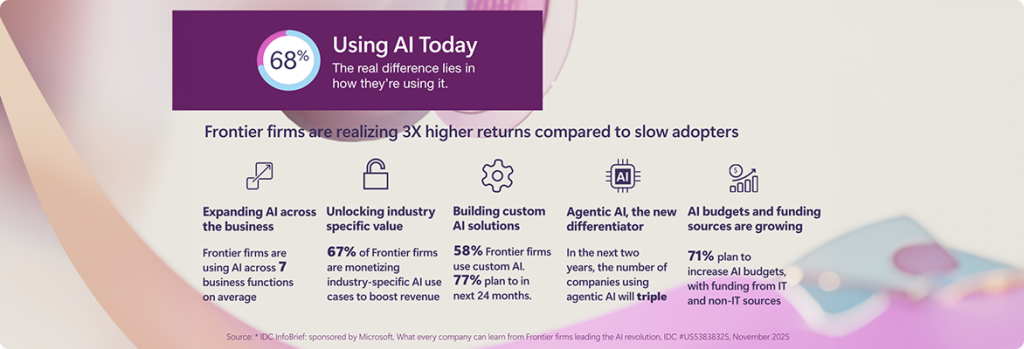
Frontier Firms don’t limit AI to a department or pilot program. On average, they deploy AI across seven core business areas – including customer experience, marketing, IT operations, product innovation, security, customer service, and R&D.
This widespread use by an AI integration company ensures AI isn’t a siloed add-on – it becomes woven into the fabric of the organization’s operations. Functions benefit from AI in many forms – from workflow automation, anomaly detection, real-time insights, content generation to predictive analytics, delivering tangible efficiencies.
Industry-Specific AI Use Cases
Beyond general-purpose productivity, Frontier Firms build use cases tailored to their sector’s problems. In financial services, AI supports fraud detection, transaction reconciliation, and personalized customer support. In healthcare, it helps with clinical documentation, diagnostic support, and personalized care. In manufacturing, AI drives predictive maintenance, quality inspection automation, production scheduling, and energy optimization.
Custom AI Solutions and Proprietary Intelligence
Roughly 58 % of leading firms already build custom AI solutions. These in-house models or tailored AI deployments embed proprietary data, compliance rules, brand voice – giving firms unique intelligence that off-the-shelf AI can’t replicate.
And over the next 24 months, a significant share of firms plan to ramp up custom AI development – showing commitment to deeper integration and long-term value.
2. Anatomy of Enterprise AI Architecture & Key Components
Enterprise AI deployment starts with secure, scalable infrastructure – cloud platforms, data pipelines, identity management, compliance frameworks, and governance policies. Without these foundational elements, AI adoption remains risky and fragmented.
A governance-aware architecture ensures data privacy, compliance, and risk management – especially critical in regulated sectors like finance and healthcare. It also supports monitoring, auditing, and updating AI models and agents over time.
Data & Knowledge Foundations
To extract value, firms need clean, well-managed data. That includes transactional data, user behavior, operational logs, domain-specific knowledge bases, and compliance rules – all structured correctly.
Custom AI models by AI application company are often fine-tuned on proprietary data – making the knowledge foundation a strategic asset. The better curated the data, the more accurate and relevant the AI output.
AI Engine & Agent Layer
This is where generative AI models, LLMs, fine-tuned models, and agentic AI engines live. These systems analyze data, generate outputs, make predictions, and, when agentic, take actions or propose decisions.
Layered on top can be custom business logic, compliance rules, audit trails, and feedback loops, enabling AI to operate within enterprise governance and brand constraints.
3. Use-Case Ladder – From Core to Specialized to Industry-Specific
| Level | Use Case Type | Typical Functions / Outcomes |
|---|---|---|
| Core (Enterprise-wide) | Workflow automation, content generation, anomaly detection, productivity tools | Customer service bots, help-desk automation, marketing content creation, IT operations alerts |
| Secondary (Function-specific) | Enhanced workflows for departments – sales, HR, finance, operations | Personalized outreach, invoice processing, compliance checks, HR onboarding automation |
| Niche / Industry-specific | Deep domain applications tuned for sector requirements | Fraud detection in banking, predictive maintenance in manufacturing, clinical documentation in healthcare |
Real-world Micro-case: Investment Firm AI-powered Support A global investment firm integrated AI across 20 applications for portfolio managers and client relationship teams. Personalized briefs, opportunity analyses, real-time analytics, and research summaries reduced manual workload per client and improved data quality – enabling faster decisions and better compliance management.
Personas That Drive & Champion AI Transformation
CTO / CIO:
Evaluates infrastructure, platform readiness, integration, data governance, and ROI models.
IT Director / Head of Engineering:
Oversees development and deployment of AI agents, systems integration, maintenance, and scalability.
Founder / CEO / Managing Director:
Seeks strategic advantage, new revenue streams, business model innovation, and competitive differentiation.
Digital Transformation Lead / Head of Innovation:
Orchestrates cross-functional adoption, culture change, upskilling, governance, and aligns AI use with business goals.
 Source: Microsoft
4. Flexsin POV – Our Approach to Helping Enterprises Become Frontier Firms
At Flexsin, we believe AI transformation is not a project – it is an enterprise-wide journey. Our approach centers on:
- A structured assessment of organizational readiness – evaluating data posture, technical architecture, governance and stakeholder alignment.
- Building a phased AI adoption roadmap: from pilot automation and productivity gains, to full-scale custom AI solutions and agentic AI deployment.
- Integration of AI with existing enterprise systems (ERP, CRM, PLM) – ensuring seamless embedding into workflow and user experience.
- Governance and compliance framework implementation – data security, ethical use, auditability, and feedback loops.
Comparison: Frontier vs Slow Adopter vs Pilot-Only Organizations
| Dimension | Pilot-Only / Siloed | Pilot-Only / Siloed | Frontier Firm (Full Integration) |
|---|---|---|---|
| Frontier Firm (Full Integration) | Few isolated tools | Some functions (IT, marketing, ops) | 6–8+ core functions across org |
| Value Realization | Productivity wins, limited impact | Moderate cost savings, some efficiency | High ROI – growth, differentiation, CX, cost and revenue impact |
| Customization | Generic tools | Limited custom modules | Custom AI solutions + proprietary data models |
| AI Agents & Autonomy | Rare or absent | Limited scripting & automation | Agentic AI managing workflows, decision-support, autonomy |
| Strategic Impact | Low-medium | Medium | High – transformation of business model & operations |
5. Best Practices for Enterprise-Wide AI Transformation
Start with a clear AI strategy aligned to business goals:
Whether it is growth, efficiency, customer experience, or innovation.
Prioritize data readiness:
Ensure data quality, compliance, governance, and proper architecture.
Adopt a phased approach:
Pilot → department-wide → enterprise-wide → agentic AI.
Build custom AI where generic solutions fall short:
Embed domain knowledge, compliance, and brand voice.
6. Limitations & Risks to Consider
Governance and compliance overhead:
Data privacy, security, and ethical considerations.
Complexity of integration:
Legacy systems, disparate data sources, and inconsistent processes.
Risk of under-utilization:
AI tools may remain unused if workflows are not redesigned or users, not trained.
Data quality constraints:
Poor data hygiene undermines AI accuracy and reliability.

Frequently Asked Questions
1. What defines a “Frontier Firm”?
A Frontier Firm is an enterprise that has embedded AI across multiple core business functions – not just isolated projects, and builds custom AI or agentic AI solutions that deliver measurable strategic value.
2. Is starting with small AI pilots still worthwhile?
Yes, pilots help validate technical feasibility, surface data or integration issues, and build internal buy-in. They are a low-risk entry point before scaling across the enterprise.
3. When should an enterprise move from generic AI tools to custom AI solutions?
When business needs demand domain-specific knowledge, compliance constraints, brand voice, or when generic AI fails to deliver required accuracy or business differentiation.
4. What is agentic AI and why does it matter?
Agentic AI refers to systems that don’t just assist but act – they can reason, plan, and execute tasks under human oversight. This elevates AI from an assistant to a collaborator, enabling automation of complex workflows and faster decision-making.
5. Which industries benefit most from full-scale AI adoption?
Industries with complex workflows, large data volumes, compliance needs, or frequent decision-making – such as finance, healthcare, manufacturing, supply-chain, logistics, and professional services.
6. How do enterprises measure ROI from AI transformation?
By tracking metrics like cost savings, revenue uplift, efficiency gains, customer satisfaction, speed improvement, risk reduction, compliance adherence, and overall business growth.
7. What infrastructure is required to support enterprise-wide AI?
A scalable cloud or hybrid infrastructure, secure data pipelines, identity and access management, data governance, compliance controls, monitoring and audit systems, and integration with existing enterprise applications.
8. How important is data quality for successful AI deployment?
Critical – poor data quality leads to inaccurate predictions, unreliable outputs, and can erode trust in AI. Clean, well-governed data is foundational for effective AI.
9. What role do governance and compliance play in AI adoption?
Governance ensures data privacy, ethical use, compliance with regulations, security, and auditability – essential especially in regulated sectors like finance or healthcare.
10. Can smaller enterprises also become Frontier Firms?
Yes, with proper strategy, phased adoption, and focus on data readiness and custom AI solutions. Scale matters less than intent and disciplined execution.
Sustainability comes from embedding AI deeply in operations, building proprietary intelligence via custom models, integrating AI into culture and workflows, and continuously evolving with governance, data, and business strategy.
Flexsin Technologies sees enterprise AI transformation as a strategic journey – not a one-off project. Our Enterprise AI Services and Digital Transformation Consulting help companies navigate data readiness, custom AI development, integration, governance, and cultural alignment – enabling them to become Frontier Firms.