

 +1.844.3539.746
 info@flexsin.com
Application Modernization: Turning Legacy Systems into Growth Assets
 Munesh Singh
Let's talk
Table of Contents:
- Application Modernization: More Than a Technology Upgrade
- The 7 Rs: A Framework for Application Modernization Strategy
- Why Application Modernization Has Moved to the Top of the IT Agenda
- What a Sound Application Modernization Roadmap Looks Like
- People Also Ask
- Ready to Modernize? Flexsin Can Take You There.
- Frequently Asked Questions
That number, cited repeatedly by Gartner, describes the maintenance trap: enterprise organizations locked into aging software stacks, spending the overwhelming majority of their technology dollars on patches, workarounds, and system survival. Application modernization is the structured discipline of breaking that trap.
It is not a migration project. It is not a cloud initiative. Application modernization is a deliberate, multi-stage transformation of legacy software systems to meet current and future business, security, and architectural requirements – executed in a way that protects operational continuity while building toward lasting competitive advantage.
Application Modernization: More Than a Technology Upgrade
Strip away the consulting jargon and the definition is straightforward: application modernization is the process of legacy application modernization so it can do what your business needs it to do today – and what it will need to do two years from now.
Aging enterprise applications were built for a different era. They ran on on-premises hardware, communicated through proprietary protocols, and scaled vertically – meaning the only way to handle more load was to buy bigger servers. That model is architecturally incompatible with cloud-native infrastructure, real-time data pipelines, AI workloads, and the API-driven integration that modern business ecosystems demand. Modern Software Development Services help enterprises replace these architectural limitations with scalable applications, APIs, microservices, and cloud-native components.
The consequences are not abstract. According to McKinsey, technical debt can represent up to 40% of the technology estate in large enterprises – and that debt compounds. A system carrying $1 million in technical debt today could require $2 million to address within four years if left unmanaged. The cost of inaction for microservices modernization is quantifiable and relentless.
The 7 Rs: A Framework for Application Modernization Strategy
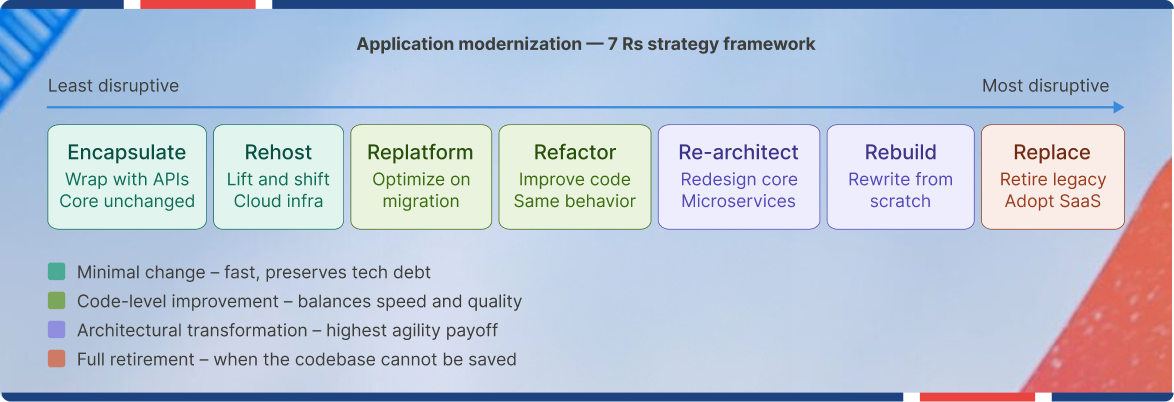
The industry broadly uses a seven-option framework to describe how organizations can approach legacy system modernization. Each option sits on a spectrum from minimum disruption to full architectural transformation:
Rehost (Lift and Shift): Move the application to new infrastructure – typically cloud – without changing its code. Fast and low-cost, but it does not result in a significant technical debt reduction.
Replatform: Make targeted optimizations during legacy applications migration – for example, swapping an on-premises database for a managed cloud database service – without redesigning core architecture.
Refactor: Restructure existing code to improve quality, performance, or maintainability without changing its external behavior. High value for applications worth preserving.
Re-architect: Redesign the application’s core structure. This often means decomposing a monolith into microservices – a significant investment that unlocks the highest long-term agility. Digital Engineering Services can support this type of re-architecture by decomposing monolithic applications, modernizing APIs, and designing scalable microservices-based systems.
Rebuild: Rewrite the application from scratch using modern languages, frameworks, and architecture. Chosen when the existing codebase cannot support the target state.
Replace: Retire the legacy application and adopt a commercial SaaS or packaged solution that covers the required functionality.
Encapsulate: Wrap the legacy system with APIs to expose its data and functions without changing the core. Useful as a transitional application modernization strategy while deeper modernization proceeds.
No single option is universally correct for software modernization. The right choice depends on the application’s business criticality, the quality of the existing codebase, integration complexity, and the organization’s risk tolerance. Most enterprise application modernization services use several of these approaches simultaneously across a portfolio.
Why Application Modernization Has Moved to the Top of the IT Agenda
The business case has shifted from “nice to have” to “risk to ignore.” Several converging pressures have made this clear.
Security Exposure Is No Longer Theoretical
Legacy systems were not designed for today’s threat landscape. Many lack modern encryption, multi-factor authentication, or real-time threat detection. Critically, vendor support for older platforms frequently expires – which means known vulnerabilities remain permanently unpatched.
AI Readiness Demands Modern Architecture
Every AI initiative your organization wants to run – predictive analytics, generative AI, intelligent automation – requires clean, accessible, high-quality data and flexible integration points. A monolithic legacy application sitting on a proprietary database with no API layer is, by design, incompatible with these workloads.
Application modernization is also a foundational component of Digital Transformation Services, giving organizations the architecture needed to connect modern applications, data platforms, AI workloads, and enterprise processes.
The Talent Market Is Forcing the Issue
COBOL programmers are retiring. Institutional knowledge of legacy systems walks out the door with them. Organizations that delay modernize legacy systems work will find themselves dependent on a shrinking pool of specialists commanding premium rates – or facing critical system failures with no one who understands the codebase.
What a Sound Application Modernization Roadmap Looks Like
The organizations that succeed at application modernization do not treat it as a technology project with a launch date. They treat it as a continuous program with measurable phases. Here is what that looks like in practice.
Phase 1 – Discovery and Dependency Mapping: Before a single line of code moves, map every integration point, data flow, and dependency in the current system. Skip this phase and you will discover your dependencies the hard way – during a production incident.
Phase 2 – Prioritize by Risk and Value: Not every application needs to be modernized at the same pace or to the same degree. Segment your portfolio by business criticality and technical debt severity. High-debt, high-criticality systems move first.
Phase 3 – Phased Migration with Parallel Operations: Run legacy and modern systems simultaneously during transition. Define explicit, measurable criteria for when the legacy system gets retired – then hold to them.
Phase 4 – Validate ROI and Iterate: Track technical KPIs (deployment frequency, mean time to recovery, system availability) alongside business KPIs (time-to-market, operational cost). The numbers tell you whether the program is delivering.
People Also Ask:
What is application modernization in simple terms? Application modernization is the process of updating legacy software to meet current business, security, and technology requirements. It moves applications from outdated architectures to modern, scalable platforms.
What is the difference between application modernization and digital transformation? Digital transformation modernizaation is the broader business strategy; application modernization is the specific technical work that enables it. You cannot transform a business on a legacy codebase.
What are the 7 Rs of application modernization? The 7 Rs are Rehost, Replatform, Refactor, Re-architect, Rebuild, Replace, and Encapsulate. Each represents a different approach to legacy system modernization, ranging from minimal change to full rebuild.
How long does application modernization take? A rehost can complete in weeks; refactoring or re-architecting an enterprise system typically runs 12 to 18 months. A full rebuild of a complex core platform can take two to three years.
What is the ROI of legacy application modernization? Gartner reports that 60 to 80 percent of IT budgets are consumed maintaining legacy systems. Modernization reallocates that spend toward innovation. Forrester cites 40 to 60 percent faster digital product releases post-modernization.
Can small and mid-sized enterprises afford application modernization? Yes. Phased approaches and cloud-native services have reduced the barrier significantly. Rehosting and encapsulation strategies deliver rapid time-to-value without requiring a full rebuild.
Ready to Modernize? Flexsin Can Take You There.
Flexsin’s Application Modernization Services cover the full program lifecycle – from system assessment and dependency mapping through phased migration, microservices decomposition, cloud-native deployment, and long-term optimization. As a Software Development Company, Flexsin combines application modernization with re-architecture, microservices development, API integration, and cloud-native engineering. We have recovered stalled modernization programs, executed greenfield re-architectures, and delivered cloud application modernization for enterprises across financial services, logistics, healthcare, and manufacturing.
Explore how Flexsin approaches enterprise application modernization.
The longer the delay, the higher the cost. Start the assessment now.
Frequently Asked Questions:
1. What triggers the decision to start application modernization?The most common triggers are rising maintenance costs, inability to integrate with modern platforms, security audit failures, and an upcoming end-of-support deadline on a core platform. Competitive pressure from cloud-native transformation by competitors also accelerates the decision.
2. Should we modernize all applications or just critical ones?Prioritize by business impact and technical debt severity. Not every application in your portfolio warrants full re-architecture – some are better candidates for encapsulation or replacement. A portfolio assessment before committing to an application modernization roadmap will save significant cost and time.
3. How do we handle data migration during application modernization?Data migration must be treated as a parallel workstream, not an afterthought. Referential integrity verification, transformation logic, and rollback capabilities need to be designed before migration begins – not during it.
4. What is the risk of running legacy and modern systems in parallel?The primary risk is data synchronization and state consistency between the two systems. The mitigation is clear data ownership rules, event-driven synchronization where possible, and defined cutover criteria with measurable stability thresholds before decommissioning.
5. How does Flexsin approach application modernization differently from a generic IT services firm?Flexsin treats modernization as an intelligence multiplier, not a technology refresh. The focus is on creating platforms where AI can deliver measurable outcomes for enterprise application migration – not simply moving infrastructure to the cloud and declaring success.
