

 +1.844.3539.746
 info@flexsin.com
AI marketing strategies accelerating startup success through automation and data-driven insights.
 Chiranjit Paul
Table of Contents:
- Rethinking Everything You’ve Been Told About AI Marketing
- Core AI Marketing Strategies That Drive Measurable Results
- Enterprise AI Marketing Tools: What’s Driving Results in 2026
- The Numbers That Close Boardroom Arguments
- Building Your AI Marketing Strategy: The Practitioner Framework
- People Also Ask
- Partner With Flexsin to Build an AI Marketing Engine That Scales
- Frequently Asked Questions
Most AI marketing investments fail at the strategy layer – not the technology layer.
That distinction matters. According to a SurveyMonkey survey, 88% of marketers now use AI tools in their daily workflow – yet organizations consistently report that returns diverge sharply between those who deploy AI with architectural intent and those who bolt it onto existing workflows and call it transformation. This AI marketing guide isn’t a tool catalog. It’s a practitioner’s map for building an AI marketing strategy that compounds.
Rethinking Everything You’ve Been Told About AI Marketing
The standard narrative frames AI in marketing as a productivity accelerator. Faster content. Smarter ads. More personalized emails. Those things are true – and they’re also table stakes by now.
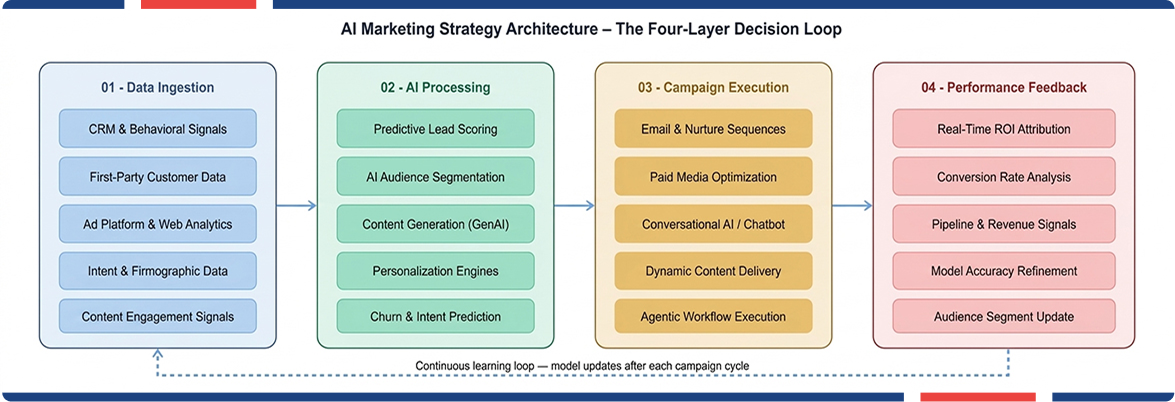
The organizations generating outsized AI marketing ROI in recent years didn’t just automate tasks. They rebuilt their campaign architecture around AI decision loops: systems that ingest signal, score it, route it, and iterate without human intervention at each step. That shift from AI as a tool to AI as operating infrastructure is the gap most AI marketing guides still haven’t addressed.
Generative AI adoption in marketing surged 116% year-over-year, according to Duke University’s CMO Survey conducted with Deloitte Digital. The brands capturing that growth aren’t the ones with the most tools. They’re the ones who built the data infrastructure that makes those tools useful.
Core AI Marketing Strategies That Drive Measurable Results
1. Hyper-Personalization at Scale With AI-Powered Content Marketing
Personalized marketing AI does one thing manually-built segments cannot: it updates in real time. Machine learning models score individual behavior signals – recency, frequency, content affinity, channel preference – and serve content that reflects where a buyer actually is in their journey, not where the last campaign assumed they’d be.
2. Predictive Analytics Marketing: Stop Reacting, Start Anticipating
Predictive analytics marketing flips the orientation of demand generation. Instead of optimizing against last quarter’s data, AI models score leads in real time, surface churn signals before they materialize, and allocate budget toward channels that are currently converting – not channels that converted six months ago.
3. AI Marketing Automation: From Campaign Execution to Autonomous Workflows
AI marketing automation has passed the task-replacement phase. The frontier now is agentic AI – systems that execute multi-step marketing workflows without manual intervention: researching a lead, scoring intent, drafting personalized outreach, sequencing follow-ups, and logging every touchpoint to the CRM.
Enterprise AI Marketing Tools: What’s Driving Results in 2026
The best AI tools for marketing today aren’t evaluated on feature lists. They’re evaluated on fit, data integration readiness, and whether they collapse into the existing stack or require it to be rebuilt. With that lens, four categories dominate enterprise adoption:
- Content generation platforms – ChatGPT, Claude, and Gemini lead AI content generation tools for copy, briefs, and first-draft production. Around 72% of global organizations now use AI for content creation, per AllAboutAI’s 2026 statistics.
- Marketing AI platforms with predictive and automation layers – Salesforce Einstein, HubSpot AI, and Marketo Engage integrate directly into CRM pipelines and automate segmentation, scoring, and nurture sequences. Salesforce Einstein’s AI email copywriting features are now in active use by 61% of enterprise customers, according to SQ Magazine’s 2026 industry data.
- Analytics and audience intelligence tools – Platforms that transform raw behavioral data into actionable audience segments, continuously updated against live campaign performance.
- AI chatbot for marketing and conversational engagement – Chatbot platforms now represent 14% of total AI tool spend in marketing, handling initial qualification, content delivery, and meeting scheduling at scale.
The Numbers That Close Boardroom Arguments
The business case for enterprise AI marketing has stopped requiring justification. It now requires precision.
AI delivers a 47% higher click-through rate on ad campaigns and enables campaigns to launch 75% faster than manually built equivalents, according to AllAboutAI’s 2026 statistics. AI-powered email programs generate 41% more revenue than non-AI email workflows. Companies using AI across three or more marketing functions see a 15% better ROI on average, according to SQ Magazine’s industry benchmarks.
The ROI picture extends to the strategic horizon. Organizations that built AI marketing infrastructure in 2024 are 1.5 times more likely to report higher revenue growth over three years compared to peers who delayed, per Loopex Digital’s 2026 analysis citing McKinsey data.
Building Your AI Marketing Strategy: The Practitioner Framework
The AI marketing guide that actually moves the needle starts with workflow mapping, not tool selection. Identify where in the campaign lifecycle human judgment is irreplaceable – strategy, creative direction, brand positioning – and isolate everything else as a candidate for AI augmentation or full automation.
Successful implementation follows a clear sequence: audit your data infrastructure first, because AI is only as accurate as the signals it ingests; establish KPIs tied directly to business outcomes rather than activity metrics; evaluate platforms for integration fit with your existing CRM and analytics stack; invest in team AI literacy so outputs are supervised and refined, not blindly published.
People Also Ask:
What is an AI marketing guide and why does it matter for enterprise teams? An AI marketing guide maps how artificial intelligence applies across the campaign lifecycle – from content generation to predictive analytics to autonomous workflow execution.
How do AI marketing strategies differ from traditional digital marketing approaches? Traditional digital marketing optimizes against historical data and static audience segments. AI marketing strategies use real-time behavioral signals and machine learning in marketing models to continuously update targeting, messaging, and budget allocation within active campaigns.
Which AI tools for marketing deliver the highest ROI for B2B companies?AI content drafting delivers an average 3.2x ROI and personalization engines deliver 2.7x, per McKinsey’s Global AI Survey. For B2B specifically, predictive analytics marketing and AI-driven lead scoring consistently outperform other AI marketing automation categories.
What are the core benefits of AI in marketing for large enterprises?The quantifiable benefits of AI in marketing include 22% higher campaign ROI, 47% better click-through rates, and 29% lower customer acquisition costs versus traditional methods. Operational benefits include faster campaign cycles – up to 75% faster.
How long does it take to see AI marketing ROI after implementation? Median payback on AI marketing investments is currently 4.2 months, according to Digital Applied’s 2026 analysis. For content-heavy marketing teams where AI replaces high-volume manual production, payback consistently arrives in under three months.
What is generative AI marketing and how is it different from standard marketing automation?Generative AI marketing uses large language models to create original content – copy, briefs, creative concepts, email sequences – rather than simply routing or triggering pre-built assets. Standard marketing AI platforms automate workflow logic; generative AI introduces net-new creative output at machine speed.
Partner With Flexsin to Build an AI Marketing Engine That Scales
Flexsin’s AI-driven digital marketing services are built for enterprises that have moved past experimentation and need proven execution. As a Google- and Meta-certified digital marketing partner with delivery centers across the US, UAE, and India, Flexsin brings the full stack – SEO, PPC, SMM, AEO, GEO, and AI automation - under a single, outcome-oriented engagement model.
If your current AI marketing strategy is generating activity without compounding returns, the gap is almost certainly structural. Flexsin’s team diagnoses that gap, aligns the right platforms to your CRM and analytics infrastructure, and engineers the AI decision loops that turn single campaigns into self-optimizing systems.
Contact Flexsin’s digital marketing practice and start building the infrastructure your AI marketing guide has been pointing toward.
Frequently Asked Questions:
1. Is AI marketing only viable for large enterprise companies?Not at all. While 57% of large marketing teams lead in AI adoption, 41% of small businesses now allocate part of their budget to AI tools. The key is matching tool complexity to team capacity – simple AI platforms can generate real AI marketing ROI for SMBs with fewer resources than most assume.
2. What data infrastructure do I need before implementing AI marketing strategies?A unified customer data platform or CRM with clean, tagged behavioral data is the minimum viable foundation. AI models are accurate to the quality of data they ingest, so unstructured or siloed data sets produce unreliable outputs regardless of which AI tools for marketing you select.
3. Can AI replace a marketing team entirely? No, and the organizations performing best in 2026 treat AI as an amplifier of human strategy rather than a replacement. AI handles high-volume, rule-based, and pattern-recognition work. Creative direction, brand positioning, stakeholder communication, and ethical oversight remain irreducibly human.
4. How does AI improve customer segmentation compared to traditional methods? Traditional segmentation groups customers by static firmographic or demographic attributes updated monthly or quarterly. AI-driven customer segmentation scores individual behavior in real time, creating dynamic micro-segments that shift with each new signal.
