

 +1.844.3539.746
 info@flexsin.com
Achieving Smarter Manufacturing Operations with Odoo ERP in Australia
 Tarun Malhotra
Let's talk
Table of Contents:
- Capability Gap Killing Manufacturing Margins
- Why Standard ERP Configurations Fall Short for Australian Manufacturing
- Odoo Manufacturing ERP Australia: Advanced Integration and Configuration Strategies
- What Real Odoo Deployments Actually Require
- ERP Limitations and Integration Challenges
- People Also Ask
- Ready to Replace Your Patchwork Systems?
- Frequently Asked Questions
Your production floor is generating thousands of data points every hour – and your business software has no idea. That is the silent crisis running beneath the surface of most Australian manufacturing operations right now: not a shortage of data, but a structural inability to act on it. A purchase order sits in one system, a manufacturing order lives in another, and your quality log is a spreadsheet someone emails on Fridays. By the time that information converges, the decision window has closed.
Australian manufacturers are facing a pressure point that is both financial and operational. According to the Australian Bureau of Statistics, the sector employed approximately 902,000 people at the end of June 2024 – a 1.0% increase year-on-year – while Industry Value Added grew from A$132.6 billion to A$134.8 billion. That modest 1.6% growth came under profitability pressure: earnings before interest, tax, depreciation, and amortisation for manufacturing declined by A$3.6 billion in the same period. Margins are compressing. The tolerance for operational inefficiency is gone.
This is exactly the environment that exposes a fundamental architectural flaw in how most mid-market manufacturers run their technology stack. And it is why Odoo manufacturing ERP for manufacturing businesses in Australia is becoming the platform executives cannot afford to ignore.
Capability Gap Killing Manufacturing Margins
Most manufacturing businesses do not struggle with a single software failure. They struggle with the compounding cost of running five or six disconnected tools that were never designed to talk to each other. That distinction matters because it shapes the solution.
Here is what that looks like in practice. Your inventory management system triggers a reorder. Your production planning tool does not know that yet. A sales order gets confirmed before the material has arrived. Your team scrambles to manually reconcile three systems – and the manufacturing order goes out late. Nobody flagged the risk; it was buried in the gap between platforms.
That gap is not a workflow problem. It is a data architecture problem. When procurement, production, inventory, and sales operate on separate data models, real-time decision-making becomes structurally impossible – regardless of how good your team is.
Three capability gaps consistently surface across Australian manufacturing engagements:
-
- Inventory blindness: No live view of stock levels, work-in-progress, or component availability means production planning runs on yesterday’s data.
-
- Quality latency: Quality checks that happen after production – not during – turn defect discovery into defect management. The damage is already done.
- Communication breakdown: When your shop floor, warehouse, and finance teams work in different systems, the cost of coordination is measured in hours of manual reconciliation per week.
Each of these gaps has a direct, measurable cost. Together, they represent the margin erosion that no amount of headcount can offset.
Why Standard ERP Configurations Fall Short for Australian Manufacturing
Generic ERP implementations fail manufacturing businesses in Australia for a reason that most vendors will not tell you: they are designed for process consistency, not manufacturing complexity.
A standard ERP deployment assumes your business runs in predictable, linear flows. Purchase order in, goods received, invoice paid. That logic works for distribution. It breaks the moment Odoo Development Consulting introduce multi-level bills of materials, variable routings, work center constraints, subcontracting arrangements, and quality hold workflows – all of which are standard operating reality in manufacturing.
The Australian manufacturing context adds regulatory layers that compound the challenge. GST and BAS compliance must be embedded in the industrial manufacturing ERP consulting’s financial logic – not bolted on via a third-party integration that breaks every time you upgrade. Single Touch Payroll requirements affect how your HR module connects to the manufacturing cost model. And if you operate across multiple sites or entities, inter-company reconciliation becomes a reporting nightmare in systems that were not purpose-built for it.
The result is a painful irony: businesses invest in Odoo manufacturing ERP Australia to reduce complexity, then spend months customizing a generic platform to approximate the functionality that manufacturing-specific ERP software should have shipped with. That is time, money, and internal bandwidth that never returns.
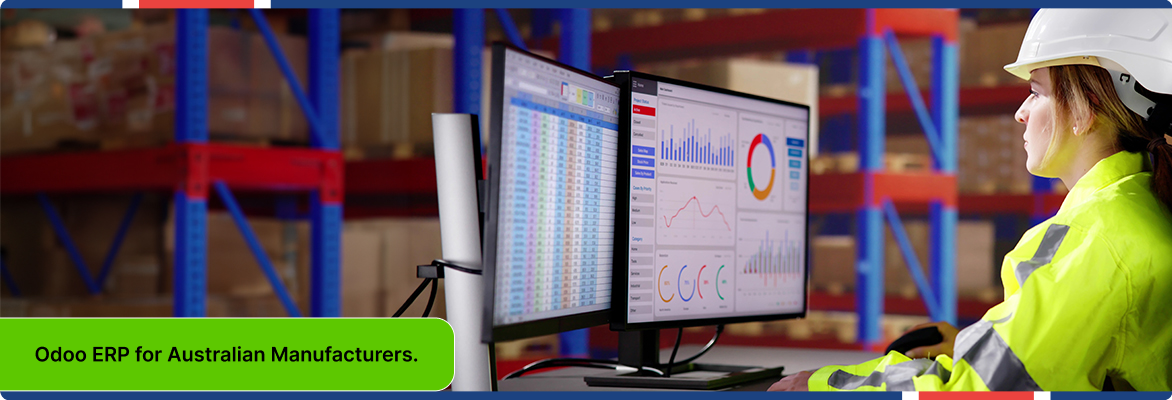
Odoo Manufacturing ERP Australia: Advanced Integration and Configuration Strategies
This is where Odoo manufacturing ERP Australia moves from concept to operational reality. Each capability below addresses a specific production challenge – not a feature checklist.
Manufacturing Resource Planning (MRP) and Master Production Scheduling (MPS)
Odoo’s MRP engine sits at the center of the platform’s manufacturing value proposition. It computes material requirements by working backward from confirmed sales orders through multi-level bills of materials, accounting for current stock, scheduled receipts, and safety stock parameters.
The Master Production Schedule (MPS) extends this by introducing a medium-term planning horizon – typically 12 to 52 weeks – that lets Odoo ERP consulting’s production planners align manufacturing capacity with forecast demand before orders are confirmed. This is the tool that finally bridges the gap between the sales team’s pipeline and the production floor’s reality.
-
- Multi-level Bill of Materials supports complex assemblies – finished goods, sub-assemblies, raw materials – with variant-based BoM configurations for products with multiple specifications.
-
- Replenishment rules (make-to-stock, make-to-order, buy) are configured per product, per warehouse, giving planners granular control over how each SKU flows through the supply chain.
- By-product and co-product support handles manufacturing scenarios common in food processing, chemicals, and pharmaceutical sectors where production of one item generates secondary outputs.
Shop Floor Control and the Odoo MES Layer
The Shop Floor app transforms tablets into production control terminals. Workers log in at their work center, view their assigned work orders, record time and material consumption, trigger quality checks, and flag maintenance issues – all from a purpose-built interface that requires no ERP training to operate.
Supervisors get a real-time Gantt view of all active work orders, with drag-and-drop rescheduling when machines go down or rush orders arrive. Overall Equipment Effectiveness (OEE) is tracked automatically – downtime, slow runs, and quality losses are categorized and reported at the work center level.
Quality Management: Inline, Not After-the-Fact
Odoo’s Quality module embeds control points directly into the production workflow. Quality checks are not a post-production audit – they are a required step in the work order sequence. A worker cannot mark a manufacturing step complete until the quality check associated with that step has been recorded.
This shift from quality assurance to quality control has direct financial implications. Defects caught mid-production cost a fraction of defects discovered at final inspection or, worse, in a customer return. Statistical quality analysis in Odoo manufacturing ERP surfaces recurring issues by product, component, work center, or operator – giving process engineers the data to intervene at the source, not the symptom.
Inventory and Traceability
Lot and serial number tracking in Odoo manufacturing integration provides end-to-end traceability from raw material receipt to finished goods dispatch. A single click on any production lot reveals its complete genealogy: which supplier batch supplied the component, which work center processed it, which quality checks were passed, and which customer received the finished product.
For Australian manufacturers operating under food safety standards, TGA requirements, or ISO certification, this traceability is not optional – it is a compliance requirement. Odoo manufacturing cloud ERP Australia makes it automatic rather than administrative.
IoT Integration and Connected Manufacturing
The Odoo IoT Box connects physical devices – barcode scanners, weight scales, temperature sensors, CNC machine controllers – directly to the ERP without custom middleware. This means machine data flows into production records in real time, removing the manual data entry that degrades accuracy on most shop floor operations.
For manufacturers moving toward Industry 4.0 capability, this integration layer is the bridge between the physical production environment and the digital data model that drives planning, costing, and compliance.
What Real Odoo Deployments Actually Require
Flexsin has delivered Odoo ERP implementations across manufacturing, industrial, and distribution verticals – and the pattern that separates successful deployments from costly ones is consistent. It is not the software. It is the implementation methodology.
The deployments that deliver measurable ROI share three characteristics. First, the scope is defined around operational outcomes – not module lists. A manufacturer that needs to reduce production lead time by 20% has a different configuration priority than one that needs to pass an ISO audit. These are not interchangeable.
Second, master data governance is established before go-live, not after. Odoo’s MRP engine is only as accurate as the bill of materials and routing data it runs on. A manufacturing client that came to Flexsin after a failed ERP rollout elsewhere had a root cause that was almost always the same: the implementation partner went live on clean software with dirty data.
Third, shop floor adoption is treated as a change management project, not a training event. Workers who understand why the system works the way it does – not just how to click through it – are the difference between a manufacturing ERP implementation that transforms operations and one that becomes a compliance burden.
In one engagement, a manufacturing client saw a 40% reduction in manual procurement tasks within six months of Odoo go-live. That outcome came from Odoo’s architecture, yes – but it came specifically from the configuration decisions made during implementation: replenishment rules, vendor lead time parameterization, and purchase approval workflows that matched how the business actually operated, not how the demo assumed it did.
ERP Limitations and Integration Challenges
No platform assessment is complete without a clear-eyed view of where the limits are. Odoo manufacturing ERP Australia is a strong choice for a specific segment of the market. It is not the right answer for every manufacturer.
Where Odoo Performs Best
Odoo manufacturing ERP integration is purpose-suited for small to mid-market manufacturers – broadly, businesses with 10 to 500 employees and production environments that operate within a single or small number of sites. Its modular structure, competitive pricing (starting from approximately A$34 per user per month), and open-source foundation make it the most cost-effective path to a genuinely integrated manufacturing ERP for this segment.
Where Odoo Reaches Its Limits
Large enterprises with intricate multinational supply chains, highly complex process manufacturing requirements, or regulatory environments that demand certified ERP configurations (FDA Part 11, for example) may find that Odoo’s standard capability requires significant Odoo customization manufacturing to reach compliance. At the upper end of the enterprise market, platforms like SAP S/4HANA or Oracle Cloud ERP offer deeper out-of-the-box configuration for those specific environments.
Performance of manufacturing ERP integration at scale requires architecture discipline. Odoo environments with 500+ concurrent users, high transaction volumes, or extensive customization need Cloud Engineering Services: load-balanced application servers, read replicas, connection pooling via PgBouncer, and a DevOps practice capable of managing Odoo-specific tuning parameters. Organizations that skip this discipline and treat Odoo as a simple SaaS deployment will encounter performance issues that reflect implementation choices, not platform limitations.
Version Upgrade Complexity
Highly customized Odoo environments carry version upgrade risk. Major releases – Odoo migrates annually – may require significant adjustment of custom modules, thorough regression testing, and planned downtime. For manufacturers with 24/7 production schedules, this requires careful change control. The mitigation is architectural: minimize custom code, use Odoo’s official API surfaces, and establish a staging environment that mirrors production for upgrade testing.
People Also Ask:
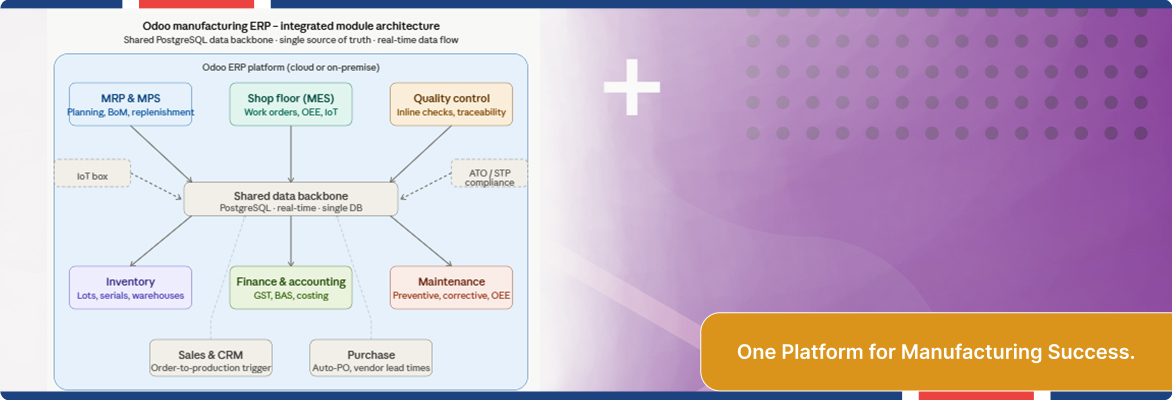
What is Odoo ERP and how does it work for manufacturing businesses in Australia?Odoo is an open-source, modular ERP platform that unifies manufacturing, inventory, purchasing, sales, and finance on a single shared database. For Australian manufacturers, this means real-time data flow across production planning, shop floor operations, and financial reporting – without integration middleware.
How does Odoo MRP handle bills of materials for complex manufacturing? Odoo MRP supports single-level and multi-level bills of materials, including variant-based BoMs for products with multiple specifications. When a manufacturing order is confirmed, Odoo automatically resolves component requirements through every level of the BoM and checks current stock availability.
How does Odoo manufacturing ERP software compare to SAP for Australian mid-market businesses? For small to mid-market Australian manufacturers, Odoo manufacturing ERP Australia offers comparable manufacturing functionality at a fraction of SAP’s total cost of ownership. SAP S/4HANA remains the stronger option for multinational enterprises with complex regulatory environments or highly specialized process manufacturing requirements.
What does Odoo ERP implementation cost for a manufacturing business in Australia? Odoo Enterprise licensing starts from approximately A$34 per user per month. Total implementation cost varies by scope, Odoo customization manufacturing, and data migration complexity – most mid-market manufacturing implementations range from A$30,000 to A$150,000 including professional services.
How long does an Odoo ERP implementation take for a manufacturing company? A focused Odoo manufacturing implementation covering Odoo MRP software, Inventory, Purchase, and Quality typically takes 10 to 20 weeks. Multi-site deployments or implementations requiring significant custom development extend that timeline.
Does Odoo support GST and BAS compliance for Australian manufacturers? Yes. Odoo’s Accounting module is configured for Australian tax compliance, including GST calculation, BAS reporting, and Single Touch Payroll integration. Australian Odoo partners deliver localised configurations that meet ATO requirements at go-live.
What is the strategic advantage of Odoo’s native MES capability versus a standalone shop floor system?Odoo’s native shop floor control eliminates the integration layer that separates most MES platforms from ERP systems. Production data – time, materials, quality results, machine events – flows directly into costing, inventory management, and reporting without translation, which removes both the data latency and the integration maintenance burden.
Ready to Replace Your Patchwork Systems?
Australian manufacturers that are still running disconnected systems are not behind because of a technology gap. They are behind because every month of delay compounds the operational cost of fragmentation.
Flexsin has delivered Odoo ERP implementations for manufacturing businesses across industrial, food processing, and distribution verticals. Our team understands the configuration decisions that separate a successful manufacturing ERP deployment from an expensive one. Explore our Odoo Development Services – built specifically for manufacturing businesses that need a partner who has solved these problems before.
Contact Flexsin Technologies to schedule a no-obligation technical scoping session for your Odoo manufacturing implementation.
Frequently Asked Questions:
1. Can Odoo ERP handle subcontracting in manufacturing?Yes. Odoo’s subcontracting feature in the Odoo MRP module allows manufacturers to outsource specific production operations to third-party suppliers while maintaining full visibility into component consumption, production progress, and quality results.
2: How does Odoo’s IoT Box integrate with manufacturing equipment? The Odoo IoT Box connects physical devices – barcode scanners, weight scales, temperature sensors, and machine controllers – to the ERP via a local network connection. Device inputs are recorded directly in production orders and Odoo quality control manufacturing checks without manual data entry.
3. What Odoo modules are most commonly used by Australian manufacturers? The core manufacturing stack in Odoo manufacturing ERP Australia covers Manufacturing (MRP), Inventory, Purchase, Sales, and Accounting. Quality, Maintenance, and Product Lifecycle Management (PLM) are commonly added as operations mature. Payroll and HR modules handle workforce compliance requirements specific to Australian employment law.
4. Is Odoo suitable for food manufacturing businesses in Australia? Yes. Odoo supports lot-based traceability, expiry date management, and quality control workflows that align with food safety requirements. By-product and co-product handling covers the specific production economics of food processing operations.
5. What is Overall Equipment Effectiveness (OEE) and does Odoo track it? OEE measures the percentage of planned production time that is truly productive, accounting for availability, performance, and quality losses. Odoo tracks OEE automatically at the work center level using data captured through the shop floor management interface, enabling maintenance and operations teams to identify and address efficiency losses systematically.
6. How does Odoo handle multi-site manufacturing operations in Australia? Odoo’s multi-warehouse and multi-company features support manufacturing businesses operating across multiple sites or legal entities. Inventory management manufacturing can be tracked and transferred between locations, manufacturing orders can be assigned to specific sites, and inter-company transactions are handled within the same Odoo instance.
7. What is the difference between Odoo Community and Odoo Enterprise for manufacturing? Odoo Community is the open-source version; it includes core manufacturing (MRP) capability but lacks advanced features. Odoo Enterprise adds the full Odoo quality control module, the shop floor app, the maintenance module, MPS, PLM, and official support from Odoo S.A. – all of which are operationally significant for manufacturing deployments.
