

 +1.844.3539.746
 info@flexsin.com
Rethinking the Logistics Operating Model: AI, Control Towers, and Connected Supply Chains
 Munesh Singh
Table of Contents:
- The Operational Limits of Legacy Logistics Models
- The Control Tower: The Core of Connected Logistics Operations
- System Integration as the Foundation of Connected Logistics
- Warehouse Automation Meets Customer Experience
- Governance That Drives Operational Excellence
- Frequently Asked Questions
- Build a Connected Logistics Operating Model With Flexsin
- People Also Ask
Let's talk
A truck goes dark on I-80, and the customer finds out before the carrier does. That single lag – tracking, not trucking – is what separates a logistics operating model built to scale from one that just survives. The global third-party logistics market is currently valued at $1.2 trillion and is projected to reach $1.5 trillion by 2031, according to Mordor Intelligence. Growth like that should be good news for every provider in the game. Instead, it is exposing which ones actually run on data and which ones run on guesswork.
What’s more. around 69% of companies report they still lack complete, real-time supply chain visibility, per Talan’s research. That is not a minor operational footnote – it is the reason exception management fails and customer trust erodes one missed ETA at a time. Layer on a global shortage of 3.6 million truck drivers, reported by the IRU, and capacity becomes as unpredictable as the freight itself.
Cost pressure compounds the problem. Last-mile delivery alone can consume 53% of total shipping cost, according to MIT Sloan Management Review. Freight already accounts for more than 7% of global emissions, per McKinsey, which means sustainability is no longer a marketing slide – it is a compliance line item.
Meanwhile, Gartner’s analysis of more than 35 million job postings found demand for supply chain roles requiring AI skills has jumped 387% since early 2023, a signal that the industry already knows where this is headed. It just has not caught up operationally.
The Operational Limits of Legacy Logistics Models
Legacy LSP operations run on fragmented systems: one platform for warehousing, another for transportation, a third for customer service, none of them talking to each other. Orders get re-keyed by hand. Exceptions get discovered by phone call, hours after they happen. Every handoff between departments is a place where information quietly dies. As a result, planners spend their mornings reconciling yesterday’s data instead of managing today’s network.
A modern 3PL by logistics & transportation solutions company reverses that sequence entirely. It centralizes shipment, inventory, carrier, and order data into one coordinated ecosystem, then layers analytics and automation on top so decisions happen at the speed the network actually moves. Nearly 46% of 3PLs already use AI tools for real-time decision-making, per ClickPost’s 2026 logistics research.
Agentic AI adds a further shift. Traditional systems flag a problem and wait for a human to approve the fix. Agentic tools work inside predefined guardrails to detect the disruption, decide on a corrective action, and execute it – then report what happened. A delayed shipment gets rerouted before a planner even opens their dashboard. That is the difference between monitoring a network and running one.
The Control Tower: The Core of Connected Logistics Operations
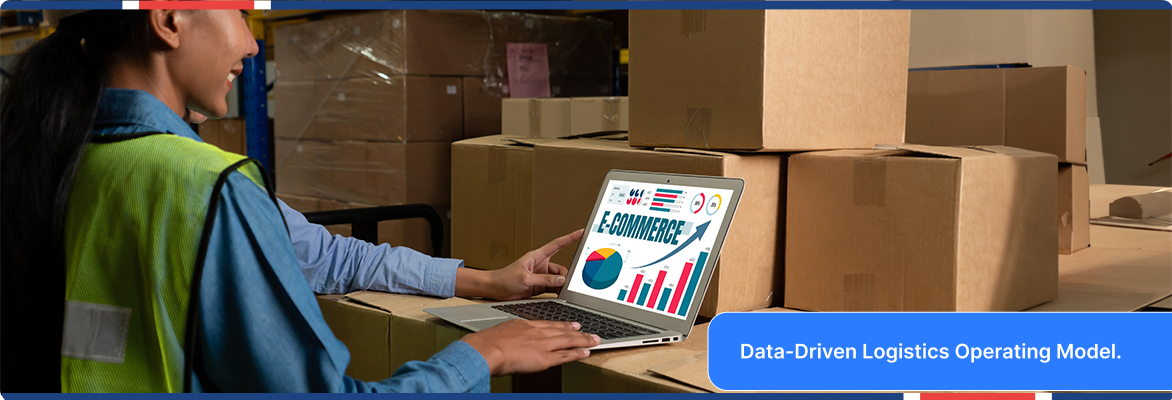
A digital control tower aggregates carrier, warehouse, transport, and order data into a single orchestration layer, giving planners live dashboards instead of end-of-day reports. Adoption is accelerating: control tower usage among logistics IT investments grew six points to 37% over the past year, according to Inbound Logistics’ 2026 market research.
Infosys Consulting’s work with a global brewer illustrates the payoff – the control tower implementation strengthened planning efficiency and improved on-time in-full performance while cutting excess inventory buffer.
System Integration as the Foundation of Connected Logistics
None of this works if the transportation management system, warehouse management system, and order management system still live in separate silos. Connecting them through APIs lets order, inventory, dispatch, and proof-of-delivery data move in real time instead of overnight batches. Infosys Consulting’s TMS implementation for a global supply chain organization improved the speed and transparency of inbound, inter-facility, and outbound flows.
Roughly 42% of 3PLs have already integrated predictive tools into inventory workflows, generating 15% to 20% better inventory turns for their customers, per ClickPost. That is a direct, measurable return – not a vague promise of digital transformation.
Warehouse Automation Meets Customer Experience
Robotics and automated storage systems now handle put-away, picking, and replenishment at a scale manual teams cannot match. Barcode and RFID scanning tighten inventory accuracy, while AI-driven slotting adjusts to real-time demand instead of last quarter’s forecast.
On the customer side, self-service portals and milestone alerts reduce inbound service calls, because customers can already see where their shipment sits. Chatbots and messaging channels absorb routine status questions, freeing service teams for the exceptions that actually need a human.
Reverse logistics benefits from the same visibility. A returned item gets scanned, inspected, and classified for resale, repair, or recycling the moment it arrives, instead of sitting in a queue until someone gets to it.
Sustainability is folding into the same architecture rather than sitting beside it. Route optimization and better load planning cut empty miles and fuel burn. One parcel operator handling 15 million pickups and deliveries annually used dynamic routing to resolve traffic congestion and staffing constraints in real time, pushing on-time pickups to near 100%.
Governance That Drives Operational Excellence
None of this compounds without a KPI framework spanning order, inventory, transportation, and quality – order cycle time, OTIF, damage rate, fuel efficiency, and carbon footprint among them. A performance governance layer with standardized reviews and escalation paths is what turns a dashboard from a screen nobody checks into the mechanism that catches problems before they hit a customer’s inbox.
Executives are backing this shift in logistics operating model with budget. 85% plan to increase AI spending this year, and one in five expects that increase to top 20%, per research covered by Supply Chain Brain. The providers pulling ahead are not the ones with the flashiest AI pilot. They are the ones who rebuilt the logistics operating model as one connected system.
Frequently Asked Questions:
How do you build a logistics control tower? Building a control tower starts with centralizing carrier, warehouse, and order data before adding real-time dashboards and alerts.
What is the difference between a TMS and a control tower? A transportation management system runs execution, while a control tower orchestrates visibility and decisions across the entire network.
How much does supply chain visibility software cost? Supply chain visibility software ranges from a few hundred dollars monthly for small fleets to six figures annually for enterprise deployments.
How long does a warehouse automation rollout take? Warehouse automation rollouts typically take six to twelve months, depending on the scale of robotics and system integration involved.
Why is agentic AI important for logistics operations? Agentic AI lets logistics systems detect disruptions and execute corrective action without waiting on manual approval.
Build a Connected Logistics Operating Model With Flexsin
Flexsin helps logistics service providers rebuild fragmented operations into a single, connected supply chain system, from control tower design to TMS and WMS integration. Explore Flexsin’s Supply Chain Management solutions and start replacing guesswork with a connected operating model today.
People Also Ask:
1. What is a logistics operating model? A logistics operating model is the connected set of processes, data, and technology that runs warehousing, transportation, and customer service as one coordinated system.
2. How long does it take to implement a control tower for a 3PL? Most 3PLs get a control tower live within four to six months when carrier and warehouse data are already digitized.
3. What does a digital logistics operating model cost to implement? Costs vary widely, but mid-market 3PLs typically budget six to seven figures depending on the scope of system integration.
4. How is a modern logistics operating model different from a legacy TMS setup? Unlike a standalone TMS, a modern operating model connects TMS, WMS, and order data into one real-time orchestration layer.
5. What technology stack powers a digital-first logistics operating model? A modern stack combines a TMS, WMS, control tower, IoT and GPS sensors, and an analytics platform feeding predictive dashboards.
