

 +1.844.3539.746
 info@flexsin.com
Data Quality Management Isn’t About Clean Data- It’s About Trusted Data
 Munesh Singh
Table of Contents:
- The Over-Cleaning Problem: When Scrubbing Erases the Signal
- Why Teams Keep Cleaning Past the Point of Value
- The Real Cost of Chasing Perfect Data
- How This Plays Out Inside a Typical Enterprise
- What "Clean Enough" Actually Looks Like
- Building a Data Quality Management Discipline That Knows When to Stop
- Frequently Asked Questions
- Building Data Quality That Protects Signal, Not Just Tidiness
- People Also Ask
Let's talk
Somewhere in your organization, an analyst just deleted a data point that would have caught your next customer churn spike before it happened. Nobody flagged it as a mistake. It looked like noise, so a cleaning script quietly removed it – the same way it removes ten thousand other rows every week. That is the trap. Data cleaning has become such a reflexive habit that teams strip out the very irregularities that make data quality management worth doing in the first place.
Enterprise teams treat cleaning as a hygiene ritual: run the script, dedupe the records, standardize the formats, move on. The instinct is not wrong. Dirty data breaks dashboards and misleads executives. This matters because the instinct becomes a default, and defaults do not know when to stop.
Over-cleaned data looks pristine and behaves like a liar. A dataset can pass every completeness check, every format validation, and every deduplication pass, and still be worse for decision-making than the messy version it replaced.
The Over-Cleaning Problem: When Scrubbing Erases the Signal
Aggressive data cleansing does not just remove errors. It removes texture. Down-sampling, averaging, and outlier suppression – the standard toolkit for a tidy dataset – can flatten the exact spikes and irregularities that reveal equipment failure, fraud, or a shift in customer behavior. Analytics platform Seeq has documented cases where hourly averages hid pressure swings that only showed up in raw, unaggregated readings.
Why Teams Keep Cleaning Past the Point of Value
The oft-repeated claim that data scientists spend 80 percent of their time cleaning data has circulated for a decade, traced back to a small CrowdFlower survey from 2016. More recent research from Anaconda’s State of Data Science survey puts data preparation closer to 45 percent of a data scientist’s week, with cleaning and organizing alone accounting for roughly a quarter of it.
That matters for data teams across every function because the incentive structure rewards visible cleaning activity over judgment. Analysts get evaluated on how tidy their datasets look for GenAI data readiness, not on whether the cleaning preserved what the business actually needed.
The Real Cost of Chasing Perfect Data
Poor data quality and dirty data problems carry a real price tag. Gartner research puts the average annual cost of poor data quality at $12.9 million per organization. MIT Sloan Management Review research from Thomas Redman estimates that poor data quality drains 15 to 25 percent of revenue at a typical company.
The cost is not caused by insufficient scrubbing. It is caused by data nobody trusts, data nobody can trace, and data that was cleaned inconsistently across departments so that finance, marketing, and operations all report a different version of the truth. Without a shared data governance strategy or a master data management layer to arbitrate which version is authoritative, every department ends up defending its own cleaned copy.
How This Plays Out Inside a Typical Enterprise
Picture a mid-market manufacturer feeding sensor data into a predictive maintenance model. The data engineering team, under pressure to deliver a tidy feed, smooths out short-duration spikes as sensor noise. Six weeks later, a compressor fails without warning, because the spikes the team smoothed away were the earliest sign of bearing wear.
The same pattern shows up in customer data when it comes to data quality vs data quantity. A marketing team standardizes every address field, strips out anything that fails a rigid data validation process, and merges records that look similar enough to be duplicates. Real customers with unusual but valid addresses vanish from the mailing list. Two distinct customers with common names get merged into one distorted profile. The dashboard featuring data quality tools reports a clean, shrinking customer base.
What “Clean Enough” Actually Looks Like
Clean enough is a business decision, not a technical one for enterprise data strategy. A churn model needs different data hygiene than a regulatory compliance report. The reason is that each use case carries a different tolerance for noise and a different cost for missing a real signal. Set the threshold by asking what decision the data supports and how expensive a false confidence would be if that decision goes wrong.
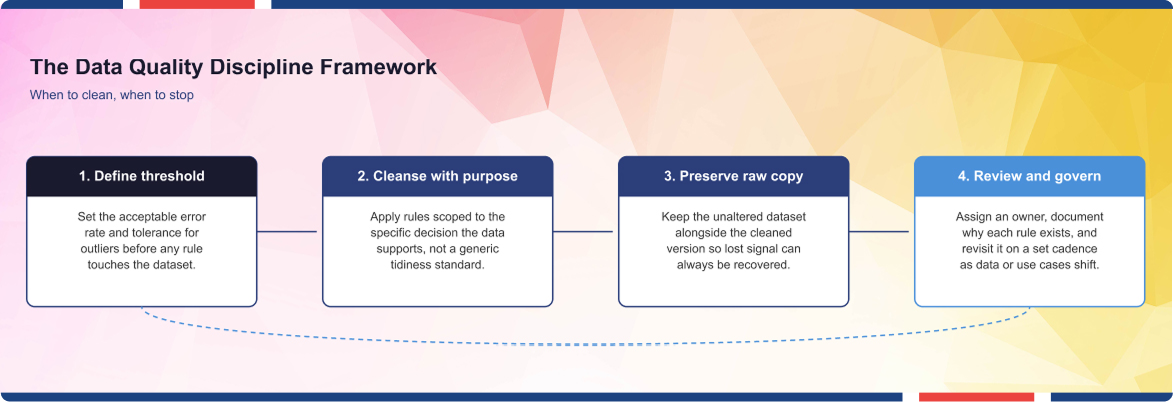
Three checkpoints keep cleaning proportional to purpose. First, define the acceptable error rate for each dataset before anyone touches it, so cleaning has a stopping point instead of running until someone gets tired. Second, preserve a raw, unaltered copy of every dataset alongside the cleaned version, because reconstructing lost signal after the fact is far harder than storing the original. Third, route cleaning rules through the business owner who understands what the data represents, not just the analyst running the script.
Building a Data Quality Management Discipline That Knows When to Stop
The organizations getting this right are not cleaning less. They are cleaning with intent. They document why a rule exists, what it is protecting against, and who approved the threshold. That documentation for data cleaning best practices New turns data quality management from an endless janitorial task into a governed process with a defined finish line.
This shift also changes what “AI-ready data” means. A dataset scrubbed into featureless uniformity trains a model that performs beautifully in testing and fails the first time it meets a real anomaly, because the anomalies were the training signal it needed and never saw. Data that carries its natural variation, paired with clear data lineage and documented quality rules, gives a model something honest to learn from.
Frequently Asked Questions:
What is data quality management? Data quality management is the ongoing discipline of keeping enterprise data accurate, consistent, and fit for the decisions it supports.
How is over-cleaning different from standard data cleansing? Over-cleaning strips out real variation and signal in pursuit of tidiness, while a disciplined data cleansing process corrects genuine errors without erasing meaningful data.
How much does poor data quality cost businesses?Gartner estimates poor data quality costs organizations an average of $12.9 million annually.
How long does it take to build a data governance framework? Most enterprises can stand up a working enterprise data governance framework for a priority dataset within eight to twelve weeks.
What is the first step to fixing an over-cleaning problem? The first step for data quality automation is defining an acceptable error threshold for each dataset before any cleaning rule runs against it.
Building Data Quality That Protects Signal, Not Just Tidiness
Flexsin’s Data & AI advisory team helps enterprises build data quality governance stategy that knows the difference between noise and real signal, so cleaning protects the data that drives decisions instead of just looking tidy on a dashboard. Explore Flexsin’s Data & Analytics Automation services to build a data quality framework engineered for AI-ready data outcomes. Get in touch with Flexsin today and put a governance layer around your data before the next cleaning script erases something you needed.
People Also Ask:
1. What causes poor data quality in enterprises? Poor data quality usually stems from siloed systems, inconsistent manual entry, and cleaning rules applied without a defined business purpose.
2. Is more data cleaning always better? No – aggressive cleaning can remove the anomalies and outliers that carry real business signal, so more is not automatically better.
3. What is the difference between data cleaning and data quality management? Data cleaning is a single corrective task, while data quality management is the continuous governance process that decides what cleaning should and should not do.
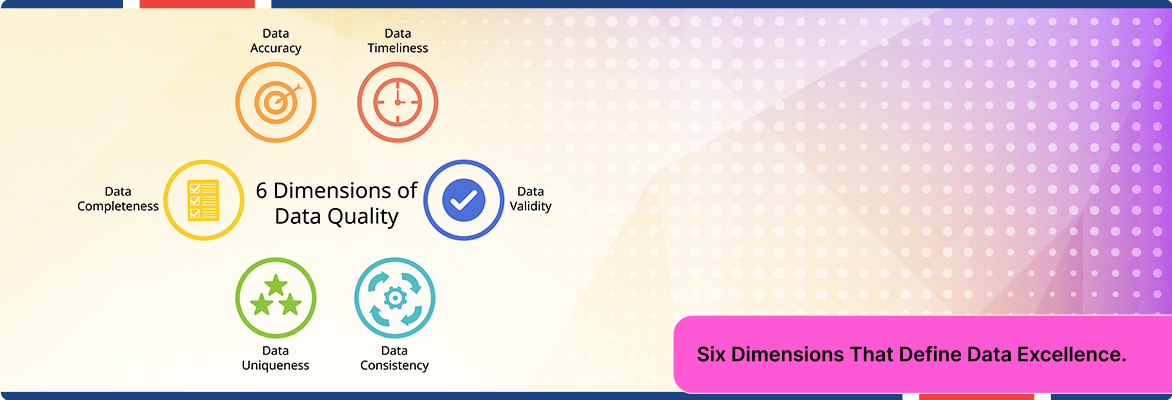
4. How do you measure data quality in an organization? Organizations measure data quality using dimensions such as accuracy, completeness, consistency, and timeliness tracked against defined data quality metrics.
5. Why is AI-ready data different from conventionally clean data? AI-ready data preserves natural variation and documented lineage, while conventionally clean data can be smoothed until a model never learns from real anomalies.
