

 +1.844.3539.746
 info@flexsin.com
Before You Configure Dynamics 365 Success By Design, Build the Governance Framework
 Sudhir K Srivastava
Let's talk
Table of Contents:
- What Success by Design Is – and Why It Matters
- The Five Success by Design Phases
- The Review System That Makes Success by Design Work
- Success Measures: Tracking Project Health Objectively
- How Flexsin Applies Success by Design
- People Also Ask
- Work with a Microsoft Partner Who Knows the Framework
Most Dynamics 365 projects don’t fail because the software doesn’t work – they fail because the organization never had a structured way to find out it was failing until the go-live date was two weeks away.
That gap between intent and outcome is precisely what the Dynamics 365 Success by Design framework was built to close. Developed by Microsoft’s FastTrack engineering team from thousands of enterprise deployments, it offers project teams a structured model for catching risk early, aligning the solution to the product roadmap, and making governance decisions before they become crises.
The numbers behind Dynamics 365 failures aren’t flattering. According to Info-Tech Research Group, over half of ERP projects run over budget, and two-thirds realize less than half of their anticipated benefits. Gartner puts the broader ERP failure rate – projects that technically go live but miss stated business objectives - at between 55% and 75%. The platform is rarely the problem.
What Success by Design Is – and Why It Matters
Success by Design is Microsoft’s prescriptive guidance system for Microsoft Dynamics 365 implementations. It is not a checklist or a project management template. It is a structured practice – built on pattern recognition from real-world projects – that gives implementation teams a reliable way to identify risks before they compound.
The framework emerged from a specific need: Microsoft realized that shipping a capable platform wasn’t enough. Organizations were still struggling during deployment, not because of software limitations, but because of avoidable architecture and governance errors. Success by Design was the answer – a systematic way for partners, customers, and internal teams to surface and resolve those errors at the right stage of the project.
The Five Success by Design Phases
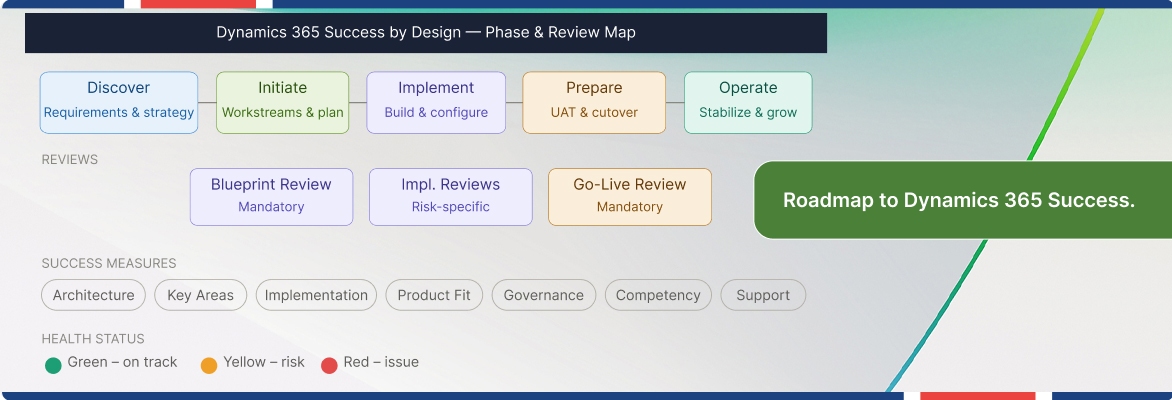
Success by Design maps the implementation lifecycle into five methodology-agnostic phases: Discover, Initiate, Implement, Prepare, and Operate. The framework doesn’t prescribe a delivery methodology - it layers on top of whichever approach the team has already chosen.
Discover: Setting the Foundation Right
The Discover phase is where teams gather and validate business requirements, finalize the high-level solution approach, and define both environment and organizational strategy. Most Microsoft solutions implementation failures trace back to decisions made – or avoided – here. Organizations that rush past discovery without validating assumptions set up every downstream phase for rework.
Initiate: Launching the Solution Blueprint Review
In the Initiate phase, the project team defines workstreams and updates the project plan. This is when the Solution Blueprint Review begins – Success by Design’s most critical exercise. The review is a structured examination of the solution design that surfaces risks before the build starts.
Implement: Drilling Into Specific Risk Areas
The Implement phase introduces targeted Implementation Reviews that emerge from the Blueprint findings. These drill into specific areas: data model design, security architecture, integration patterns, and application lifecycle management. The goal is to address risks before the solution build has gone too far to redirect. This phase is where most projects that skip structured reviews begin to show the early signs of technical debt.
Prepare: The Go-Live Readiness Review
By the Prepare phase, the solution has been built and tested. The Go-Live Readiness Review is the final structured checkpoint – assessing whether cutover plans are solid, UAT is complete, the support model is in place, and the deployment runbook has defined owners, tasks, and durations.
Operate: Stabilization and Continuous Value
The Operate phase begins at go-live. The immediate objective is stabilization – ensuring the live system performs as designed under real transaction volumes. From there, focus shifts toward planned enhancements and the next phase of capability rollout. Success by Design’s structured approach to the earlier phases makes this transition significantly smoother.

The Review System That Makes Success by Design Work
The framework’s intellectual core is its review system. Each review raises structured questions that project teams use to assess risk, confirm alignment to best practices, and generate findings – categorized as assertions (what’s working well), risks (things that could go wrong), and issues (things already going wrong).
Findings are matched against known patterns from thousands of prior implementations. That pattern-matching is what turns observations into actionable recommendations. A risk around performance testing, for example, doesn’t just get flagged – it gets mapped to a known failure pattern and resolved with a specific recommendation before the test cycle closes.
Success Measures: Tracking Project Health Objectively
One of the most underutilized elements of Success by Design is its success measure tracking system. After each review, a FastTrack solution architect or partner architect updates project health across seven categories and over 30 individual success measures – each rated red, yellow, or green.
This tracking creates something most ERP implementation projects never have: an objective, real-time view of project health that isn’t filtered through the project manager’s status report. At scale, the same tracking across ten, twenty, or a hundred projects reveals systemic patterns – whether an ALM problem is project-specific or endemic to a partner’s delivery model, for instance. That macro-level visibility is where the framework’s value compounds.
Why Success by Design Is Critical for Dynamics 365 Success
A Forrester Consulting Total Economic Impact study commissioned by Microsoft found that organizations deploying Dynamics 365 correctly achieved a 106% return on investment over three years, with a 17-month payback period (source: Forrester Consulting TEI Study, https://tei.forrester.com/go/Microsoft/Dynamics365ERP/). Finance teams saved an average of 14.5 hours per week. Reporting preparation time fell by 39%.
The methodology gap is what separates those outcomes from the 60% that don’t see expected ROI. Success by Design directly addresses that gap – not by replacing a partner’s delivery capabilities, but by adding a product-aligned governance layer that catches the specific types of risks that consistently derail Dynamics 365 projects: under-scoped performance testing, poorly defined integration requirements, inadequate change management frameworks, and go-live readiness gaps.
How Flexsin Applies Success by Design
At Flexsin Technologies, our Dynamics 365 practice is built around the principles of structured, phase-gated implementation governance. We integrate the Success by Design framework into every enterprise engagement – using Blueprint Reviews to establish solution architecture alignment early, Implementation Reviews to address integration and data risks during the build, and Go-Live Readiness Reviews to validate that every system, process, and team is prepared before cutover.
This isn’t a checkbox exercise. It’s a delivery discipline that consistently reduces the scope surprises, architecture rework, and post-go-live stabilization periods that characterize less structured implementations.

People Also Ask:
What is the Dynamics 365 Success by Design framework?Success by Design is Microsoft’s prescriptive implementation guidance system built from thousands of real Dynamics 365 deployments. It provides structured reviews, risk identification, and recommended practices across five phases of the implementation lifecycle.
How does Success by Design reduce implementation risk?It maps project findings to known failure patterns and generates recommendations before risks become problems. Early detection in the Discovery or Initiate phase costs significantly less to resolve than issues found after go-live.
What is the Solution Blueprint Review in Dynamics 365? The Solution Blueprint Review is Success by Design’s foundational review – a structured assessment of the solution design conducted in the Initiate phase. It surfaces architecture risks before the build begins and drives all subsequent implementation reviews.
Is Success by Design only for FastTrack-enrolled projects?No. While Success by Design originated within Microsoft’s FastTrack program, the framework is available for any Dynamics 365 implementation. Microsoft has published the full methodology on Microsoft Learn for community access.
What are ERP implementation failure rates and how does Success by Design address them? Info-Tech Research Group reports over 55% of ERP projects exceed budget, and Gartner puts the broader failure rate at 55-75%. Microsoft’s Success by Design reduces these odds by enforcing structured phase-gate reviews, risk documentation, and health tracking across the full project lifecycle.
Work with a Microsoft Partner Who Knows the Framework
Flexsin is a Microsoft Solutions Partner with deep Dynamics 365 practice experience across Finance, Supply Chain, and Business Central. If you are evaluating a new implementation, rescuing a troubled one, or planning the next phase of your Dynamics 365 roadmap, the Success by Design framework should be central to your delivery model – not an afterthought.
Connect with Flexsin’s Dynamics 365 team to assess your implementation approach and build a structured path to go-live.
