

 +1.844.3539.746
 info@flexsin.com
Microsoft Fabric Agentic AI: The Missing Link Between Data and Decisions
 Sudhir K Srivastava
Let's talk
Table of Contents:
- The Real Bottleneck in Agentic AI Is Not the Model
- Rayfin: Powering Trusted Agentic AI with Microsoft Fabric
- Fabric IQ: Giving Microsoft Fabric Agentic Apps a Shared Brain
- GPU-Accelerated Analytics for Faster Microsoft Fabric Agentic AI
- Azure Cosmos DB and the Multi-Agent Memory Problem
- Microsoft Fabric Agentic Apps: A New Blueprint for Enterprise AI
- Accelerate Your Microsoft Fabric Agentic AI Journey with Flexsin
- People Also Ask
Most enterprises are funding AI agents that are functionally amnesiac. Gartner projects that 40% of enterprise applications will embed task-specific AI agents by the end of this year – up from under 5% just twelve months ago – yet the majority of those agents still start every session with zero understanding of how the business actually works (Source: Gartner). They rediscover your customer taxonomy on Monday, misread your pricing logic on Thursday, and hallucinate your inventory rules every time a new workflow fires.
That is not an AI problem. That is a data architecture problem. Microsoft Build 2026 AI put that architecture problem front and center. The announcements around building agentic apps with Microsoft Fabric and Microsoft Databases were not a product showcase – they were a structural argument.
The Real Bottleneck in Agentic AI Is Not the Model
Here is the tension most AI roadmaps ignore. According to a Prefactor survey updated in March of this year, 74% of enterprises expect to use agentic AI at least moderately within two years – but only 23% are doing so today (Source: Prefactor Tech).
The gap between intention and production deployment has one root cause: agents cannot coordinate when they cannot agree on what a ‘customer,’ an ‘order,’ or a ‘revenue target’ actually means inside your organization.
Microsoft Fabric agentic AI addresses this by treating shared business context as infrastructure – not as an afterthought bolted onto model calls.
Rayfin: Powering Trusted Agentic AI with Microsoft Fabric
The prototype-to-production chasm is where most enterprise AI initiatives quietly die. Rayfin - the open-source SDK and CLI Microsoft introduced at Build – attacks that chasm directly. It lets developers and AI coding agents describe what to build in familiar GitHub-based workflows: data models, backend logic, access policies, all in code.
The implication for building agentic apps Microsoft Fabric is significant. Because Rayfin deploys to Fabric, application data lands in OneLake AI-ready data lake, and is immediately available across the full Fabric data stack – unified with analytics, real-time data, and AI engines by default. Replit CEO Amjad Masad described the result as ‘a path from idea to enterprise-grade production measured in hours, not months.’

Fabric IQ: Giving Microsoft Fabric Agentic Apps a Shared Brain
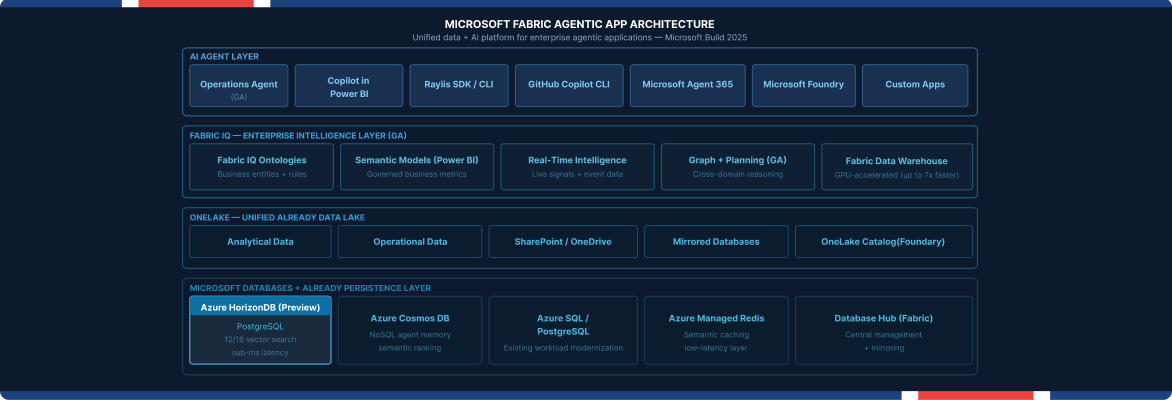
Now generally available, Fabric IQ delivers three integrated layers of business context. OneLake provides Microsoft Fabric unified data platform across analytical and operational sources. Power BI semantic models provide structured, governed representations of that data – the layer your finance and operations teams already trust for business metrics.
Operations agents, also now generally available, reason over this shared live context, make policy-based decisions, and act in the moment. That closed-loop capability - observe, reason, act, in real time, grounded in shared definitions – is what separates Microsoft Fabric agentic apps from isolated AI experiments.
GPU-Accelerated Analytics for Faster Microsoft Fabric Agentic AI
Agentic AI data context enterprise only helps agents if that context can be refreshed fast enough to stay relevant. Microsoft Fabric Data Warehouse now ships with GPU acceleration – the first fully managed data warehouse to do so, per ACM SIGMOD’s Best Industry Paper of 2026 recognition of the underlying research.
Internal benchmarking from May 2026 showed the GPU-accelerated Fabric Data Warehouse delivering up to 7x faster query performance relative to three comparable external vendors at 64-user concurrency (Source: Microsoft Azure Blog, June 2026). UNC Health reported up to 5x improvement in query speeds in real-world usage.
Azure Cosmos DB and the Multi-Agent Memory Problem
Any honest conversation about Microsoft Fabric agentic apps has to include Cosmos DB – because most Azure Cosmost DB multi-agent system architectures have a persistent memory problem, and Cosmos DB is how Microsoft solves it at scale.
OpenAI chose Azure Cosmos DB as its primary operational database specifically for automatic scaling and schema-less flexibility. At Build, Microsoft added semantic reranking in preview – improving search relevance through built-in data context AI agents enterprise understanding.
Microsoft Fabric Agentic Apps: A New Blueprint for Enterprise AI
There is a clear pattern running through every Build 2026 announcement: Microsoft is collapsing the number of specialized systems you need to run production agentic AI. Rayfin SDK Microsoft Fabric removes infrastructure management. HorizonDB removes the need for polyglot database stacks. Fabric IQ removes the per-agent context-rebuilding tax.
The businesses that will win with enterprise agentic AI platform 2026 are not the ones with the biggest model budgets. They are the ones who built a data foundation that agents can actually trust. Microsoft Fabric agentic apps, backed by this stack, give your organization that foundation – and every agent you deploy after the first one gets smarter faster because of it.
Accelerate Your Microsoft Fabric Agentic AI Journey with Flexsin
Flexsin is a Microsoft Gold Solutions Partner with deep expertise in enterprise AI architecture, Microsoft Fabric implementation, and intelligent application development. Our teams have delivered production agentic AI systems across manufacturing, healthcare, financial services, and professional services – and we know exactly where the data context gaps kill agent performance before it ever reaches end users.
Visit Flexsin’s Microsoft Fabric and AI services page at flexsin.com to start the conversation with our practice leads.

People Also Ask:
1. What is Microsoft Fabric and how does it support agentic AI applications? Microsoft Fabric is a unified data and AI platform that consolidates analytics, operational data, and real-time intelligence into a single governed layer. It supports agentic AI by providing shared business context.
2. How does Rayfin help developers build agentic apps on Microsoft Fabric?Rayfin is an open-source SDK and CLI that lets developers define data models, backend logic, and access policies in code, then deploys the entire enterprise application backend directly into Microsoft Fabric.
3. What makes Azure HorizonDB different from standard PostgreSQL databases for AI? Azure HorizonDB is a fully managed PostgreSQL-compatible database engineered specifically for AI workloads, offering native vector search, integrated AI model management, and direct Foundry connectivity alongside elastic storage up to 128 TB and sub-millisecond multi-zone commit latency.
4. What is Fabric IQ and why does it matter for multi-agent systems? Fabric IQ is Microsoft Fabric’s enterprise intelligence layer that combines OneLake data unification, Microsoft Fabric Power BI agentic analytics, and operational ontologies to give every agent a shared, governed understanding of the business.
5. How fast is the GPU-accelerated Microsoft Fabric Data Warehouse?In internal benchmarking from May 2026, the GPU-accelerated Fabric Data Warehouse delivered up to 7x faster query performance compared to three external vendors at 64-user concurrency. Real-world customer UNC Health reported up to 5x improvement in query speeds.
6. Can Azure Cosmos DB support persistent memory for AI agents?Yes – Azure Cosmos DB now includes a dedicated agent memory toolkit that helps developers standardize persistent memory for multi-agent systems using Cosmos DB, Azure Durable Functions, and Microsoft Foundry agent integration models.
