

 +1.844.3539.746
 info@flexsin.com
AI for Nonprofits: The Smarter Way to Scale Fundraising Impact, Not Costs
 Munesh Singh
Let's talk
Table of Contents:
- The Reality Nonprofits Can No Longer Ignore
- Which Means the CRM Itself Has to Change Shape
- What Successful AI for Nonprofits Implementation Looks Like
- The Stakes Are Higher Than a Software Decision
- What It All Means
- People Also Ask
- Flexsin’s Recommendation
Ninety-two percent of nonprofits now use AI. Only seven percent say it has moved their mission forward in any measurable way. That gap has a name now: the efficiency plateau, and most organizations using Agentforce 360 AI for Nonprofits, Salesforce’s flagship platform for nonprofits, are trying to climb out of it rather than fall into it.
The math behind that plateau is not complicated. A staff member drafts a thank-you email faster. A volunteer coordinator clears her inbox ten minutes sooner. Multiply small time savings across a department, and the organization still ends the quarter with the same donor retention rate, the same grant backlog, and the same burnout numbers it had in January. Sixty-five percent of nonprofits describe their AI use as individual and reactive.
This matters now because the funding environment has stopped being forgiving. Nearly three-quarters of nonprofits have seen demand for services climb since January 2025, while close to a third have already cut staff. Foundation revenue fell short of projections for the majority of organizations now running a deficit. The sector is being asked to serve more people with fewer hands and tighter budgets, and ad hoc AI experiments will not close that gap.
Agentforce 360 AI for Nonprofits, Salesforce’s rebrand and expansion of what was Nonprofit Cloud, is built around a different premise: give every fundraiser, program officer, and volunteer manager an AI agent that acts on unified data instead of one more dashboard to check. Pacific Clinics CEO Kathy McCarthy described the shift in practical terms – her staff now spend more time listening to clients because administrative work moved to an agent that works in the background.
The Reality Nonprofits Can No Longer Ignore
Here is what the staffing data actually shows. Forty-five percent of nonprofit leaders now name staffing as their organization’s single biggest challenge, ahead of fundraising itself. Layer in burnout - nearly half of CEOs say it is now a serious concern, up sharply from a year earlier – and the conclusion is unavoidable: nonprofits cannot hire their way out of this. They have to automate the parts of the job that do not require a human heartbeat, using nonprofit staff burnout solutions.
Agentforce for nonprofit organizations targets exactly that category of work. Prospect research, which used to consume hours of a fundraiser’s week cross-referencing wealth databases and giving histories, now runs as a background agent that surfaces a ranked list inside Slack before the morning stand-up.
Donor follow-up drafts that took twenty minutes per email now take seconds, freeing the fundraiser to make the actual phone call instead of staring at a blank subject line. The agent does not replace the relationship. It clears the runway to it. The same logic extends to nonprofit volunteer management platform tools, where shift confirmations and reminder calls that once ate up a coordinator’s afternoon now run on autopilot.

Which Means the CRM Itself Has to Change Shape
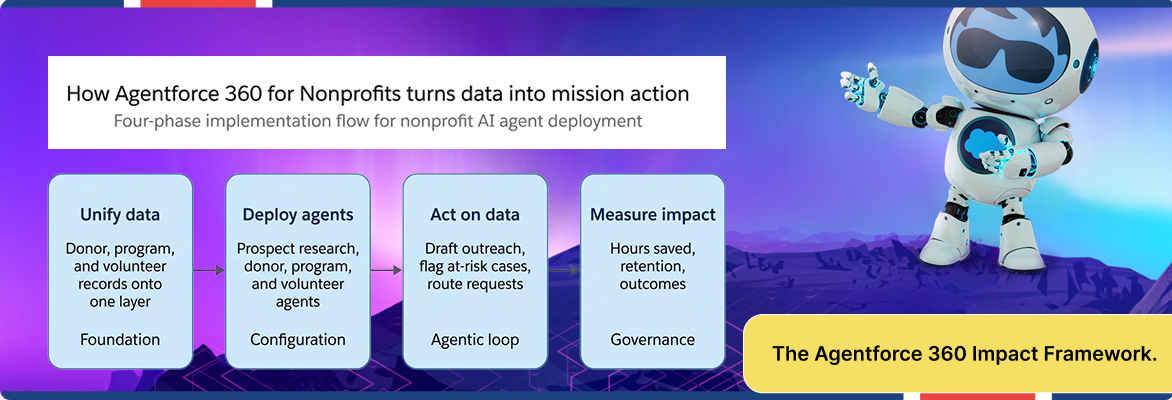
A donor database that only stores history cannot act on it. Agentforce 360 AI for Nonprofits sits on top of Salesforce’s Data 360 layer, which unifies donor records, nonprofit program management software’s outcomes, volunteer hours, and grant status into one queryable foundation – the same architecture Salesforce 360 Cloud for nonprofit uses across its broader Agentforce platform, now reportedly processing tens of trillions of records enterprise-wide.
Four purpose-built nonprofit AI agents anchor the rollout: Prospect Research for fundraisers, plus agents for program management, nonprofit volunteer coordination, and donor support. Pledge 1% is building a custom Pledge Impact Partner agent to guide more than nineteen thousand member companies through their giving commitments.
Good360 is applying the same agent logic to disaster response logistics, matching donated goods to the communities that need them fastest, which is a problem no spreadsheet ever solved in real time.
What Successful AI for Nonprofits Implementation Looks Like
A mid-sized human services nonprofit running Agentforce Nonprofit might see a volunteer coordination agent handle shift confirmations and no-show backfills automatically, a donor support agent answer routine giving questions around the clock, and a program management agent flag a participant whose attendance pattern signals risk of dropping out – all without a staffer opening three separate tools.
Cost is the other half of the adoption story, and nonprofits do not get a pass on it. Through the Power of Us program, eligible nonprofits receive ten donated Agentforce Nonprofit Enterprise Edition licenses, with discounted pricing on additional seats. For organizations watching every dollar against a deficit, that donated tier removes the single biggest barrier other AI fundraising tools for nonprofits never address: licensing cost before value is proven.
The Stakes Are Higher Than a Software Decision
Donor trust has not caught up to the technology curve, and that gap deserves a straight answer rather than a marketing one. Forty-three percent of donors say AI use would have a neutral or positive effect on their giving. Thirty-one percent say it would make them less likely to give.
The difference between those two outcomes is almost entirely about transparency – whether the agent’s role is disclosed and whether a human still owns the relationship at the moment it matters. Nonprofits adopting Agentforce 360 AI for Nonprofits without a governance policy are taking on reputational risk that no efficiency gain offsets.
Our own read, after watching enterprise AI rollouts across sectors that move slower than nonprofits typically can: the organizations that win with agentic AI are not the ones with the most sophisticated use case. They are the ones that wrote the governance policy before the first agent went live, not after a donor complained.
The second non-obvious point worth stating plainly about AI agent for nonprofit fundraising: Agentforce 360 AI for Nonprofits will not fix a nonprofit’s revenue problem if the underlying data is fragmented across three systems and a shared drive. The nonprofit data management platform amplifies whatever foundation it sits on.
A nonprofit migrating from a patchwork of spreadsheets and a legacy donor engagement software needs the data consolidation work done first, or the agent will confidently act on incomplete information – which is a worse outcome than no automation at all.
What It All Means?
The efficiency plateau is not a technology problem for nonproift grants management system. It is a sequencing problem. Nonprofits that treat Agentforce 360 AI for Nonprofits as a bolt-on chatbot will join the 79% stuck on marginal time savings.
Nonprofits that unify their data, define governance before deployment, and assign agents to the specific bottlenecks draining staff capacity – prospect research, volunteer scheduling, donor follow-up – are the ones already reporting hundreds of hours redirected back to mission work. The platform is ready. The sequencing is the differentiator.
People Also Ask:
What is Agentforce 360 AI for Nonprofits? Agentforce 360 AI for Nonprofits is Salesforce’s AI-powered nonprofit platform, formerly Nonprofit Cloud. The nonprofit donor management software unifies donor data, program outcomes, and volunteer records, then layers in AI agents for nonprofit fundraising automation and operations.
How is Agentforce 360 AI for Nonprofits different from Salesforce Nonprofit Cloud?Nonprofit Cloud provided the CRM foundation for donor and program data. Agentforce 360 AI for Nonprofits adds autonomous AI agents on top of that same unchanged foundation.
How much does Agentforce 360 AI for Nonprofits cost for a small nonprofit?Eligible nonprofits can receive ten donated Enterprise Edition licenses through Salesforce’s Power of Us program. Additional licenses and Agentforce add-ons are available at discounted nonprofit pricing.
How long does an Agentforce Nonprofit implementation typically take?Timelines depend on data readiness and the number of agents deployed. Organizations with clean, unified donor data move faster than those migrating from fragmented legacy systems.
What is the biggest risk when adopting AI agents for nonprofit fundraising?The biggest risk is deploying agents without a governance policy or disclosure standard. Donor trust drops sharply when AI involvement feels hidden rather than transparent.
Can Agentforce 360 AI for Nonprofits replace a fundraising team?No, the platform is built to handle administrative and research tasks, not donor relationships. Agents free up staff time for the conversations that actually move major gifts forward.
Flexsin’s Recommendation:
Flexsin Technologies has spent years inside Salesforce Nonprofit Cloud deployments, long before Agentforce turned that platform into an agentic system. As a Salesforce.org Premium Partner, Flexsin’s team has migrated NGOs off legacy donor databases, configured the Nonprofit Success Pack for organizations running on tight budgets, and built the governance frameworks that keep AI agents accountable to the missions they support.
Visit Flexsin Agentforce implementation partner’s Salesforce Nonprofit Cloud consulting page o see how a structured Agentforce 360 AI for Nonprofits rollout starts with the data foundation, not the chatbot. Flexsin’s nonprofit technology consulting builds the foundation that makes every AI agent decision trustworthy from day one.
