

 +1.844.3539.746
 info@flexsin.com
Your CMS Is Holding Back Growth. A DXP Moves You Forward
 Munesh Singh
Let's talk
Table of Contents:
- What Is a Digital Experience Platform?
- The DXP vs CMS Question Enterprises Ask Too Late
- Why Enterprises Need a Digital Experience Platform Now
- How to Get Started with a Digital Experience Platform
- Work with a DXP Partner Who Has Built This Before
- People Also Ask
Every channel your customer touches tells them something about your brand. Right now, most of those channels are lying to each other. Your website serves one version of the story. Your mobile app serves another. Your email nurture sequence is working off data from six months ago. That fragmentation is not a perception problem – it is a revenue problem, and it compounds with every new touchpoint you add. For enterprises undertaking digital transformation services, a DXP can provide the experience layer needed to connect customer journeys across websites, applications, portals, commerce platforms, and emerging AI interfaces.
A digital experience platform (DXP) is built specifically to solve it. The global DXP market was valued at $18.22 billion in 2025 and is projected to reach $68.92 billion by 2035, growing at a 14.23% CAGR (Global Growth Insights, 2026). That number reflects a fundamental shift: enterprises are no longer asking whether they need unified digital experience infrastructure. They are asking how fast they can get it deployed.
What Is a Digital Experience Platform?
The shortest accurate definition of what is DXP: It’s the operating system for your entire customer-facing digital estate. Gartner defines it as an integrated and cohesive piece of technology for engaging with multiple audiences across a broad array of digital touchpoints – websites, portals, mobile apps, and beyond.
What separates a digital experience platform from a CMS comes down to architecture and intent. A CMS manages content. A DXP orchestrates experiences. That is not a subtle distinction. When 84% of customers say the experience of interacting with a company is just as important as the product itself (Salesforce, State of Marketing), the system responsible for that experience cannot be limited to publishing pages.
A mature DXP integrates content management, customer data, personalization, commerce, analytics, and marketing automation under a single connected layer. Every module knows what the others know. Which means a customer who browses a product on mobile, reads a comparison guide on desktop, and calls your support line the next morning encounters a brand that has been paying attention – not one that treats each channel as a fresh introduction.
This connected architecture allows organizations to deliver digital solutions that combine content, customer data, personalization, commerce, analytics, and automation rather than managing each capability in isolation.
The DXP vs CMS Question Enterprises Ask Too Late
Most organizations arrive at the DXP conversation after the damage is done. They have stitched together a CMS, a separate analytics tool, a CRM that does not talk to either, and a marketing automation platform sitting on top of stale data. The resulting digital experience is a sequence of disconnected touchpoints, and the customer feels every seam.
The DXP vs CMS debate often gets framed as a technology upgrade. It is more accurately a business model shift – from managing content to managing relationships at scale. Brands with superior digital customer experience platform generate 5.7 times more revenue than competitors with inferior CX (Sitecore/Forrester data). The digital experience platform is the infrastructure that makes superior CX possible at enterprise velocity.
Why Enterprises Need a Digital Experience Platform Now
Three structural forces have made the digital experience platform software a strategic necessity rather than a competitive differentiator. For enterprises, a DXP becomes part of the broader enterprise solutions architecture, connecting customer-facing experiences with the data, applications, and systems that support them.
Channel Proliferation Has Outpaced CMS Architecture
Over 70% of consumers report using multiple sources – web, mobile, social, conversational AI – over the course of a single transaction. A point solution built to manage one channel cannot govern omnichannel digital experience without creating version drift, governance gaps, and maintenance overhead that compounds quarterly.
Personalization at Scale Requires Unified Data
More than 59% of enterprises now use real-time data for DXP personalization services (Global Growth Insights, 2026). You cannot deliver personalization in real time when customer data is siloed across five platforms. The DXP unifies that data layer, giving marketing and product teams a single source of behavioral truth. DXP personalization enabled at this layer produces a 5x to 8x return on marketing spend, per analysis from multiple enterprise deployments.
AI Integration Demands a Clean Data Foundation
AI agents embedded in enterprise digital experience platform software cannot function effectively without clean, structured, unified customer experience platform. A composable DXP built on API-first, MACH architecture (Microservices, API-first, Cloud-native, Headless) provides exactly that foundation – and 58% of US digital teams report measurable improvement in operational efficiency after adopting it.
How to Get Started with a Digital Experience Platform
The organizations that stall on DXP adoption are usually the ones that treat it as a platform selection exercise. The ones that move fast treat it as a digital experience capabiity strategy and leverage DXP platform benefits. There is a meaningful difference in outcome.
Step 1: Audit Your Current Digital Experience Gaps
Map every channel your customers use – website, app, portal, email, chat – and identify where data does not flow between them. These gaps are your DXP business case. Quantify the customer drop-off, support escalations, or campaign inefficiency each gap generates. That audit converts a technology conversation into a board-level investment rationale.
Step 2: Define the Experience Architecture Before Selecting the Platform
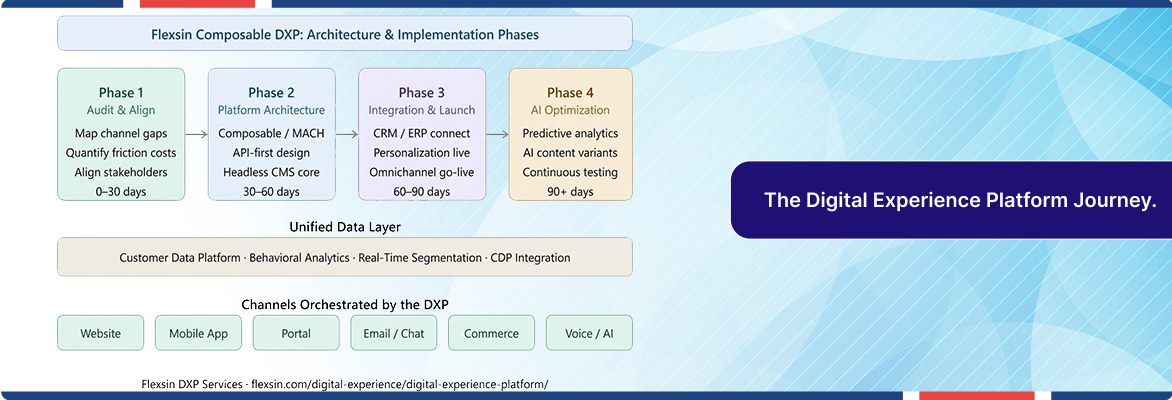
Choose a composable DXP architecture over a monolithic suite, unless your organization genuinely lacks the technical governance to manage modular components. Composable DXPs let you replace individual capabilities – swap your CDP, upgrade your headless CMS DXP layer, add a new commerce module – without re-platforming the entire stack.
Step 3: Prioritize Integration Depth Over Feature Count
The most common DXP implementation failure is selecting a platform on feature breadth and discovering integration depth is shallow. Your CRM, ERP, and existing martech investments must connect via robust APIs. A digital experience platform that cannot synchronize behavioral data with your CRM in real time is not a DXP – it is a CMS with ambition. Evaluate integration depth as your first technical criterion, not your last.
An IT consulting company can help evaluate integration requirements across CRM, ERP, martech, analytics, and customer-data systems before the organization commits to a DXP architecture.
Step 4: Adopt a Phased Rollout With Measurable Milestones
The fastest DXP implementations phase delivery by outcome: unified content management and governance in the first 30 days, personalization and customer data integration within 90 days, advanced AI-driven experience optimization in the second half of year one. Squiz’s enterprise DXP implementation data shows organizations can stand up a functional DXP in as little as 30 days with the right architectural foundation and implementation partner.
Work with a DXP Partner Who Has Built This Before
Selecting the right digital experience platform is a six-month conversation. Getting it deployed and delivering ROI in year one is an execution problem – and that is where most implementations slow down.
Flexsin’s Digital Experience Platform services give enterprises the end-to-end capability to assess, architect, and implement a DXP that connects your CRM, ERP, and content infrastructure into a single experience layer. From legacy CMS migration to composable DXP rollout and ongoing personalization optimization, Flexsin handles the full DXP implementation lifecycle.
Explore Flexsin’s DXP consulting services and schedule a capability assessment at https://www.flexsin.com/digital-experience/digital-experience-platform/. Build the digital experience architecture your customers already expect.
People Also Ask:
1. What is a digital experience platform and how does it differ from a CMS?A digital experience platform unifies content management, customer data, personalization, and analytics across all digital channels into one connected layer. A CMS manages content publishing on a single channel – a DXP orchestrates the entire DXP customer journey across every touchpoint simultaneously.
2. How does a composable DXP work?A composable DXP assembles best-of-breed components – headless CMS, CDP, personalization engine, commerce module – connected via open APIs using MACH architecture DXP. Each component can be upgraded or replaced independently without re-platforming the full stack.
3. What is the ROI of implementing an enterprise digital experience platform? Forrester’s Total Economic Impact study on Optimizely’s DXP found a 370% ROI over three years with an 8-month payback period. Personalization enabled at the DXP layer delivers a 5x to 8x return on marketing spend in enterprise deployments.
4. How long does a DXP implementation typically take?A phased DXP implementation can achieve a functional go-live in 30 days with the right partner and architectural readiness. Full personalization and data integration typically completes within 90 days; AI-driven optimization layers are deployed in the second half of year one.
5. Which industries benefit most from a digital experience platform?Retail accounts for over 30% of DXP usage, but BFSI (banking, financial services, insurance) is the fastest-growing segment at 15.1% CAGR. Healthcare, telecom, and public sector organizations are also accelerating DXP adoption due to personalization, compliance, and omnichannel engagement demands.
6. What is the current size of the digital experience platform market?The global digital experience platform market was valued at $18.22 billion in 2025. It is projected to reach $68.92 billion by 2035, growing at a 14.23% CAGR. The US market alone sees over 70% of large enterprises deploying DXPs for omnichannel experience delivery.
