

 +1.844.3539.746
 info@flexsin.com
Customer Trust in AI Is Becoming More Valuable Than AI Itself
 Munesh Singh
Let's talk
Table of Contents:
- The Missing Link in Customer Trust in AI
- Why AI Implementation Alone Doesn’t Create Customer Trust in AI
- Inside the Architecture of Trustworthy AI Systems
- Responsible AI Adoption: The Four Capabilities Defining Market Leaders
- What We See When Enterprise AI Trust Actually Gets Built
- What AI Trust Architecture Cannot Fix
- People Also Ask
- Build AI Your Customers Will Actually Trust
- Frequently Asked Questions
Your customers are not afraid of artificial intelligence. They are afraid of what you will do with it when they are not watching. That is the real trust problem in enterprise AI – and most organizations are solving the wrong version of it. They are investing in model performance, deployment speed, and feature parity. They are not investing in the thing their customers actually need: visible, verifiable customer trust in AI.
The numbers are unambiguous. According to the Auth0 Customer Identity Trends Report, 44% of consumers who refuse to use AI agents cite one specific reason: they do not trust AI agents with their personal data. That is not a product problem. That is a relationship problem. And relationship problems do not get fixed by shipping a better model.
Trust has always been the invisible infrastructure of every durable business relationship. What has changed is that AI makes trust gaps visible, instantly and at scale. One opaque automated decision, one unexplained data use, one interaction that feels surveilled rather than served – and your customer is gone.
The Missing Link in Customer Trust in AI
Most executives misread the trust problem. They assume customers are skeptical of AI because they do not understand it. The real issue is asymmetry: customers know exactly what AI is capable of, and they have no idea what your specific deployment is actually doing with their data.
Relyance AI’s 2025 Consumer Trust Survey surveyed over 1,000 U.S. consumers and found that 84% would react to opacity in AI data handling with either abandonment or significant restriction of data sharing. That is not fear of technology. That is a rational response to information asymmetry – the same reason consumers read drug labels and financial disclosures.
The asymmetry operates on three axes. First, customers cannot see how their data flows through your AI systems. Second, they cannot audit the decisions those systems make on their behalf. Third, they have no reliable signal for whether your AI is operating within ethical boundaries – because your organization has probably not published one.
Why AI Implementation Alone Doesn’t Create Customer Trust in AI
The conventional playbook for responsible AI looks roughly like this: publish a privacy policy, add a cookie banner, appoint a data protection officer, and deploy an AI model that has been tested for bias. Every one of those steps is necessary. None of them is sufficient.
The problem is architectural. Standard enterprise AI deployments treat trust as a layer added on top of a system that was designed without it. The result is what practitioners call trust theater - visible signals that satisfy a compliance audit but do not actually change the information asymmetry that drives customer behavior.
Three specific failure modes are worth naming.
Failure Mode 1: Privacy Policies That No One Reads
A privacy policy is not a trust mechanism. It is a legal document written to protect your organization. 46% of consumers feel they cannot effectively protect their personal information even when policies exist (SQ Magazine, 2026). The policy exists. The trust does not. The reason is that policies describe what is permitted, not what is actually happening. Customers need the second thing.
Failure Mode 2: AI Ethics Committees Without Operational Teeth
Many enterprises have standing AI ethics committees. Most of them meet quarterly, review high-level principles, and have no direct authority over model deployment timelines. McKinsey reports that over 40% of business leaders identify lack of AI explainability as a key risk – yet only 17% are actively addressing it (McKinsey, cited in Parallel HQ, 2026).
Failure Mode 3: Human Oversight as a Formality
Human in the loop AI sounds like a meaningful safeguard. In practice, it often means a human rubber-stamping a model recommendation under time pressure with no meaningful ability to interrogate the decision logic. Thales’ 2026 Digital Trust Index found that when AI acts autonomously - making decisions or interacting with systems on a user’s behalf, people begin asking harder questions about security, control, and accountability.
Inside the Architecture of Trustworthy AI Systems
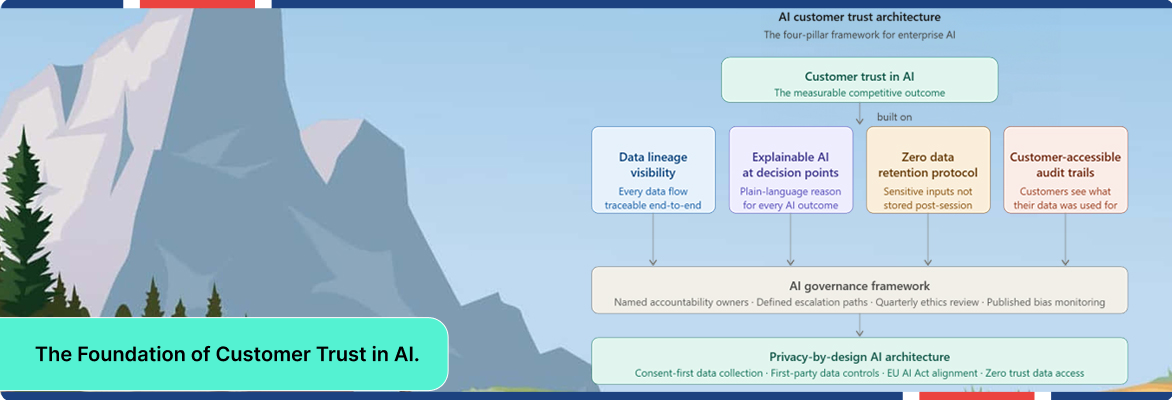
Building customer trust in AI is not a communications challenge. It is an engineering challenge with a communications layer on top. The organizations closing the AI trust gap are deploying four specific architectural capabilities – not as afterthoughts, but as foundational requirements.
1. Data Lineage Visibility
Every customer interaction that feeds an AI model should be traceable from the moment of collection through to its use in model training or inference. This is not aspirational – it is what enterprise AI data privacy now requires. B2B buyers are already incorporating AI transparency documentation into vendor evaluations. Companies that can produce a clean data lineage map on demand.
2. Explainable AI at the Point of Decision
Explainable AI customer experience means something specific: when an AI system makes a decision that affects a customer – a loan approval, a service tier change, a pricing recommendation – the customer receives a plain-language explanation of why. Not a disclaimer. A reason. Research across behavioral economics consistently shows that people are more likely to accept negative outcomes when the process feels fair.
3. Zero Data Retention Protocols for Sensitive Inputs
Enterprise AI deployments handling sensitive customer data should operate on zero-data retention AI protocols for the most sensitive inputs – meaning the data used to generate an AI response is not stored after the interaction concludes, and is never used to train the public model. This is already a table-stakes expectation in financial services and healthcare.
4. Customer-Facing AI Audit Trails
Forward-thinking enterprises are deploying customer-accessible audit logs – structured records that allow customers to see, in plain language, what their data was used for over a specified time window. 66% of consumers say they trust companies with easy-to-manage privacy settings, but only 8% find such settings easy to use (Thales Digital Trust Index, 2026).
Responsible AI Adoption: The Four Capabilities Defining Market Leaders
The distance between “we take AI ethics in business seriously” and a measurable customer trust advantage is exactly four capabilities. Most organizations have partial implementations of some of them. Very few have all four operating as integrated, customer-facing systems.
Capability 1: AI Governance Framework With Named Accountability
An AI governance framework B2B buyers respect is not a document. It is a named organizational structure with specific accountability owners, defined escalation paths, and published review cadences. The EU AI Act requires explainability mechanisms and human oversight with clear accountability structures for high-risk AI applications (Vendict, 2025).
Capability 2: Consent Management That Earns Rather Than Extracts
AI consent management customers actually trust is opt-in by default for sensitive data categories, with real-time visibility into what consented data is currently being used for. 92% of customers value companies that give them control over what information is collected (Salesforce State of the Connected Consumer). Yet most enterprise AI consent flows are designed to minimize opt-out rates, not maximize informed consent.
Capability 3: Bias Monitoring With Customer-Visible Outcomes
AI bias and fairness in customer outcomes requires active monitoring – not just model testing at deployment. Production models drift. Customer demographics shift. An AI system that was fair at launch can develop systematic disparities within 18 months if no one is measuring outcomes by customer segment. The organizations leading on this publish bias monitoring results publicly, in plain language.
Capability 4: Human Escalation Paths That Are Actually Accessible
Human in the loop AI is only meaningful if the human escalation path is accessible without friction. When a customer disagrees with an AI decision, how many steps does it take to reach a human with the authority to review and override? If the answer is more than two, the human oversight is structural theater.
What We See When Enterprise AI Trust Actually Gets Built
Across enterprise AI implementation trust engagements, a consistent pattern emerges. The clients who treat responsible AI adoption as a technical requirement – something that gets designed into the architecture, not bolted on at the end – are the ones whose AI deployments generate compounding competitive advantage. The clients who treat it as a legal and communications problem are the ones who call us 18 months later when a trust incident has disrupted a key customer relationship.
The difference is not philosophical. It is structural. Trustworthy AI deployments share four observable characteristics: they have named data lineage owners, they have explainability logic that is readable by customer-facing teams (not just data scientists), they have consent flows that were tested with actual customers before launch, and they have documented escalation paths that are reviewed quarterly.
The organizations that get this right also share a cultural signal: they measure customer trust in AI as a leading indicator, not a lagging one. They track things like escalation rates, data consent opt-in rates, and customer-visible audit log access – before any incident forces them to. That proactive posture is, in my assessment, the single greatest predictor of durable enterprise AI success.
The companies that argue trust infrastructure slows down AI deployment have it backwards. A well-designed trust architecture accelerates deployment by eliminating the late-stage rework, regulatory friction, and customer acquisition friction that poorly governed AI creates.
What AI Trust Architecture Cannot Fix
Responsible AI implementation is not a solution to every trust problem. Four constraints deserve honest acknowledgment.
Structural Limits of Explainability
Some of the most capable AI models are also the least explainable. Deep neural networks and large language models can produce highly accurate outputs through reasoning paths that are genuinely opaque – even to the engineers who built them.
Explainable AI (XAI) methods such as LIME and SHAP provide local explanations for individual predictions, but complex models remain difficult to interpret globally (Frontiers journal, cited in Parallel HQ, 2026).
Regulatory Patchwork
AI data privacy enterprise compliance operates across a fragmented regulatory landscape. A multinational AI deployment that is compliant in one jurisdiction may require significant modification in another. Trust architecture must be designed for the most stringent applicable standard – which adds cost and complexity that not every organization has budgeted for.
Internal Culture Barriers
Technical trust architecture is only as effective as the organizational culture that operates it. Privacy risks related to generative AI grew from 22% to 34% in a single year (SQ Magazine, 2026). Most of that risk is not malicious – it is the product of well-intentioned employees using AI tools in ways that were never sanctioned, because the governance conversation did not happen before the tools were deployed.
The Personalization-Privacy Tension
AI personalization vs privacy is a genuine tradeoff, not a false dilemma. The same customer data that enables meaningful personalization creates privacy exposure. There is no architectural resolution that eliminates the tension. There is only a design philosophy that acknowledges it openly, gives customers real control, and makes the tradeoff visible.
People Also Ask:
What does customer trust in AI actually mean for a B2B business?Customer trust in AI means your customers believe your AI systems use their data fairly, explain their decisions clearly, and give customers real control over their information. For B2B buyers, it also means your AI governance framework meets procurement security requirements.
How is building trust with AI different from traditional data privacy? Building trust with AI goes further than compliance – it requires real-time transparency into how AI decisions are made and what customer data is being used at the point of inference. Traditional privacy frameworks address data collection; AI trust frameworks address data use inside active models.
What is human in the loop AI and why does it matter for customer trust?Human in the loop AI means a human reviewer can inspect, challenge, or override AI-generated decisions before they affect customers. It matters because 70% of users still prefer human interaction for sensitive decisions (Auth0, 2025); accessible override paths are the proof that preference is respected.
How long does it take to implement an AI governance framework for enterprise? A baseline AI governance framework B2B deployment typically requires three to six months to design, test, and operationalize. Full integration with production AI systems and customer-facing audit capabilities adds another two to four months depending on system complexity.
Does responsible AI adoption cost more than standard AI deployment? Responsible AI adoption carries a higher upfront investment in governance design, explainability logic, and AI consent management infrastructure. That cost is consistently lower than the cost of incident response, regulatory penalties, and customer acquisition friction that poorly governed AI generates.
What is zero data retention in enterprise AI? Zero data retention means customer data used to generate an AI response is not stored after the interaction and is never used to train external models. It is the strongest signal an enterprise can send about AI customer data protection, and it is quickly becoming a standard enterprise procurement requirement.
How do I measure whether my AI trust architecture is working? Track customer consent opt-in rates, AI escalation rates, data access request frequency, and customer satisfaction scores on AI-mediated interactions. A well-designed trust architecture improves all four metrics over a 12-month deployment horizon.
Build AI Your Customers Will Actually Trust
Most enterprises are building AI systems that are technically impressive and organizationally fragile. The fragility is always in the same place: the gap between what the AI does and what customers can see, verify, and control.
Flexsin‘s AI and digital transformation practice is built specifically for organizations that want to close that gap permanently – not patch it. We design AI architectures with trust infrastructure as a first-order requirement: data lineage systems, explainability layers, consent management frameworks, and customer-facing audit capabilities that turn responsible AI adoption from a compliance exercise into a measurable competitive advantage.
Our work with global enterprises and high-growth B2B companies has consistently demonstrated one result: organizations that build customer trust in AI before they need to are the ones that grow through AI-led relationships rather than in spite of them.
Explore Flexsin’s AI development and enterprise AI services and let us build the AI architecture your customers will trust.

Frequently Asked Questions:
1. Is AI transparency for businesses legally required?In many jurisdictions it is becoming mandatory. The EU AI Act requires explainability for high-risk applications, and GDPR requires that automated decisions be explainable on request.
2. What is the difference between AI explainability and AI interpretability?Interpretability refers to understanding how a model works internally – useful for engineers debugging model behavior. Explainability refers to communicating why a model produced a specific output in terms a non-technical user can understand.
3. How does AI bias and fairness affect customer trust? AI systems that produce systematically different outcomes for different customer groups – by demographics, geography, or purchasing history – generate measurable trust deficits even when the underlying model was not designed to discriminate.
4. What is the relationship between AI data privacy enterprise and AI personalization? AI personalization requires data. Data collection creates privacy exposure. The relationship is not inherently adversarial – but it requires explicit design choices. The enterprises that navigate it successfully treat personalization as a value exchange: clearly communicated.
5. How do I start building an AI governance framework? Start with an asset inventory: document every AI system currently in production, the data it consumes, the decisions it influences, and who in the organization owns accountability for each. That inventory is the foundation for every governance structure that follows.
6. Can SMBs afford enterprise-grade AI trust infrastructure? The core elements of customer trust in AI architecture data lineage documentation, consent management, and human escalation paths – scale down effectively. The larger cost driver is not technology; it is organizational design: who owns the accountability, how decisions are reviewed, and how customers are informed.
7. What action can enterprise take to improve customer trust in AI? Publish a plain-language AI transparency statement – not a legal privacy policy – that explains, in customer-readable language, which AI systems are making decisions that affect customers.
