

 +1.844.3539.746
 info@flexsin.com
Custom Website vs Website Builder: The Decision That Shapes Long-Term Growth
 Munesh Singh
Let's talk
Table of Contents:
- The Blind Spot That Changes Everything
- Why Website Builders Work – Until They Don’t
- The Architecture of a Custom Website vs Website Builder
- Six Signals That You’ve Outgrown a Website Builder
- Custom Website vs Website Builder: Beyond the Monthly Subscription
- The Performance Gap of Custom Website vs Website Builder
- Flexsin’s Perspective on Custom Website vs Website Builder
- Custom Website vs Website Builder: Important Technical Factors
- Expert Answers to Common Questions
- Ready to Build a Website Your Business Won’t Outgrow?
- Most Asked Questions
Most businesses that end up in a three-month rebuild conversation made a platform decision in three minutes. That is not an exaggeration – it is a pattern. The debate over a custom website vs website builder sounds like a budget conversation. It is actually a growth architecture conversation, and the consequences of getting it wrong compound quietly until the day they do not.
This is not a case against custom website builders. Wix crossed $1.99 billion in revenue in 2025 (Source: Colorlib / W3Techs, March 2026) because the product genuinely solves a real problem for a specific category of business. The question is whether your business is in that category – and the honest answer requires understanding both sides of this tradeoff with more precision than most comparison articles deliver.
The Blind Spot That Changes Everything
Website builders for small businesses have gotten remarkably good. Webflow’s AI Site Builder launched in beta in early 2025 with tailored theme generation. Wix completed an $80 million acquisition of Base44 that same year to add conversational, natural-language site creation. These are not trivial capabilities.
Yet something measurable keeps separating builder-powered sites from custom-built ones. A 2025 HTTP Archive analysis found that the median website builder site scored 62 on Google PageSpeed Insights for mobile – compared to 85 for custom-built sites using modern frameworks like Next.js or SvelteKit. That 23-point gap is not cosmetic. Google’s Core Web Vitals directly influence search rankings, and Deloitte/Google research found that a 0.1-second improvement in load time boosts retail conversions by 8.4% and travel conversions by 10.1%.
The performance gap comes in custom website vs website builder from a structural reality: website builders inject platform JavaScript, load CSS from template features you are not using, and serve content from shared infrastructure optimized for platform economics rather than your site’s specific traffic patterns. Custom development eliminates all of those overheads by design.
Why Website Builders Work – Until They Don’t
For a startup validating a business model, a five-person professional services firm that updates its site twice a year, or a creative portfolio that lives and dies on visual template quality – a website builder is not a compromise. It is the right call.
Website builders for small businesses are strongest when: the site scope is 5-15 standard pages; the team needs to edit content without developer help; the budget is under $5,000; and time-to-launch is measured in days, not months. For that profile, Squarespace or Wix will outperform a custom build on every practical dimension – including the hidden cost of over-engineered infrastructure for a brochure site.
The problem starts when the business grows. A B2B company that needs its website to connect with a website builder CRM integration, pull inventory from a backend system, fire custom events into a marketing automation stack, and serve different content based on visitor segment – that is not a website builder use case. That is a web application. Trying to do it inside a builder leads to plugin sprawl, fragile workarounds, and eventually a platform migration that costs more than a custom build would have from the start.
The Architecture of a Custom Website vs Website Builder
Understanding the structural difference between the two options of custom website vs website builder clarifies why certain capabilities are possible on one path and genuinely unavailable on the other.
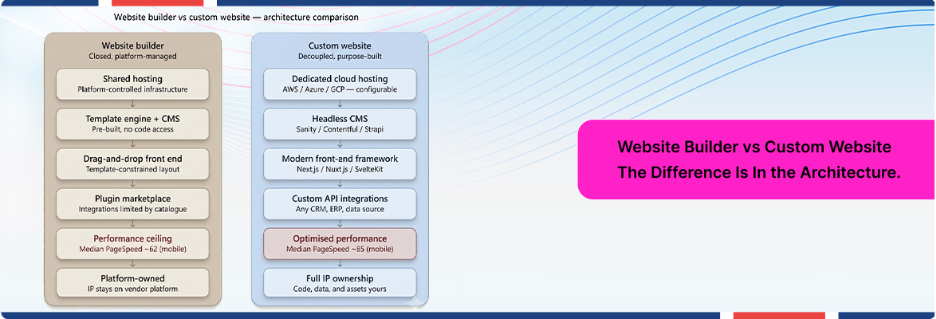
A website builder packages hosting, templating, CMS, and front-end rendering inside one closed system. Every choice you make happens within the constraints that platform chose to support. That is not a flaw – it is the product design. Speed and simplicity require opinionated constraints.
Enterprise custom website development built today typically uses a decoupled architecture: a modern framework like Next.js or Nuxt.js handles the front end, a headless CMS like Sanity or Contentful manages content, and the business logic lives in custom backend services. This architecture lets every layer scale independently. The CMS can change without rebuilding the front end. The front end can be rebuilt without migrating content. Performance can be optimized at every layer because nothing is locked inside a platform’s rendering pipeline.
The practical outcome of that architectural difference of custom website vs website builder: custom sites can connect to any API, any system, any data source. The website builder limitations for business become clearest here – the answer to “can we integrate X?” in a builder environment is always conditional on whether a plugin exists or whether the platform’s API surface supports it. In a custom environment, the answer is almost always yes.
Six Signals That You’ve Outgrown a Website Builder
There is rarely a dramatic moment when a builder stops working. The friction accumulates. Here are the six signals that your business has outgrown a platform-dependent solution:
-
- Your development team is spending more time configuring plugins than building features. Plugin dependency creates compounding maintenance debt – each update is a potential conflict.
-
- You need to connect the website to internal systems – a CRM, ERP, inventory database, or customer data platform – and the integration requires expensive middleware or produces unreliable data sync.
-
- Your Core Web Vitals scores are dragging down organic search performance. Builder-generated JavaScript bundles are notoriously difficult to optimize because the platform controls the output.
-
- You cannot control URL structure, schema markup, or server-side rendering behavior at the level that competitive SEO in your industry requires.
-
- Your legal or security team has flagged concerns about shared infrastructure and data residency that the platform’s standard offering cannot address.
- A key competitive differentiator for your business would require a user experience that no template supports and no plugin can simulate.
Custom Website vs Website Builder: Beyond the Monthly Subscription
The custom website development cost conversation almost always starts from the wrong baseline. People compare the $25/month builder subscription against a $30,000 custom build and conclude the builder wins by a factor of 100. That math ignores the full cost equation on both sides.
A website builder over three years typically looks like this: $50-100/month platform fee, plus $20-50/month for premium plugins, plus agency costs for custom website vs template website does not support, plus eventual migration costs when the business outgrows the platform. The three-year total for a growing business routinely runs $8,000-$18,000.
A professionally built custom website for a small business currently starts at $3,000-$10,000 for 10-15 pages with a modern CMS. A custom e-commerce platform with real integrations runs $15,000-$50,000. Ongoing hosting and maintenance adds $200-$500/month. The custom site costs more. But it also delivers measurably better SEO performance, eliminates platform constraints, and – critically – is an asset you own outright. When you migrate away from a builder, your SEO equity does not automatically transfer. The custom site does not have that risk. (Sources: hdwebsoft.com Web Development Costs 2026).
The Performance Gap of Custom Website vs Website Builder
Custom website SEO advantage is not theoretical. The numbers are concrete.
According to the 2025 HTTP Archive analysis, the median mobile PageSpeed score for builder-powered sites sits at 62. Custom-built sites using modern frameworks median at 85. That 23-point difference shows up in Core Web Vitals pass rates as well – Duda, the highest-performing builder for Core Web Vitals, passes at 85%. Wix, the market leader, passes at 71-75%. WordPress, which underlies many “custom” implementations, passes at only 43-45% (Source: Colorlib Website Builder Market Share 2026.
For businesses that compete on organic search, choosing custom website vs website builder is not a minor issue. Google has been explicit that page experience signals influence ranking. A site that fails Core Web Vitals on mobile is conceding ground to competitors who have built for performance. That cost does not show up on a platform invoice – it shows up in traffic reports and lead volume.
The website builder performance score ceiling also creates a ceiling on conversion rates. If responsive design alone can produce 11% higher conversions – as evelan.de’s 2026 web design analysis documents – purpose-built UX that goes beyond responsive templates has proportionally larger upside.
Flexsin’s Perspective on Custom Website vs Website Builder
Enterprise custom website development conversations at Flexsin tend to start in one of two places. The first: a growth-stage company that launched on a builder, gained traction, and is now managing a site that no longer reflects the sophistication of the business. The second: a company evaluating its first serious digital investment and trying to understand whether the complexity of a custom build is justified.
A clear answer to the second group is that it depends entirely on what the website needs to do. A custom website is not inherently better than a builder. It is better for specific jobs: sites that must integrate with business systems, sites where performance directly drives revenue, sites that need to differentiate on user experience in a competitive market, and sites that will need to scale in ways the business cannot yet fully predict.
What Flexsin brings to that equation is 20+ years of full-cycle development experience across enterprise applications, web portals, B2B/B2C marketplaces, and custom e-commerce platforms. The process is not “build something custom and charge for complexity.” The process is scoping the actual requirement, identifying where platform solutions are genuinely sufficient, and applying custom development only where the business case is clear.
Flexsin’s custom web development practice covers the full stack – from modern front-end frameworks and headless CMS architecture to backend systems, DevOps delivery models, and post-launch managed support.
Custom Website vs Website Builder: Important Technical Factors
This would not be an honest analysis without the other side of the custom development equation.
-
- Custom websites require technical maintenance. Security patches, dependency updates, and infrastructure management do not happen automatically – they require a development partner or in-house team. Website builders handle this by default.
-
- The timeline is real. Simple sites take 4-8 weeks. E-commerce platforms with integrations typically run 10-20 weeks. If your business needs a web presence in 72 hours, a builder is the correct answer for now – even if a custom build is the correct answer for later.
-
- Migration is not seamless. Moving from a builder to a custom site means rebuilding functionality, redesigning pages, and planning an SEO migration carefully. Content can export. Design equity, plugin behavior, and accumulated domain authority do not transfer automatically.
- The upfront cost is real, even when the total cost of ownership math favors custom over three to five years. Cash flow matters, and not every business is at the stage where a $15,000-$50,000 build investment is the right deployment of capital.
The right framework: choose the platform for custom website vs website builder that matches where the business is today, with a clear plan for what the trigger points are for reconsidering. “We will move to custom when our website becomes the primary lead generation system” or “when we need CRM integration that the builder cannot support” are legitimate decision criteria.
Expert Answers to Common Questions:
What is the main difference between a custom website and a website builder? A custom website is built from scratch using modern frameworks and designed around your specific business requirements. A website builder uses pre-built templates and a closed platform that constrains design, performance, and integration options.
When should a business choose a website builder instead of custom development? Use a website builder when the site scope is standard (under 15 pages), the budget is under $5,000, launch speed is critical, and the team needs to manage content without developer help. Custom development becomes necessary when performance, integrations, or scale matter.
How does the custom website vs website builder decision affect SEO? Custom websites provide full technical SEO control – URL structure, schema markup, server-side rendering, and Core Web Vitals optimization. Website builders offer basic SEO features but score a median 23 points lower on mobile PageSpeed than custom-built sites, which directly impacts ranking.
What does custom website development cost compared to a website builder? Website builders run $0-$500/year in platform fees, with cumulative costs of $8,000-$18,000 over three years once plugins and agency customization are included. Custom websites start at $3,000-$10,000 for simple sites and $15,000-$50,000 for platforms with integrations, with full ownership and no platform dependency.
How long does it take to build a custom website? Simple custom sites take 4-8 weeks. E-commerce platforms with third-party integrations typically require 10-20 weeks. Website builders can produce a live site in 1-7 days.
Can I start with a website builder and switch to custom development later? Yes – but migration requires rebuilding functionality and planning an SEO transition carefully. Content exports; design, plugin behavior, and SEO equity do not transfer automatically. Plan 2-4 weeks for the migration effort alone.
Is Webflow a middle ground between builders and custom development? Webflow offers the most design flexibility of any builder and is appropriate for marketing sites needing a unique look without full custom code.When it comes to Webflow vs custom development, Webflow has platform constraints around complex backend integrations and performance optimization at enterprise scale.
Ready to Build a Website Your Business Won’t Outgrow?
The custom website vs website builder decision is not about spending more – it is about investing in the right infrastructure for where the business is going. If your website needs to integrate with business systems, compete on organic search, deliver a differentiated user experience, or scale with a growing operation, a template platform is not the long-term answer.
Flexsin’s custom web development team has built full-cycle digital products for en terprises and growth-stage companies across global markets – from enterprise web portals and B2B marketplaces to custom e-commerce platforms and headless CMS implementations. The engagement starts with scoping what the business actually needs, not selling complexity for its own sake.
Explore Flexsin’s custom web development services and start the conversation today:

Most Asked Questions:
1. Is WordPress a website builder or custom development?It depends on implementation. WordPress.com (hosted) functions as a website builder with simplified management. Self-hosted WordPress with custom themes and plugins is closer to custom development but still carries platform overhead and security management requirements that fully custom frameworks avoid.
2. Do website builders hurt SEO performance? Modern builders provide meta tags, alt text, and sitemaps, covering basic on-page SEO. The limitation is technical: builders constrain Core Web Vitals optimization, URL architecture, schema markup depth, and server-side rendering – all of which matter for competitive keyword rankings. For low-competition searches, builders are adequate. For serious organic search investment, the custom website SEO advantage is measurable.
3. How do website builder hidden costs add up? Platform fees are the visible cost. The hidden costs include premium plugin subscriptions ($20-$50/month), agency fees for customization the template does not support, migration costs when the business outgrows the platform, and the revenue impact of slower load times and lower conversion rates. Over three years, these costs routinely close most of the gap between a builder and a properly scoped custom build.
4. Can a custom website integrate with any third-party tool? Yes. Custom development connects to any system with an API – CRM, ERP, marketing automation, analytics platforms, payment gateways, inventory systems, and custom data sources. This is the core architectural advantage over website builders, which are limited to the integrations their plugin marketplace supports.
5. What is the right custom website vs website builder choice for an e-commerce business A business selling under 50 products with standard checkout requirements can start on Shopify and operate efficiently. Once the operation requires custom inventory logic, third-party fulfillment integration, personalized product recommendations, or ERP-connected pricing, a custom e-commerce platform delivers capabilities the builder cannot replicate without fragile plugin architecture.
6. How does Flexsin approach the custom website vs website builder decision for new clients? The starting point for custom website vs website builder decision is the business requirement, not the technology preference. Flexsin’s team scopes the site’s commercial role, integration requirements, performance targets, and growth trajectory. Where a builder genuinely fits, that is the recommendation. Where the business case requires custom development, the engagement is scoped around specific capabilities – not padded for complexity.
