

 +1.844.3539.746
 info@flexsin.com
Speed Is the New Currency: How Warehouse Automation Transforms Order Fulfillment
 Munesh Singh
Let's talk
Table of Contents:
- Why Manual-First Warehouses Are Losing Ground
- How Warehouse Automation Order Fulfillment Speed Actually Works
- The Compound Effect: Speed, Accuracy, and Scalability Together
- The Flexsin Perspective: Where Most Implementations Break Down
- Operational Limitations and Constraints
- People Also Ask
- Ready to Accelerate Your Order Fulfillment?
- FAQs
Your warehouse could be the single biggest reason customers never come back. That sounds harsh – but the math is relentless. When a customer clicks “Buy,” the internal clock starts. Every hour between that click and the moment the right package reaches the right door is an hour your competitors are using to close the gap. Manual warehouse operations, however well-run, hit a throughput ceiling around 60 to 80 picks per hour. Automated systems regularly clear 120 picks per hour and beyond, per recent benchmarking data from Optioryx. That delta does not just affect speed – it compounds into capacity, labor costs, and customer retention.
The operational gap between manual and automated fulfillment is no longer a technology debate. It is a competitive one.
Why Manual-First Warehouses Are Losing Ground
Most operations leaders know manual picking has limits. What they underestimate is how quickly those limits become visible to customers.
Recent survey data from Logistics Management found that 52% of companies are still running mostly or fully manual order fulfillment – actually up from 43% the prior year. The number of highly automated operations dropped from 10% to 4% in that same period, suggesting a meaningful segment stalled mid-transformation. That stall is expensive: manual picking error rates run between 1% and 3%, while automated systems consistently achieve 99.9%+ accuracy, according to CXTMS benchmarking data.
For a warehouse shipping 5,000 orders daily, moving from 1.5% error rate to 0.1% eliminates roughly 70 mis-picks per day – at $25 to $50 correction cost per error, that is $640,000 to $1.28 million in preventable annual losses.
Standard ERP configurations and basic warehouse setups were not designed for the throughput demands of modern omnichannel fulfillment. They manage inventory. They do not orchestrate it.
How Warehouse Automation Order Fulfillment Speed Actually Works
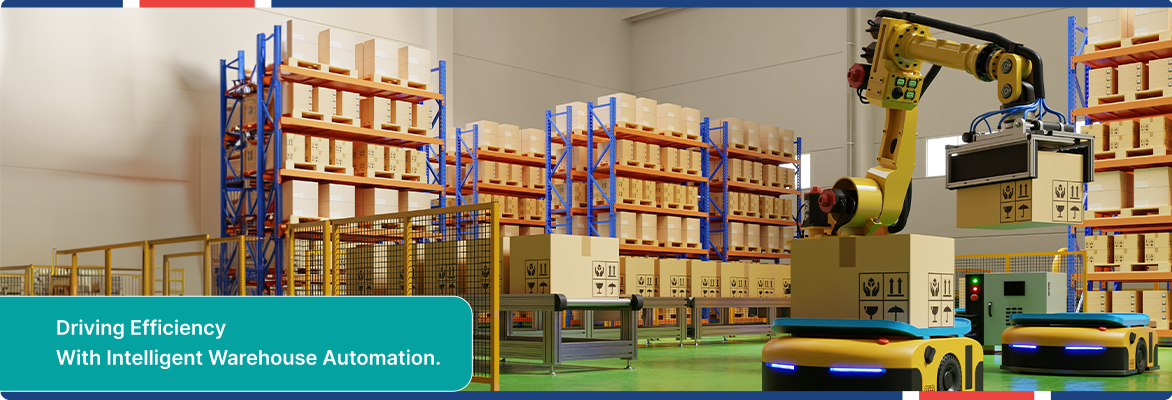
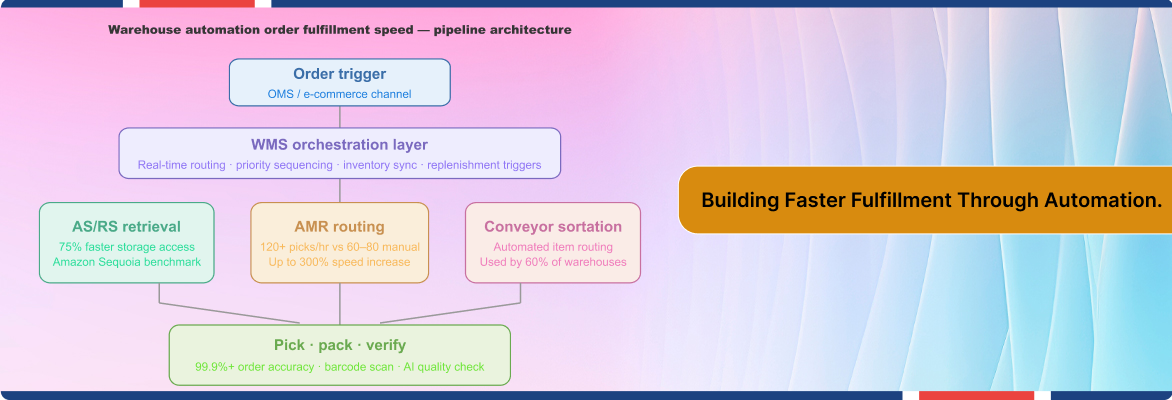
The speed improvement from warehouse automation is not magic – it is architecture. Three interlocking systems do the heavy lifting.
Robotic Picking and Autonomous Mobile Robots (AMRs)
AMR autonomous mobile robots eliminate the single largest time drain in any warehouse: travel. A human picker walks an estimated 10 to 15 miles daily navigating static shelving. AMRs bring the inventory to the picker, or handle picks entirely. According to McKinsey, automated picking systems improve order fulfillment speeds by up to 300%. That figure is not theoretical – DHL Supply Chain and Locus Robotics crossed 500 million picks with AMRs across 35 global sites as of mid-2024, with the pace accelerating sharply: their first 10 million picks took 2.5 years; the most recent 100 million took 154 days (source: Synkrato).
Automated Storage and Retrieval Systems (AS/RS)
AS/RS warehouse technology transforms static shelving into a dynamic, searchable inventory matrix. Items are retrieved by machine, not by a worker navigating aisle geography. Amazon’s Sequoia robotic system demonstrated AS/RS at scale, enabling inventory identification and storage 75% faster and cutting order processing time by 25% at its Houston facility. Storage automation solutions have been shown to boost workforce productivity by up to 85%, allowing a single operator to manage workloads that previously required several people.
Warehouse Management System Integration and Real-Time Orchestration
Neither AMRs nor AS/RS operate at full potential without tight WMS automation integration. The WMS layer is what converts machine speed into system intelligence. It routes orders dynamically, prioritizes pick sequences based on delivery windows, triggers replenishment before a stockout happens, and feeds real-time inventory data across every channel simultaneously.
The Compound Effect: Speed, Accuracy, and Scalability Together
This is where most analysis stops short – and where the real business case lives.
Warehouse automation does not just improve one metric. Speed gains and accuracy improvements arrive together, and they amplify each other. Fewer errors mean fewer returns. Fewer returns mean fewer reverse logistics cycles. Fewer reverse logistics cycles mean your throughput capacity is not being silently cannibalized by rework.
Warehouses adopting automation have seen a 35% increase in productivity and a 25% reduction in workplace injuries, per data from SellersCommerce. Deloitte analysis indicates most businesses recover their automation investment within 18 to 24 months, with efficiency gains often exceeding 20%.
The scalability story matters as much as the day-one speed story. A manual warehouse hits its ceiling during peak season. An automated warehouse uses the same infrastructure to handle demand spikes that would break a manual operation. Walmart has publicly targeted 65% of its stores to be serviced by automation, with 55% of fulfillment center volume flowing through automated facilities by FY2026 – expecting a 20% improvement in unit costs as a result.
The Flexsin Perspective: Where Most Implementations Break Down
After working with distribution, manufacturing, and e-commerce clients across multiple geographies, one pattern repeats: organizations invest in automation hardware and underinvest in systems integration.
The robot that cannot talk to the ERP is not fast – it is expensive. The AS/RS that does not sync with the WMS creates a different kind of bottleneck: perfect inventory visibility inside the machine, zero visibility outside it. The throughput gains from automation are fully realized only when the warehouse management system, the order management system, and the robotics layer operate as a single coordinated stack. That integration work is precisely where Flexsin brings enterprise-grade discipline – scoping, implementing, and optimizing the connective tissue that makes automation investments perform at the level the business case promised.
Speed without accuracy is noise. What clients consistently need is fulfillment velocity that can be measured, monitored, and improved over time.
Operational Limitations and Constraints
Warehouse automation delivers measurable gains – but the implementation path requires clear-eyed planning.
Capital exposure: Full AS/RS and conveyor-based systems carry payback windows of 4 to 7 years for high-volume operations. Packaging automation and AMR deployments typically return capital in 1 to 2 years and under 2 years respectively.
Integration complexity: Legacy ERP environments often require middleware layers or API development before automation hardware can communicate effectively with existing systems.
Workforce transition: Automation reshapes roles rather than eliminating them entirely. New skills – system monitoring, exception handling, data analysis – must be built or sourced.
Demand variability risk: Fixed automation infrastructure (conveyor, AS/RS) is optimized for predictable SKU profiles. High-mix, frequently changing product lines may be better served by modular AMR-first approaches.
The global warehouse automation market sits at $29.98 billion as of this year, projected to reach $59.52 billion by 2030 at an 18.7% CAGR. That growth trajectory suggests the question for most operations leaders is no longer whether to automate – but in what sequence, and with what integration foundation.
People Also Ask:
What is warehouse automation order fulfillment speed? It refers to how quickly an automated warehouse can process, pick, pack, and dispatch orders. Automated picking systems improve fulfillment speeds by up to 300% compared to manual operations, per McKinsey.
How do AMR autonomous mobile robots speed up order fulfillment?AMRs bring inventory to stationary pickers, eliminating travel time. They consistently achieve 120+ picks per hour versus 60 to 80 for manual pickers, reducing cycle time significantly.
What is the ROI timeline for warehouse automation benefits? Most businesses recover their investment in 18 to 24 months for AMR-based systems. Full AS/RS installations in high-volume facilities typically require 4 to 7 years for payback.
How does automated order fulfillment reduce picking errors? Automated systems use barcode scanning, AI-guided routing, and real-time verification to achieve 99.9%+ accuracy. Manual operations typically run error rates between 1% and 3%.
What role does WMS automation integration play in fulfillment speed? The WMS layer orchestrates order routing, pick sequencing, and replenishment in real time. Without it, automation hardware improves speed in isolation – with it, the entire fulfillment chain accelerates.
How does supply chain order accuracy impact fulfillment speed? High accuracy rates reduce rework cycles, reverse logistics, and restocking delays. Accurate orders move through the fulfillment chain without interruption, compounding throughput gains.
Ready to Accelerate Your Order Fulfillment?
Most warehouse automation projects deliver a strong first quarter – then plateau. Not because the technology fails, but because the integration layer was never built to scale. Picking speed improves; inventory sync lags. Robots move faster; the WMS still batches overnight. The hardware is there. The connective architecture is not.
Flexsin’s business process automation team closes that gap. We design and integrate warehouse automation stacks that align robotic systems, WMS platforms, and order management layers into a single coordinated operating model. From AS/RS warehouse technology and AMR workflow design to real-time ERP integration and fulfillment analytics, we build the architecture that makes speed sustainable – not a one-time spike you spend the next quarter trying to explain.
Our engagements begin with a scoped assessment: a structured review of your current fulfillment stack, your throughput bottlenecks, and the specific integration gaps costing you cycle time. You leave with a prioritized roadmap, not a vendor pitch.
What that typically looks like in practice:
WMS integration and optimization – connecting your warehouse management system to robotics platforms, OMS, and ERP in real time, so every pick, pack, and dispatch decision is driven by live data.
Robotic workflow design – sequencing AMR routing, AS/RS retrieval, and conveyor sortation logic to eliminate handoff delays between automated systems.
Fulfillment analytics and performance monitoring – building the dashboards and alerting frameworks that let operations teams see where throughput is leaking before it shows up in customer complaints.
Phased automation roadmaps – scoping which automation investments return capital fastest and in what order, so you build momentum rather than absorb risk all at once.
Flexsin has delivered automation integration projects across distribution, manufacturing, and e-commerce fulfillment environments. The results that hold are the ones built on integration discipline – not hardware alone.
Explore Flexsin’s Business Process Automation Services:
Start your scoped assessment with Flexsin today.
FAQs:
1. Does warehouse automation require replacing my existing WMS?Not necessarily. Most modern automation platforms are designed to integrate with existing WMS environments via APIs or middleware. A Flexsin implementation assessment will identify compatibility gaps before any infrastructure commitment is made.
2. What warehouse operations benefit most from automated order fulfillment? High-volume, multi-SKU operations – including e-commerce, 3PL, and direct-to-consumer fulfillment centers – see the fastest and largest gains. Operations with frequent seasonal demand spikes benefit from the scalability of modular AMR-first deployments.
3. How do automated inventory management systems prevent stockouts? Real-time inventory visibility across the WMS allows the system to trigger replenishment automatically when stock thresholds are crossed. This eliminates the lag inherent in manual cycle counts and reactive reordering processes.
4. What is the difference between AMRs and AGVs in warehouse automation? Automated Guided Vehicles (AGVs) follow fixed paths and require floor infrastructure. AMR autonomous mobile robots navigate dynamically using onboard sensors and mapping algorithms, making them far more flexible and easier to redeploy as warehouse layouts change.
5. How quickly can a warehouse see results from automation implementation?Targeted automation – such as pick-to-light or AMR deployment in a single zone – typically shows measurable throughput improvements within weeks. Full ROI on combined hardware and software automation generally arrives within 18 to 24 months for most operational profiles.
6. Is warehouse automation order fulfillment speed improvement consistent during peak seasons?Yes. Automated systems maintain consistent throughput during demand spikes because they do not fatigue, call in sick, or require temporary staffing ramp-ups. The operational floor that performs in July performs in December.
Closing Perspective
The warehouses winning on warehouse automation order fulfillment speed today are not the ones with the most robots – they are the ones with the tightest integration between automation hardware and orchestration software. The technology gap has narrowed. What separates category leaders from followers now is execution depth: the quality of the integration layer, the granularity of performance tracking, and the operational discipline to tune the system as demand patterns shift. That is not a hardware problem. That is a systems architecture problem – and it is solvable with the right implementation partner.
